2026-03-16 09:50:00
Prediction markets are sending a sharper message than many traditional headlines right now
Prediction markets on rates: Fed cuts in 2026?
The biggest move is in rates. The market mood has turned more hawkish as energy-driven inflation risk rises, even though many economists were still recently centered on a June Fed cut. That gap matters because it shows how quickly traders are repricing the inflation fallout from the Iran war compared with the slower-moving survey consensus. Reuters reported that both Barclays and Goldman Sachs pushed their first Fed cut call to September, with Barclays now expecting only one 25 basis point cut in 2026. In other words, the market is not fully calling recession as the base case. It is first saying that the inflation shock is changing the rates story faster than economists are willing to move. Read more in Reuters’ report on Barclays pushing back its Fed cut call.
That rates repricing is also connected to politics. Rising energy prices are no longer just a macro issue. They are becoming a voter issue. Reuters reported that gas prices rose sharply after the strikes on Iran, adding a fresh affordability problem for Republicans heading into the midterms. That helps explain why political prediction markets have moved faster toward a more Democratic national environment than some traditional seat-by-seat coverage. The map is still tight, and House control could still come down to a small number of competitive races, but markets are increasingly translating consumer stress and national mood into chamber odds. See Reuters on how higher gas prices are pressuring Republicans and Kalshi’s summary of shifting Senate odds.
Geopolitically, traders still look far more skeptical than headline diplomacy might suggest. Even as Reuters reported expected Israel-Lebanon talks aimed at a more durable ceasefire, prediction markets continue to treat negotiations more as crisis management than true de-escalation. The same skepticism carries over to Ukraine, where peace efforts remain stalled and attention has increasingly shifted toward the Middle East. The market takeaway is simple: diplomacy headlines alone are not enough to reverse the risk premium. For context, see Reuters on the expected Israel-Lebanon talks and AP’s broader coverage of the geopolitical backdrop.
The sharpest odds-versus-process divergence may be in crypto. Prediction markets still look relatively constructive on major crypto legislation, yet the Washington process story looks much messier.
In Crypto Law, the wisdom of the crowd is still supportive.
Reuters reported that the Clarity Act has hit a fresh impasse, with banks still objecting to key provisions and the calendar becoming increasingly hostile as campaign season approaches. That makes crypto one of the most interesting areas for editorial monitoring right now: markets are still leaning more optimistic than the legislative plumbing seems to justify, but they are not fully endorsing the more euphoric crypto-native narrative either. Read Reuters on the new crypto bill impasse as we show on investingLive.com that Etherum is the new black in crypto.
There is also a deeper second-order story here. The signal itself is becoming political and regulatory. The CFTC has opened a rulemaking process on event contracts and prediction markets, with a focus on manipulation, margin, and whether contracts tied to war, terrorism, or military action should even be allowed. That means journalists, investors, and traders are increasingly using a signal source whose own future rules may change. If that regulatory pressure intensifies, the structure, availability, or credibility of some prediction-market signals could shift quickly over the next quarter. See Reuters on the CFTC rulemaking process.
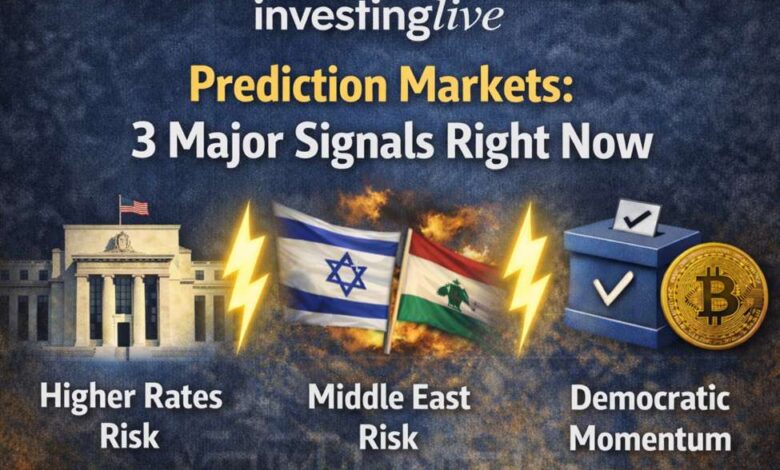
The bottom line is that prediction markets are flashing three important signals right now. First, higher-for-longer rates risk has become a more urgent market message than the older economist consensus implied. Second, the market is treating diplomacy in the Middle East as a temporary management tool, not yet as proof of de-escalation. Third, political markets have moved faster toward a Democratic-leaning national mood than mainstream seat coverage has fully embraced. The most notable gap remains crypto, where market optimism still looks a bit ahead of Washington reality.
For investors and traders alike, that is what makes this space worth watching. Prediction markets are not replacing traditional reporting, polling, or macro analysis. But they are becoming a faster-moving layer of real-time sentiment, one that can sometimes spot a shift before the mainstream narrative catches up.
Remember, investors and traders, prediction markets are not a crystal ball. Forecasts and market odds can shift quickly as new information comes in, so please trade and invest at your own risk and make decisions based on your own judgment and risk tolerance.