تكنلوجيا اليوم
2026-03-13 22:25:00
Binance suing the Wall Street Journal is not a new kind of signal, as the exchange has fought what it considered hostile coverage before.
However, this time the market may read the move differently.
In earlier cycles, a Binance-versus-media clash fit neatly into a larger story of regulatory danger. Now, after a softer US enforcement turn and deeper overlap with President Donald Trump-linked crypto networks, the same kind of pushback may be read less as panic and more as confidence.
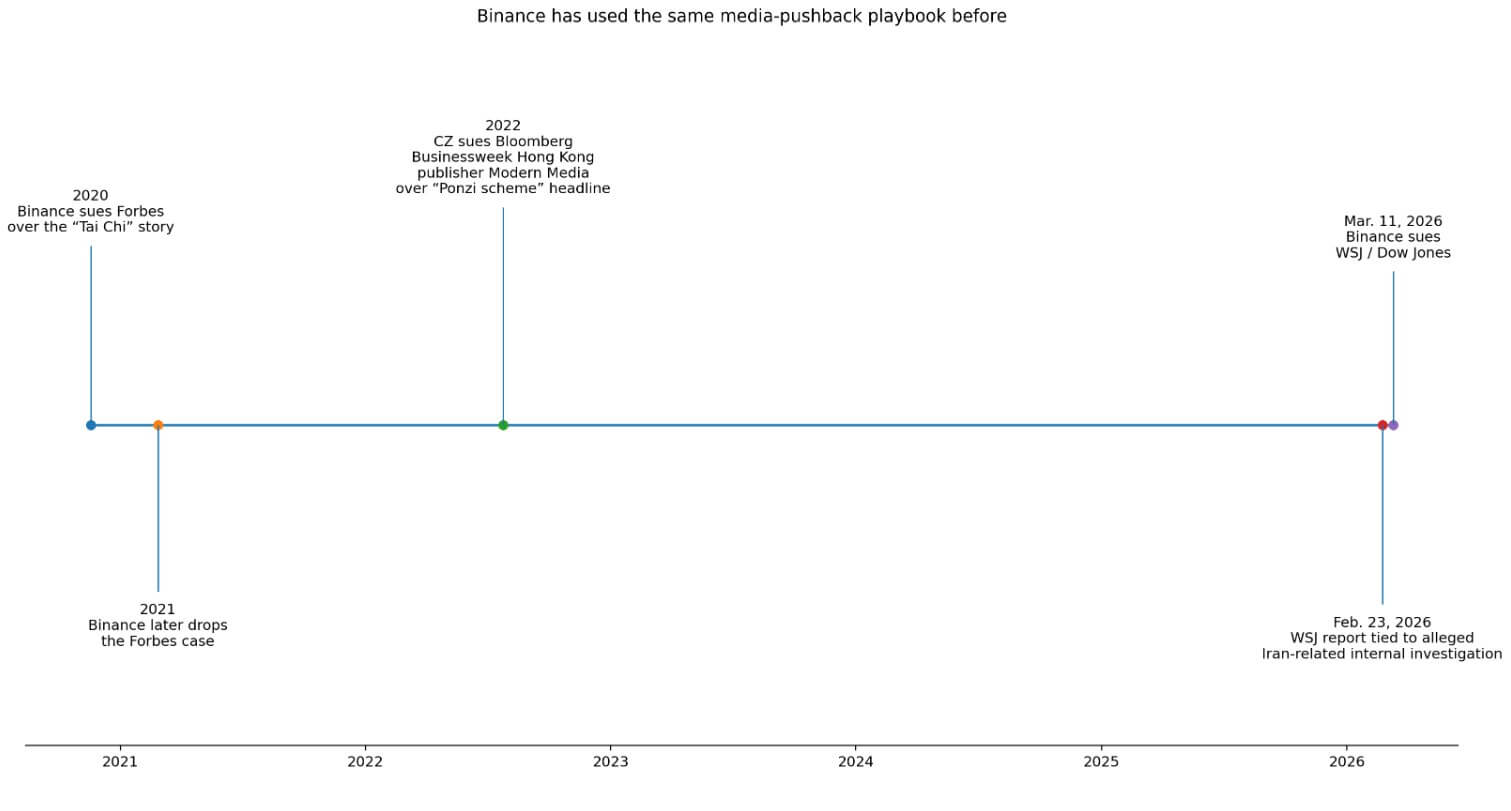
On Mar. 11, Binance sued the Wall Street Journal and Dow Jones over a Feb. 23 report tied to an alleged Iran-related internal investigation, saying the story made false and defamatory claims about how Binance handled roughly $1 billion in transfers allegedly linked to Iran-backed groups.

The suit says the Journal ignored corrections and published at least 11 false statements.
That sounds familiar because it is. Reuters previously reported that Binance sued Forbes over its 2020 “Tai Chi” article and later dropped the case.
Additionally, Binance founder Changpeng Zhao (CZ) personally sued Bloomberg Businessweek’s Hong Kong publishing partner, Modern Media, in 2022 over a “Ponzi scheme” headline.
The novelty in the WSJ fight lies in the backdrop against which the tactic is being used.
In 2020 and 2022, a Binance-versus-media clash slotted naturally into a broader narrative of regulatory danger. In 2026, the same move followed the SEC’s dismissal of its civil case with prejudice, after Trump-linked World Liberty’s USD1 was reportedly used in MGX’s $2 billion Binance investment, and after Trump pardoned CZ.
Same tactic, different setting
Binance may be facing a friendlier US climate, but the Iran-related scrutiny and ongoing litigation show the fear premium is shrinking, not gone.
Senator Richard Blumenthal opened a preliminary inquiry in February 2026 after reporting on alleged sanctions exposure related to Iran and Russia.
Reports also noted that, in late February 2026, a federal judge refused Binance’s attempt to force certain customer-loss claims into arbitration.
And on Mar. 6, Reuters reported that Binance and Zhao had won dismissal of a lawsuit by victims of 64 attacks, but the judge allowed the plaintiffs to amend the complaint.
In February 2025, Binance and the SEC jointly requested a pause in the agency’s case as Trump’s crypto policy took shape. In May 2025, the SEC dismissed the case with prejudice and said the move was appropriate “in the exercise of its discretion and as a policy matter,” not because the merits had been fully vindicated.
Also in May, Trump-linked USD1 would be allegedly used to close MGX’s $2 billion Binance investment. In October 2025, Trump pardoned CZ.
The WSJ lawsuit now sits atop that sequence.
| Event | What happened | Why it changed the Binance risk read |
|---|---|---|
| Feb. 2025 | Binance and the SEC jointly sought a pause in the agency’s case | Suggested a softer US policy posture might be emerging |
| May 2025 | The SEC dismissed its civil case against Binance with prejudice | Lowered the perceived civil-enforcement overhang |
| May 2025 | Trump-linked USD1 was reportedly used in MGX’s $2 billion Binance investment | Tied Binance more closely to Trump-adjacent crypto networks |
| Oct. 2025 | Trump pardoned CZ | Reinforced the idea that Washington risk may be lower than before |
| Feb. 2026 | Sen. Richard Blumenthal opened a preliminary inquiry | Showed the fear premium is shrinking, not gone |
| Late Feb. 2026 | A federal judge refused Binance’s attempt to force certain customer-loss claims into arbitration | Confirmed that legal vulnerability remains real |
| Mar. 6, 2026 | Binance and Zhao won dismissal of a lawsuit by victims of 64 attacks, but plaintiffs were allowed to amend | Not a full all-clear; litigation risk still lingers |
| Mar. 11, 2026 | Binance sued WSJ / Dow Jones | The same old tactic now lands inside a different, more politically favorable backdrop |
The clean investor takeaway is that the fear premium around Binance may be shrinking. For years, damaging headlines about Binance were often read as possible preludes to a fresh regulatory shock.
If Washington now looks less hostile, then the same headlines may no longer trigger the same fear response. That matters for competitor positioning, headline sensitivity, and how the market prices Binance’s legal noise.
The lawsuit itself fits that interpretation. A company that still sees itself as maximally exposed tends to play defense. Binance instead escalated into open legal combat with one of the world’s most influential financial publications.
Despite not proving insulation, it suggests Binance believes the downside of fighting back is lower than it used to be.
The political read layers onto scale
The political angle should not swallow Binance’s actual business strength.
Binance remains the dominant centralized exchange by spot volume: CoinGecko said it held 38.3% of total spot volume in December 2025 and 39.2% of top-10 CEX spot volume for full-year 2025.
In February 2026, Binance served about 300 million users and held roughly $44 billion in Bitcoin in customer wallets.
A friendlier political read may be to layer on scale and liquidity rather than replace them.
The visible conflict is between Binance and the WSJ, while the deeper conflict is between two narratives about the company. The old narrative cast Binance as a permanently vulnerable regulatory target.
The newer one says the exchange may now be operating in a friendlier US climate, where scale, global relevance, and Trump-adjacent crypto overlap reduce the market impact of hostile coverage.
The market may be seeing the same playbook play out in a friendlier US regime.
Forward scenarios
The bull case for this new Binance clash is that the market increasingly concludes that the old US crackdown template no longer lands the same way on Binance.
The SEC dismissal, the pardon, and the reportedly Trump-linked USD1/MGX overlap fit into a broader narrative that Binance is less liable than before.
In that case, the WSJ suit looks less like defensiveness and more like incumbent confidence.
The bear case is that investors overread the friendliness. The Iran-related controversy, congressional scrutiny, or civil litigation reminds the market that Binance still has real legal vulnerability.
In that scenario, the WSJ lawsuit gets reinterpreted as overreach, and the supposed shrinkage in fear premium reverses.
The black swan is that a formal US sanctions or national security action emerges from the Iran-related reporting. Then the whole “friendlier backdrop” thesis flips from support to liability because the market would suddenly relearn that political narratives do not neutralize hard enforcement when national security is at stake.
| Scenario | What investors assume | How the WSJ lawsuit gets read | Market consequence |
|---|---|---|---|
| Bull case | The old US crackdown template no longer lands the same way on Binance | The lawsuit reads as confidence and incumbent strength | Binance’s fear premium shrinks further |
| Base case | Washington is friendlier, but Binance is still exposed to some real legal risk | The lawsuit reads as aggressive but manageable | Headline panic weakens, but some enforcement discount remains |
| Bear case | Investors overread the friendliness and underestimate remaining legal vulnerability | The lawsuit reads as overreach | Binance’s enforcement discount widens again |
| Black swan | Iran-related reporting leads to formal US sanctions or national-security action | The lawsuit looks reckless in hindsight | The political-insulation thesis breaks and risk gets repriced sharply |
The investor question is “Why might the same move create less fear this time?”
For years, the “Binance discount” was simple: any damaging headline could be read as the prelude to another major enforcement blow.
That transmission mechanism may be weakening. If investors increasingly think the old crackdown playbook no longer lands the same way, then bad headlines lose some of their panic power, Binance’s enforcement discount shrinks, and competitors that benefited from “Binance fear” lose some of their relative advantage.
Binance suing the press is old behavior. The market may be reading it through a softer US policy backdrop as the new part.
What makes this WSJ clash worth watching is whether the same old tactic now hits investors through a different lens. One where Washington looks less like a threat and more like uncertain terrain that Binance feels confident enough to navigate aggressively.