
Strategy has found a new gear in its Bitcoin accumulation engine, and its STRC preferred stock equity is doing a growing share of the driving.
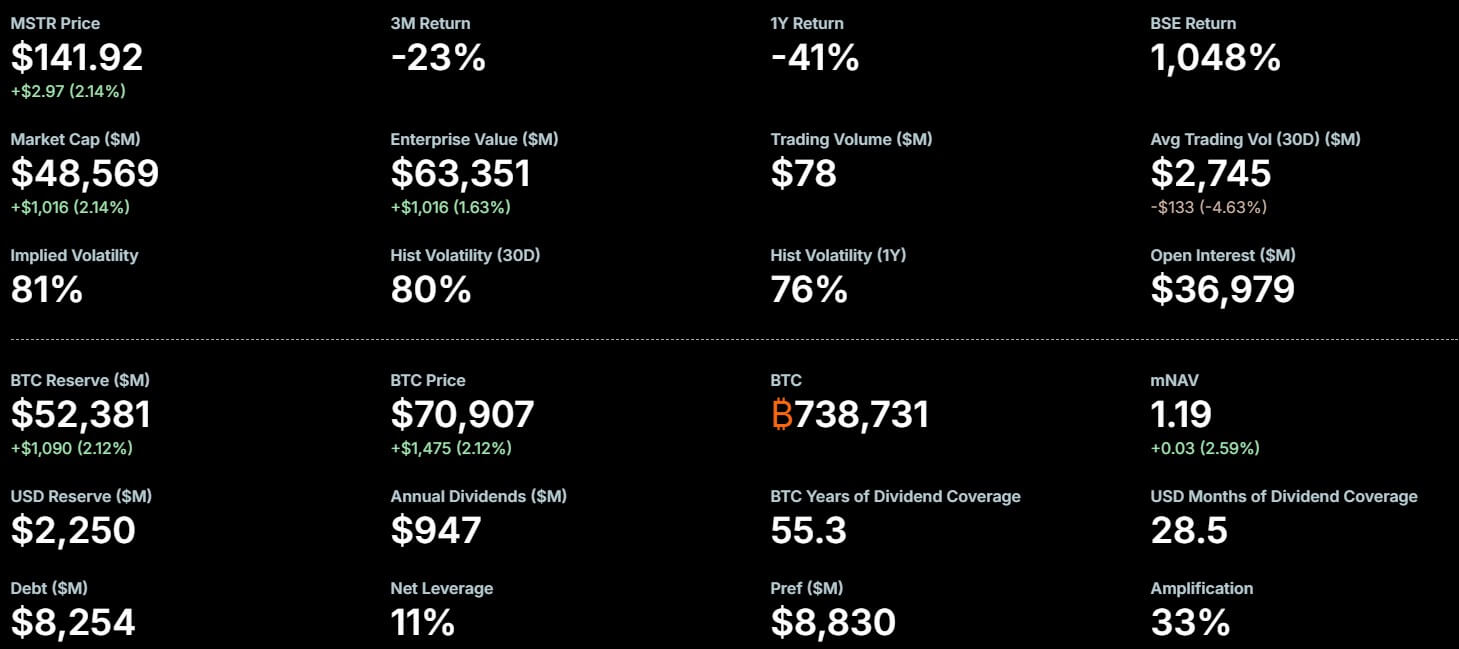
The company, formerly known as MicroStrategy, held 738,731 BTC as of March 8, up from 672,500 at the end of 2025. This represents an addition of 66,231 coins in 68 days, already surpassing its full-year net purchases in 2021, 2022, or 2023.
The pace of these acquisitions is striking by any measure, and what makes 2026 different is where the capital is coming from.
For years, Strategy leaned primarily on its common equity, MSTR, and convertible debt to finance Bitcoin purchases.
Typically, MSTR shares trade at a premium to net asset value, allowing the company to raise capital on favorable terms, essentially monetizing investors’ enthusiasm for leveraged Bitcoin exposure.
However, that premium to the value of its Bitcoin holdings (mNAV) has significantly compressed in the past year to 1.20, a far cry from its previous highs.
How STRC became a core funding rail
With mNAV less generous, the Michael Saylor-led firm has embraced a newer instrument called STRC, which is a perpetual preferred stock carrying an 11.50% annual dividend and designed to trade near its $100 par value.
Through this, Strategy is building a more continuous capital-raising system, one that can reach different investor bases and operate across different parts of the trading day.
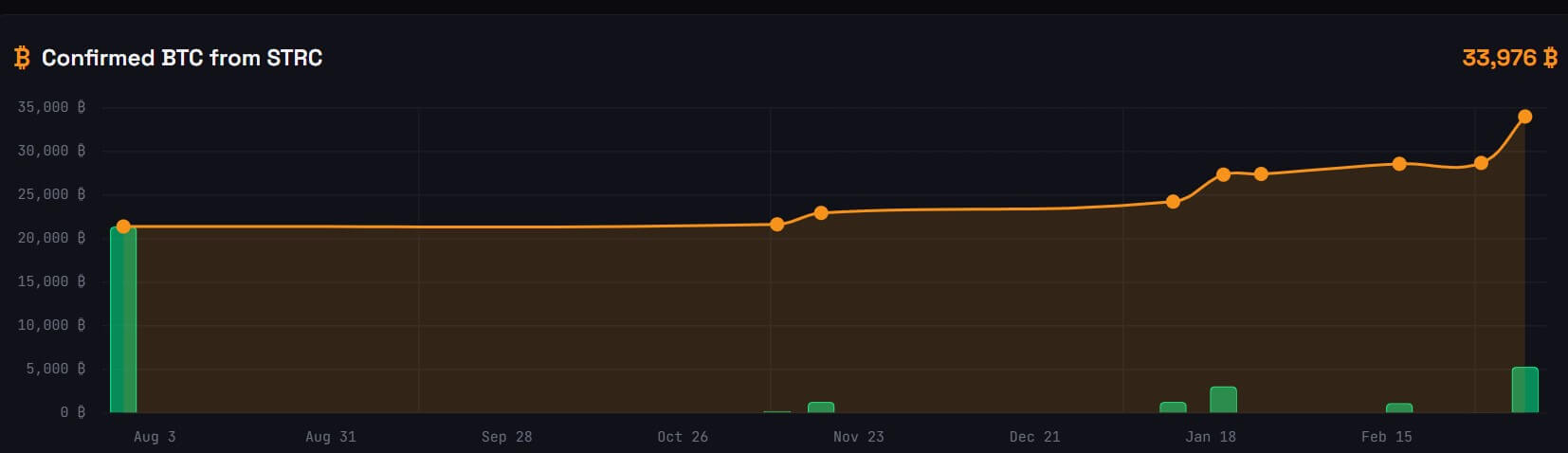
For context, Strategy sold 3.78 million STRC shares for approximately $377.1 million in net proceeds in the week ended March 8. Notably, this was the best-performing week by STRC share sales since its launch last July.
This means STRC accounted for roughly a third of the week’s at-the-market funding of $1.28 billion, a proportion large enough to show that preferred stock has moved from a supplemental instrument to a core component of the capital stack.
What made this particularly significant was that the funding came during a week when BTC struggled amid rising geopolitical tensions in the Middle East.
Moreover, data from STRC.live suggest that the trend has continued strongly, with March 9 alone registering a record STRC issuance, with proceeds estimated to fund the purchase of approximately 1,420 BTC. Since its launch, STRC has funded 33,976 BTC, worth more than $3.5 billion.
These impressive figures show that STRC is commanding significant attention from the yield-hungry investors.
For context, Jeff Walton, chief risk officer at asset management firm Strive, pointed out that STRC was generating more volume and yield than JPMorgan’s perpetual preferred (JPM-PD).
According to him, the JPMorgan product carried an effective yield of approximately 5.8% and generated roughly $2 million in daily volume, while STRC, at an effective yield of 11.50%, generated approximately $213.5 million in volume.
He added:
“STRC [sic] trading 106x $JPM-PD volume. Digital Credit [sic] going to eat the world.”
Unsurprisingly, this strong performance has attracted significant institutional bids, with preferred-focused and income-oriented funds appearing among STRC holders, including the BlackRock iShares Preferred and Income Securities ETF (PFF) and the Fidelity Capital & Income Fund (FAGIX), among others.
At the same time, Prevalon Energy and Anchorage Digital recently revealed that they had allocated part of their corporate treasuries to STRC.
Due to these strong demand levels, Strategy is stepping up efforts to accelerate STRC’s market availability.
On March 9, the Bitcoin-focused company amended its Omnibus Sales Agreement to allow multiple agents to sell the same class of securities on a single day. This includes during pre-market and after-hours sessions, while preserving the ability to conduct block sales after 4 p.m. ET.
For a company whose entire corporate strategy rests on converting investor demand into Bitcoin as quickly as possible, the ability to operate across more of the trading day with multiple execution pathways is a genuine throughput improvement.
The operational logic is straightforward. Preferred issuance gives Strategy another instrument to sell when common stock demand is soft, volatile, or concentrated in narrow windows.
So, the amended sales agreement adds flexibility in timing and execution, which can matter for a strategy built around repeatedly turning investor demand into Bitcoin purchases.
The cost of running the machine continuously
Meanwhile, the yield that makes STRC attractive to income investors comes at a cost of continuity to Strategy.
With approximately $3.84 billion of STRC notional outstanding, the 11.50% annual dividend implies roughly $442 million in annual cash obligations, or about $36.8 million per month.
This means Strategy is paying a significant premium for the ability to buy Bitcoin continuously, across different market conditions and from a broader range of investor types.
The firm’s critics have raised those points, with Peter Schiff, a longstanding Bitcoin skeptic, arguing that Strategy is burning ever-increasing amounts of cash to sustain its pace of accumulation.
He added that Saylor will eventually face a choice between suspending the preferred dividend or selling Bitcoin to meet payments.
At the same time, famed short seller James Chanos, who holds a short position in MSTR, has challenged the company’s framing of STRC as “digital credit.”
Notably, Strategy has described its preferred securities as Bitcoin-collateralized, yield-bearing financial instruments designed to transform BTC reserves into a perpetual capital engine.
However, Chanos dismissed that framing, saying:
“They’re literally credit instruments denominated in fiat. What’s digital is the assets, not the liabilities/preferred.”
The tension between those two views captures the core debate around Strategy’s model.
In a constructive market, where Bitcoin appreciates and preferred demand remains strong, the company continues to accumulate coins at an accelerating pace while fixed costs remain manageable relative to asset gains.
In a weaker market, where Bitcoin falls and financing windows narrow, Strategy may need to offer higher yields, as it is doing presently, to attract preferred buyers. This can result in the cost structure growing heavier relative to the value of what is being purchased.
MSTR’s resilience supports the model
Despite these concerns, market traders appeared to have absorbed the tradeoff with relative equanimity.
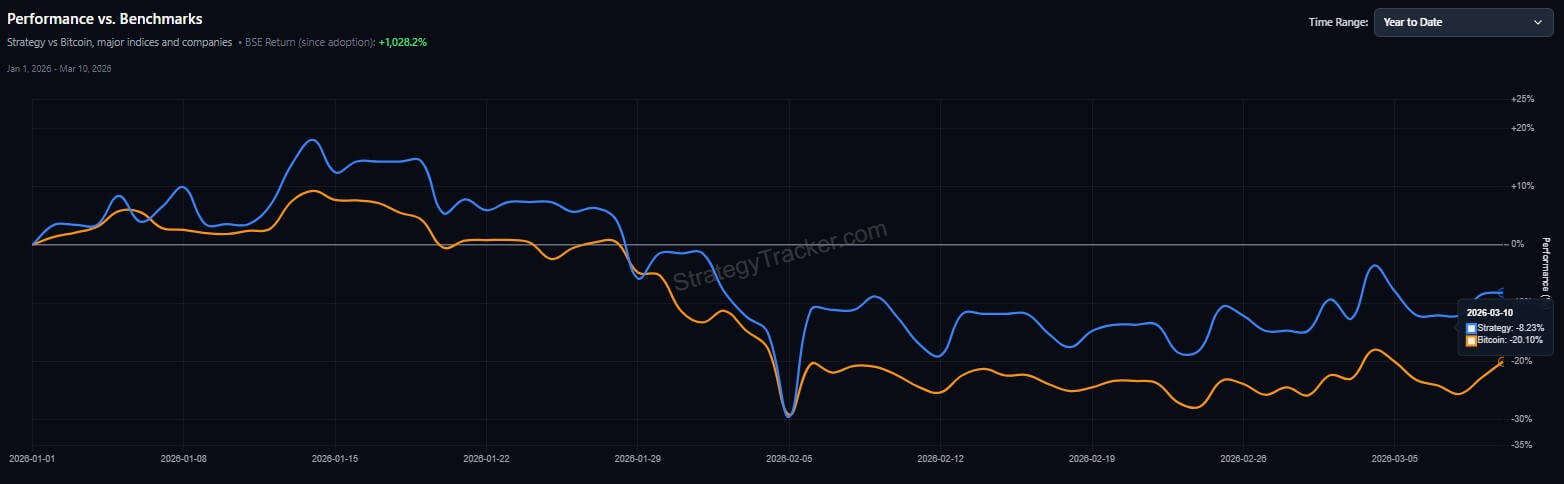
Data from Strategy Tracker showed that MSTR was down about 8.3% year to date, while Bitcoin itself was down about 20%. That relative outperformance carries practical significance for Strategy’s ability to raise capital.
This is because a narrowing common-stock premium would reduce the appeal of issuing MSTR shares and put more pressure on preferred issuance to carry the load.
Meanwhile, Strategy still has substantial remaining ATM capacity across its securities, and the first two months of 2026 suggest management is prepared to deploy it aggressively.
Nonetheless, the question of whether the preferred-stock model can sustain its current pace depends heavily on where Bitcoin trades from here and whether income investors continue to find the yield compelling at current levels.