Australia printed another upbeat data point as the headline growth figure for Q4 2025 came in at 0.8% versus the 0.4% consensus.
However, underlying GDP metrics painted a more concerning picture of spending and inventory buildup, triggering bearish AUD setups amid a complex market environment with tense geopolitical developments. Let’s see how it all played out!
Watchlists are price outlook & strategy discussions supported by both fundamental & technical analysis, a crucial step towards creating a high-quality discretionary trade idea before working on a risk & trade management plan.
If you’d like to follow our “Watchlist” picks right when they are published throughout the week, check out our BabyPips Premium subscribe page to learn more!
The Setup
What We Were Watching: Australia GDP (Q4 2025)
- Expectation: Australian economy to expand by 0.8% quarter-on-quarter after previous 0.4% growth figure
- Data outcome: Australia GDP came in at 0.8% as expected for Q4 2025, bringing the annual reading up to 2.6% versus the 2.5% forecast
- Market environment surrounding the event: Markets seemed jumpy as the spotlight was mainly on the US-Iran conflict and the Strait of Hormuz closure, though energy commodities found support from supply concerns and rallies in defense stocks kept U.S. indices in a range.
Event Outcome
Australia saw a faster pace of growth at 0.8% quarter-on-quarter for Q4 2025 compared to the previous period’s 0.4% expansion, lifting the annual GDP reading up from 2.1% to 2.6% – its strongest level since 2023.
Underlying components revealed that much of the growth was spurred by a 0.4% increase in inventories, outpacing the meager 0.1% uptick in household consumption to suggest that companies are building stock, but consumers are in no rush to buy.
Key Takeaways:
- Headline GDP: +0.8% quarter-on-quarter as expected, up from earlier 0.4% expansion
- Annual GDP: +2.6% year-on-year vs. 2.5% forecast, up from previous 2.1% growth
- Household consumption grew 0.1%, led by discretionary categories including hotels, cafes and restaurants boosted by Black Friday and Boxing Day promotional sales, major sporting events, and the school holiday period
- Household saving ratio rose to 6.9% from 6.1% in the September quarter, as disposable income growth (+1.8%) outpaced nominal spending growth (+1.1%)
- Inventories contributed 0.4% to growth, as mining saw a moderate buildup in replenishment of coal
- Net trade detracted 0.1% from growth, as the rise in imports of goods and services (+1.8%) outpaced exports (+1.4%)
The Australian dollar had already been edging lower leading up to the GDP release, as risk-off flows extended their stay in the markets amid a major selloff in Asian equities then. The currency dipped despite upbeat headline figures since traders quickly zoomed in on underlying metrics that painted a less optimistic outlook.
AUD sustained its bearish trajectory in the hours following the GDP report, shrugging off slightly upbeat PMI readings from China, while the market spotlight remained focused on the ongoing US-Iran war and strong U.S. data points that fueled hawkish Fed expectations.
Fundamental Bias Triggered: Given the divergence between headlines and underlying metrics, we considered the outcome net neutral and likely lower weight of influence on AUD relative to to broad market sentiment.
Promotion: Top tier catalysts like Australia’s GDP data can trigger emotional execution. TradeZella AI powered journal turns your raw data into a high-performance playbook. Sync your broker, replay your trades bar-by-bar, and use the Playbook Designer to ensure that next time a central bank surprises the market, you’re executing with clinical precision.
Click on the link to learn more and use code “PIPS20” to save 20% off first purchase!
Disclosure:We may earn a commission from our partners if you sign up through our links, at no extra cost to you.
Broad Market and Exogenous Drivers:
Geopolitical Shakeup (Mon-Tues): The trading week opened in panic mode, as market players rushed to price in the Middle East war premium after the U.S. struck Iran over the weekend. Upbeat U.S. data points and Fed commentary also fueled higher interest rate expectations, adding support for the safe-haven dollar, while the oil-related Canadian dollar found its legs thanks to global supply woes.
Risk Appetite Rebound (Wed): Another round of stronger than expected U.S. data points appeared to soothe recession fears, this time triggering a risk rally instead of a flight to safety. A rebound in U.S. technology shares propped major indices higher, also allowing bitcoin to benefit, while gold and oil still squeezed out some gains from geopolitical uncertainty.
Market Correlation Mess (Thurs-Fri): Traditional risk correlations were out of sync during the back half of the week, as asset classes took cues from individual catalysts. Crude oil sustained its climb to fresh war-era highs on China’s efforts to conserve supply while the Strait of Hormuz remained in a gridlock. Gold retreated while the U.S. dollar and Treasury yields remained elevated on inflation concerns, with the dismal NFP release seeing limited USD weakness as safe-haven demand stayed in play.
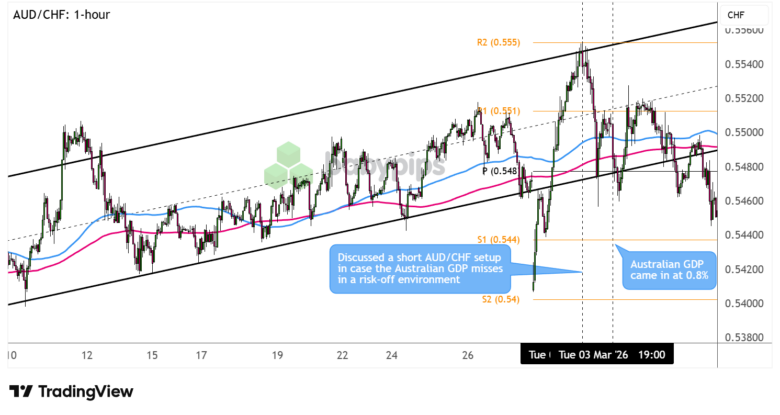
AUD/CHF: Bearish AUD Event Outcome + Risk-off Scenario = Arguably good odds of a net positive outcome
AUD/CHF 1-hour Forex Chart Faster with TradingView
The original watchlist identified AUD/CHF as the risk-off play for a bearish GDP outcome. Price had been trending higher inside a well-defined ascending channel, with the Pivot Point near 0.548 converging with channel support. The thesis was straightforward: a GDP miss in a risk-averse environment could attract sellers from that area, crack the channel floor, and open a path toward S1 at 0.544 and the S2 extension at 0.540.
The GDP outcome was not the clean bearish catalyst the setup required. Australia’s Q4 growth came in at 0.8% q/q — in line with consensus and a clear acceleration from Q3’s 0.4%. The headline was not a miss. Underlying components were weak enough to dampen bullish AUD enthusiasm, but not sufficient to trigger a confident bearish fundamental bias. The event outcome was effectively neutral, meaning the original trade premise was only partially met.
After the GDP event, we reassessed the data and environment and determined that AUD/CHF short was still a solid short setup, and looked for a bounce to Monday’s swing high / R2 Pivot resistance and bearish reversal patterns there as a potential area for short plays.
It looks like we were a bit conservative with our timing because from that point the AUD/CHF moved lower as the broad risk environment turned more negative due to the conflict in the Middle East. So it did move as we expected but for traders who were looking for the perfect entry, it’s likely they missed out on the downward move. For traders who were more creative and flexible with their entry, it’s highly likely they achieved a net positive outcome given that the pair moved 60 pips from our reassessment discussion.
Promoted: Capitalize on the News Events Without Risking Your Own Funds.
In a geopolitical shock regime, the major currencies, gold and the S&P 500 can swing wildly intraday. Why risk your personal capital during extreme volatility?
Most proprietary firms terminate your evaluation account if you execute a trade during a major macroeconomic release, but FundedNext permits news trading across all models. Test your thesis with up to $300,000 in simulated capital, or take advantage of their Free Trial to experience the platform risk-free.Explore FundedNext and Start Your Free Trial!
Disclosure: We may earn a commission from our partners if you sign up through our links.
Not Eligible to Move Beyond Watchlist – EUR/AUD & Bullish AUD Setups
EUR/AUD: Bearish AUD Event Outcome + Risk-On Scenario
EUR/AUD 1-hour Forex Chart Faster with TradingView
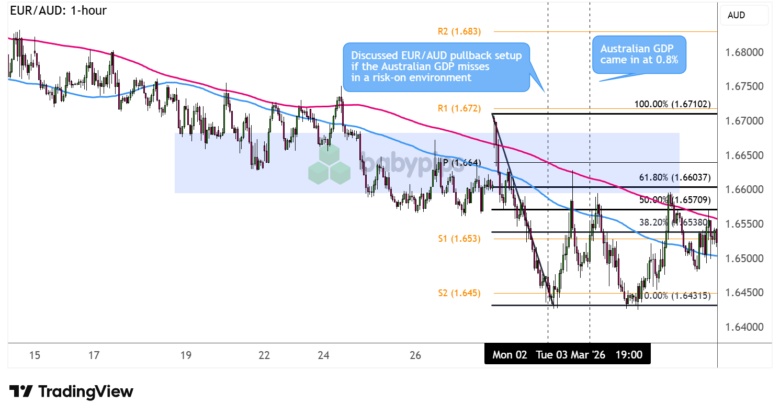
The EUR/AUD watchlist required both a weak GDP print and a risk-on backdrop for a potential move back up to the falling moving averages and Fibonacci retracement area from depressed levels around 1.6462. We actually saw the pair rally up ahead of the event and then dip back lower before the release due to broad market volatility elevating.
At the time of our reassessment where we thought the GDP outcome was net neutral for AUD, we thought that EUR/AUD warranted a bearish outlook given Europe’s exposure to the conflict as likely outweighing other driving factors for the pair. But with the pair already moving lower, in our opinion, EUR/AUD didn’t warrant a move beyond the watchlist stage at that time.
With that said, EUR/AUD did bounce one more time before the week ended, setting up another opportunity to short euros within the downtrend at favorable prices, potentially yielding a positive outcome for those who leaned with the trend before the weekly close.
AUD/USD: Bullish AUD Event Outcome + Risk-On Scenario
AUD/USD 1-hour Forex Chart Faster with TradingView
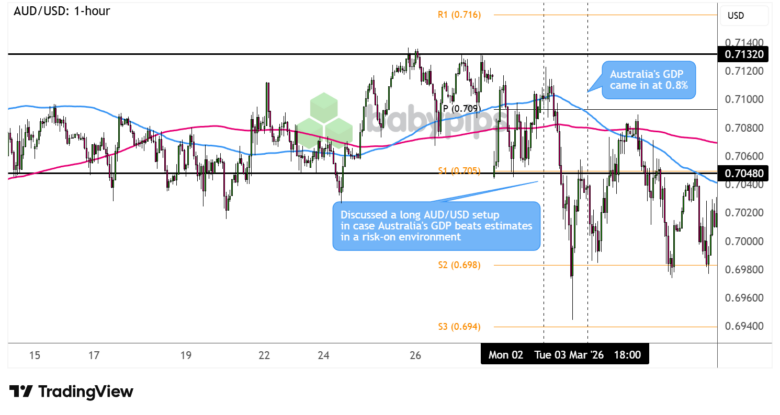
This AUD/USD watchlist setup focused on the short-term range with support at the .7050 minor psychological mark at S1 and resistance around .7135, foreseeing a potential break above the top or a bounce off the bottom in case the Australian GDP makes a strong upside surprise.
Although the headline figure came closely in line with expectations of a faster expansion compared to the previous quarter, underlying components painted a more concerning picture that cast some doubts on hawkish RBA expectations.
The combination of rising business inventories and bleak consumer spending, along with prevailing geopolitical uncertainty, rendered this bullish AUD/USD idea ineligible to move beyond the watchlist stage.
After filling its weekend gap, AUD/USD dropped sharply back to its weekly open and range support while markets continued to price in the implications of a prolonged US-Iran conflict, eventually leading to a break below the bottom while tensions remained elevated. Price bounced off S2 (.6890) but the broken range support held as resistance after the Australian GDP was released, spurring another dip to intraweek lows.
Although the midweek risk rebound sparked a stronger rally, AUD/USD soon caved to dollar strength fueled by improving U.S. economic data and safe-haven demand while geopolitical uncertainty lingered. AUD/USD found itself testing the weekly lows at S2 once more, keeping its head below the former range bottom while markets remained focused on the US-Iran war.
GBP/AUD: Bullish AUD Event Outcome + Risk-Off Scenario
GBP/AUD 1-hour Forex Chart Faster with TradingView
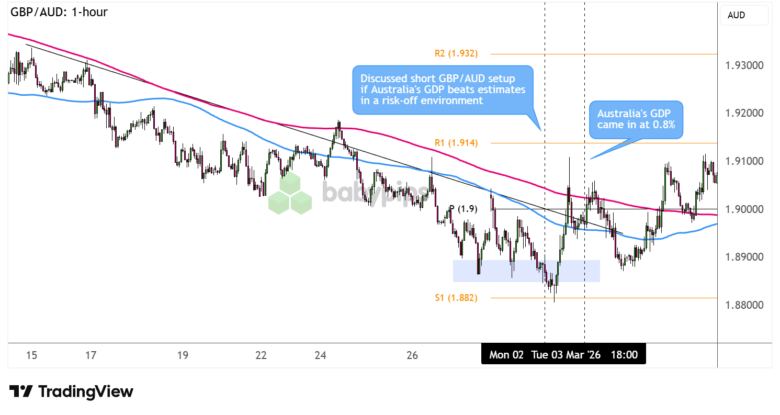
Our analysts spotted a steady downtrend on GBP/AUD, with the pair hesitating to carry on with the decline around the 1.8900 major psychological support. The watchlist idea focused on a possible break below the short-term consolidation in case the Australian GDP surprises to the upside in a risk-off setting.
Even though the headline GDP figure came in closely in line with estimates, the expansion was mostly driven by business stockpiling while consumers appeared hesitant to spend. These undermined Australia’s growth outlook and clouded March RBA hike expectations, making this bearish GBP/AUD ineligible to move beyond the watchlist stage.
The pair already made a strong bounce off the support zone while risk-off flows weighed more on the higher-yielding AUD than GBP early in the week. Australia’s GDP release sparked a slight bump higher above the pivot point (1.9000) and major psychological resistance, though a midweek risk rebound forced the pair to retreat back to the 1.8900 support.
Still, GBP/AUD gained stronger traction on its climb, eventually turning the 1.9000 area into support and extending its rally to 1.9100 as sterling found some tailwinds from upbeat U.K. housing reports while the Aussie suffered another wave lower on downbeat trade balance and household spending figures from the Land Down Under.
The Verdict
While Australia’s GDP report showed stronger-than-expected results on the surface, rising business stockpiles and bleak consumer spending metrics suggested that the growth picture was not as rosy. Against the backdrop of elevated Middle East tensions, this kept traders scrambling to safety while risk rallies remained limited.
The AUD/CHF setup offered the cleanest risk-reward for a short-term bearish setup in a highly-fluid market environment that was extra-sensitive to geopolitical headlines, demanding flexibility and active risk management.
The resistance at the middle of the channel top and R1 held quite well, despite SNB jawboning that initially discouraged franc-buying, leading to a sharp turnaround and selloff back to the channel bottom even before the Australian GDP release. Support held briefly, spurring a pullback ahead of the target event, which then sparked another test of the floor.
Overall, we’d rate this week’s watchlist discussions and reassessment as “likely” supportive of a potential positive outcome for those who leaned bearish right away on AUD/CHF after the reassessment, given that the Australian dollar had a bearish reaction to the weak GDP components and prevailing risk-off lean from geopolitical events. AUD barely gained any traction on brief risk rallies midweek, resuming its bearish trajectory as the US-Iran war extended one day after another, hardly recovering past pre-event levels as the week progressed.
Key Takeaways:
Underlying Data Matters
While the headline growth figure appeared impressive and supportive of hawkish RBA bets, traders paid closer attention to GDP components that would likely have a stronger say in longer-term policy trajectory. After all, the March RBA interest rate increase seems to have been widely priced in, so markets are more keen to find out whether the central bank can keep up its tightening cycle or not.
In practice, look beyond the headline print to gauge if underlying metrics are telling a different story. Don’t rush to jump in positions just because the results are way above or below estimates, and take a beat to see how markets are reacting to the data release as well.
Geopolitics Can Trump All
Although there are still some green shoots in Australia’s GDP report, the prevailing risk-off mood appears to have kept traders on edge and extra sensitive to any misses that stoke recession fears. Remember that macro reports are typically backwards-looking and that bigger global growth risks like war can overshadow even the most positive recovery narrative.
Exogenous Noise Can Masquerade as Confirmation
AUD/CHF’s sharp initial move toward the bearish watchlist target was driven by geopolitics, mixed China PMI, and a potential buy-the-rumor, sell-the-news scenario, not by the GDP miss the short setup required. Just because price reaches a target area doesn’t mean the trade idea is valid if the original reason for the trade didn’t happen. If price moves the way you expected but the key data or catalyst doesn’t confirm the idea, treat the move with caution rather than assuming the setup worked.
Promoted: How Do Professionals Trade Tariff News?
You’ve seen the retail reaction to the tariff whiplash—now see the institutional one. Brent Donnelly’s “The Art of Currency Trading” (4.7 ⭐; 517 reviews on Amazon) bridges the gap between the news headlines you read and the execution on your screen. It’s a practical, “no-fluff” guide to how professional FX desks navigate the exact type of geopolitical volatility described in today’s report.
Learn more about “The Art of Currency Trading” at Amazon
Disclosure: We may earn a commission from our partners if you sign up through our links, at no extra cost to you.