


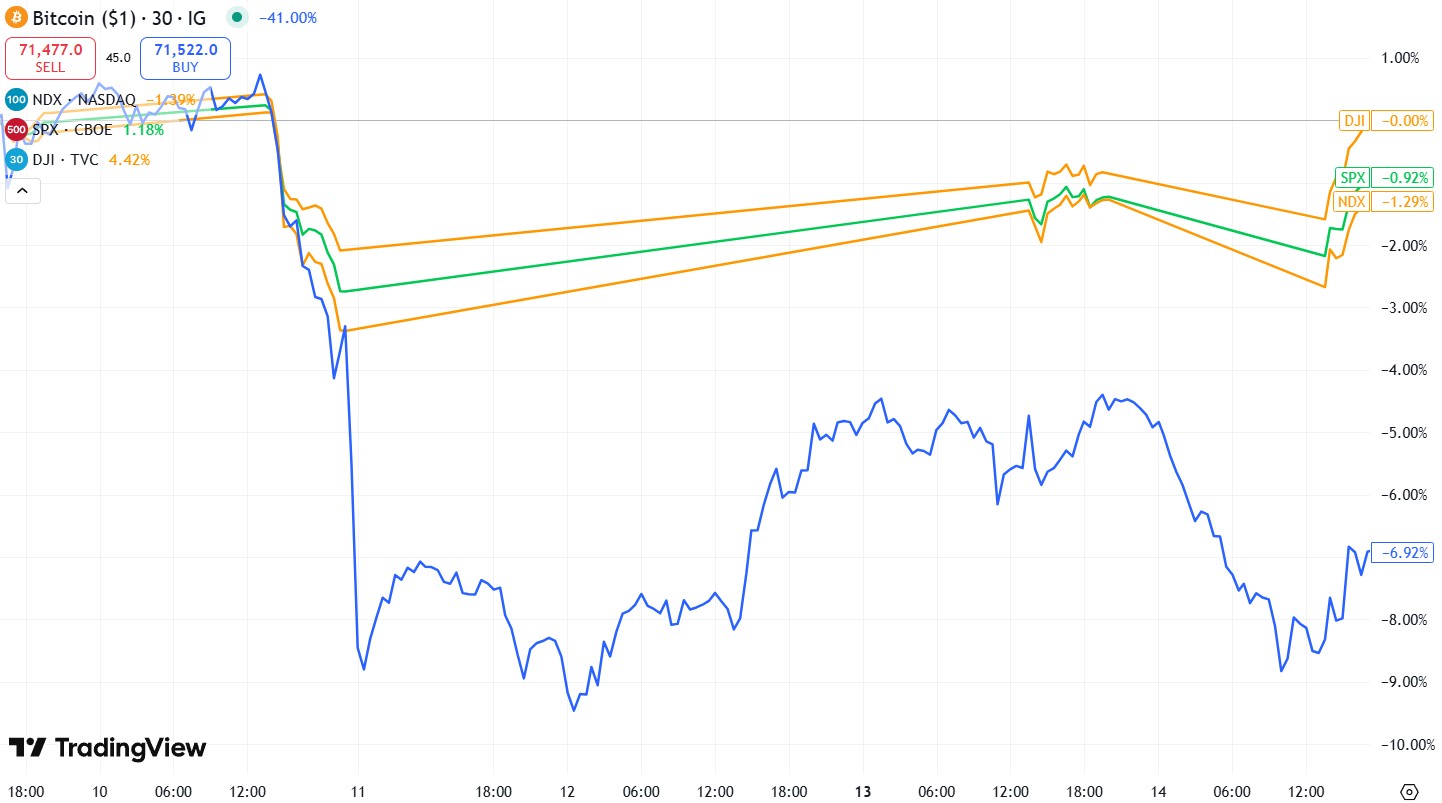
Crypto markets became the first outlet for investor reaction after US and Israeli strikes on Iran rattled global sentiment over the weekend.
At around 7:30 am (UTC) on Saturday, or in the wee hours of Wall Street, US President Donald Trump posted a video to announce that the US and Israel had launched attacks against Iran. Bitcoin (BTC) immediately reacted and dropped to around $63,000.
Meanwhile, traders rushed to crypto-native platforms to trade commodities futures while traditional markets remained closed.
Including the latest war breaking out, major geopolitical events have frequently occurred over the weekend or late Friday evenings. As crypto is increasingly tied to macro settings, Bitcoin’s 24/7 trading is evolving as a gauge of stock markets while they’re closed.
“The initial [weekend] move to the downside was sharp but contained, [and] Bitcoin never broke its broader market structure. When confirmation came that [Supreme Leader Ayatollah Ali Khamenei] had been killed and the immediate escalation risk appeared limited, price retraced quickly, and Bitcoin held its footing,” Jonatan Randin, senior market analyst at PrimeXBT, told Cointelegraph.
“By Monday morning, traditional market participants who had been watching crypto through the weekend already had a clear read on sentiment: This was a significant geopolitical event, but not a systemic one,” he added.
Bitcoin absorbing geopolitical shocks in real time
Though not always the case, governments and public companies often consider releasing important announcements before or after markets close. A guideline from New Zealand on dealing with financial products is among those that directly state this:
“Unless compelling reasons exist to release the announcement or media release while the affected market is open, it should be made when the market is closed to give investors time to consider the information before the market opens.”
Due to the nonstop trading cycle, crypto investors often don’t have time to assess the information and must react in real time, as observed during the war escalation over the weekend.
“While liquidity can be thinner during these periods, occasionally amplifying short-term volatility, the uninterrupted market ultimately enhances real-time price discovery and accelerates the adjustment process,” Iliya Kalchev, analyst at Nexo Dispatch, told Cointelegraph.
Related: $19B crypto market crash: Was it leverage, China tariffs or both?
It certainly felt that way on Oct. 10, 2025, when the crypto market experienced its largest liquidation event on record. Trump threatened steep tariffs against China, which was enough to tank markets.
This occurred before the US closing bell, so Bitcoin sank along with major stock market indexes. However, crypto markets continued to operate afterward, and liquidations continued, totaling around $19 billion.
For macro traders, this makes crypto a real-time sentiment gauge during geopolitical shocks. When events occur outside traditional trading hours, investors increasingly turn to digital asset markets to express their views on risk, liquidity or inflation expectations before equity, bond or commodity markets reopen.
Crypto’s 24/7 market does not stop at Bitcoin or other spot assets. Much of the activity now flows through perpetual futures across centralized and decentralized exchanges, while institutions are also experimenting with tokenized real-world assets (RWAs) that bring traditional financial instruments onto blockchain rails.
24/7 trading open beyond spot crypto
As Bloomberg reported, perpetual futures decentralized exchange Hyperliquid became a popular trading platform for commodities and traditional assets, like oil and precious metals.
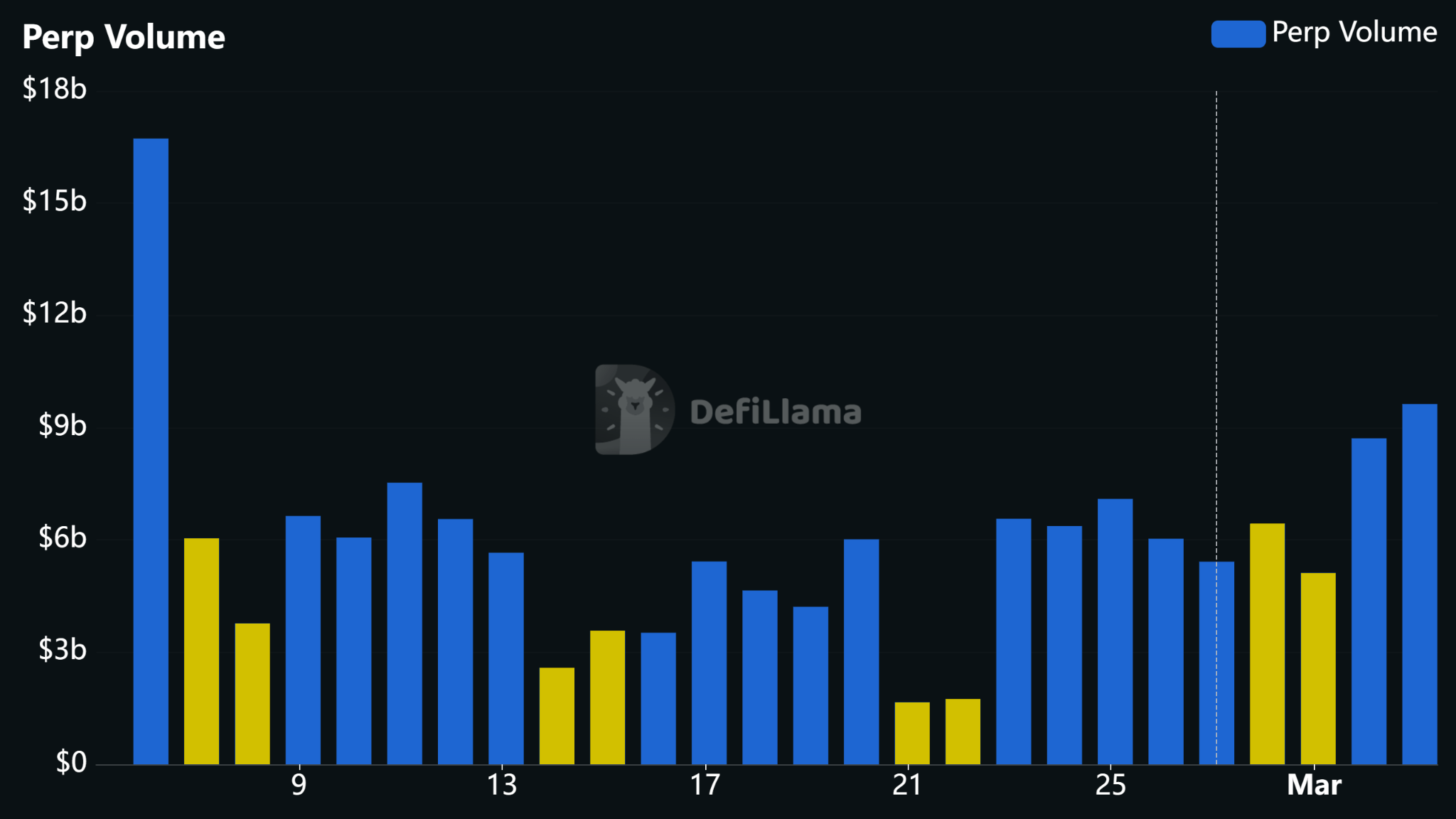
Hyperliquid’s volume also usually drops on weekends, DefiLlama data shows. But in the past weekend of geopolitical unrest, its volume remained high and matched that of business days.
Bitwise chief investment officer Matt Hougan added that Tether’s tokenized gold XAUT had a spike in trading volume over the weekend, while prediction markets volume set new records.
Weekend trading demand is increasingly reflected in traditional finance through surging institutional interest in RWAs. Tokenized assets inherit some of crypto’s market features, including cross-border accessibility and trading outside conventional market hours.
Related: Banks can’t seem to service crypto, even as it goes mainstream
McKinsey and Standard Chartered estimate tokenized assets could reach around $2 trillion by 2030, while Boston Consulting Group projects the market could grow to between $16 trillion and $30 trillion over the same period.
Traditional markets are also moving to extend their trading hours. In December, Nasdaq sought approval for a 23-hour trading system, split into day and night sessions with a maintenance hour in between, which wasn’t well received by financial services firm Wells Fargo.
“I cannot think of an action that single-handedly gamifies the stock market even more than it has already become. This is the epitome of making trading even more like gambling,” Wells Fargo’s trading desk said in a note to clients, as reported by CNBC.
In January, the New York Stock Exchange said it is developing a 24/7 blockchain platform for stocks and exchange-traded funds.
Crypto markets absorbing global shocks in real time
Weekend geopolitical shocks are increasingly testing the structure of global markets. While traditional financial systems pause between trading sessions, crypto continues to absorb information and reflect investor sentiment in real time.
“Bitcoin has evolved into a highly sensitive macro asset, reacting not only to technology-sector dynamics but also to shifts in liquidity conditions, monetary policy expectations and geopolitical tensions,” Kalchev said.
Bitwise’s Hougan said the weekend trading activity made traditional stock exchanges look “archaic.”
While more traditional finance venues are exploring extended or uninterrupted trading systems, Hougan said the blockchain markets’ performance during the past weekend’s military escalation suggested the blockchain transition may happen faster than he previously expected. He claimed he previously expected traditional finance to move onchain within 10 years.
Magazine: Would Bitcoin really be at $200K if not for Jane Street? Trade Secrets
Cointelegraph Features and Cointelegraph Magazine publish long-form journalism, analysis and narrative reporting produced by Cointelegraph’s in-house editorial team and selected external contributors with subject-matter expertise. All articles are edited and reviewed by Cointelegraph editors in line with our editorial standards. Contributions from external writers are commissioned for their experience, research or perspective and do not reflect the views of Cointelegraph as a company unless explicitly stated. Content published in Features and Magazine does not constitute financial, legal or investment advice. Readers should conduct their own research and consult qualified professionals where appropriate. Cointelegraph maintains full editorial independence. The selection, commissioning and publication of Features and Magazine content are not influenced by advertisers, partners or commercial relationships.