Dollar Jumps as ISM Manufacturing Beat and Inflation Surge Push Back Fed Rate Cut Bets

2026-03-02 23:24:00
The ISM Manufacturing PMI slipped just 0.2 points to 52.4 in February, but it still topped the 51.8 forecast and stayed firmly in expansion territory. That makes it two straight months above 50, and only the third time in the past 40 months that manufacturing has managed to hold that line.
While the headline figure pointed to continued resilience, the bigger shock was the prices paid index, which surged 11.5 points to 70.5, its highest level since June 2022, signaling a dramatic acceleration in input cost pressures.
Key Takeaways
- Manufacturing expands for second straight month: The PMI slipped marginally to 52.4 from 52.6 in January but beat the 51.8 forecast, sustaining expansion for the second consecutive month after 10 straight months in contraction
- Price pressures explode higher: The prices paid index soared to 70.5 from 59.0 — the sharpest single-month jump since March 2022 — driven by rising steel and aluminum prices and tariff pass-through from suppliers
- New orders and production cool from January highs: New orders dipped to 55.8 from 57.1, while production eased to 53.5 from 55.9, both retreating from nearly four-year highs hit in January but remaining firmly in expansion territory
- Employment contracts for 29th straight month: The employment index nudged up to 48.8 from 48.1, with 45% of panelists still focused on managing headcounts rather than hiring
- Order backlogs hit highest since May 2022: The backlog of orders index jumped 5 points to 56.6, suggesting a pipeline of demand building beneath the surface
- Supplier deliveries continue to slow: The supplier deliveries index rose to 55.1 from 54.4, indicating slower delivery performance for the third consecutive month
Link to official ISM Manufacturing PMI Report (February 2026)
February’s report shows a manufacturing sector that’s holding up, but paying more to do it. Twelve industries expanded while only five contracted.
The real headline was tariff-driven inflation. Multiple respondents pointed to rising input costs tied to Trump’s import tariffs. Transportation equipment firms said Section 232 is lifting prices while squeezing demand and margins, with U.S. produced steel and aluminum among the most expensive globally. Machinery makers echoed the same theme, saying domestic sourcing of materials like steel and wire is pushing costs higher.
Inflation risks also got another boost as the U.S. and Israel launched strikes on Iran, sending Brent crude sharply higher and rattling shipping through the Strait of Hormuz. ISM Chair Susan Spence said she would not be surprised to see the prices index rise again in March.
With input costs accelerating, markets pared back expectations for a June Fed rate cut, with CME’s FedWatch Tool showing reduced odds of easing in the near term.
Promotion: Master your trading psychology with AI-powered insights! TradeZella helps you track, backtest, and eliminate bad habits automatically! Click on the link and use code “PIPS20” to save 20%!
Disclosure: To help support our free daily content, we may earn a commission from our partners if you sign up through our links, at no extra cost to you.
Market Reactions
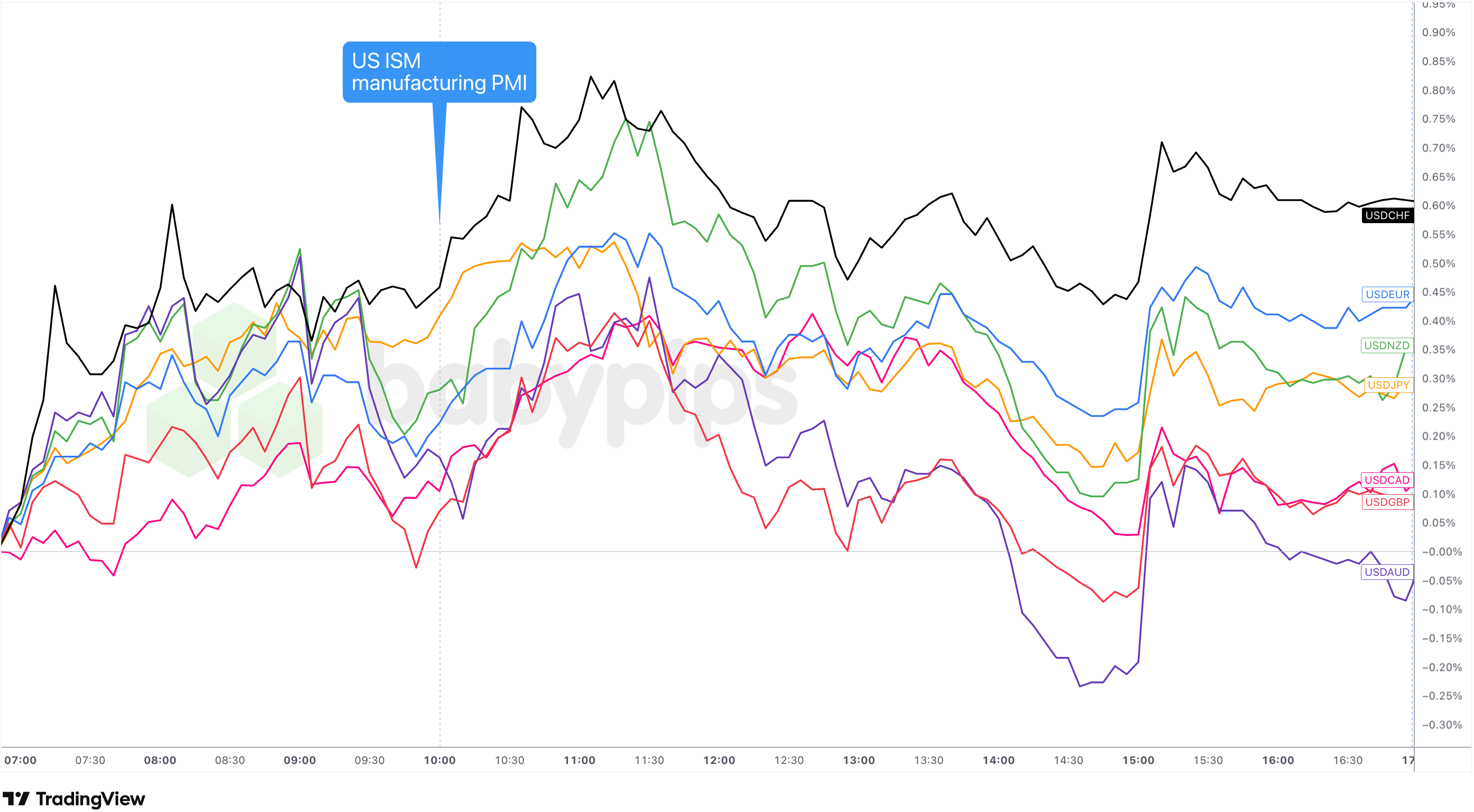
U.S. Dollar vs. Major Currencies: 5-min
Overlay of USD vs. Major Currencies Chart Faster with TradingView
The U.S. dollar, which dipped around the U.S. session open, jumped broadly after the better-than-expected ISM PMI print.
A stronger-than-expected headline and a sharp surge in the prices paid index reinforced the view that the Fed may not be in a rush to cut. USD/CHF led gains near +0.60%, while EUR/USD slid, leaving USD/EUR up roughly +0.45% on the day.
The move held until around the London close, when AUD/USD, NZD/USD, and GBP/USD staged sharp pullbacks, likely on profit taking. At the same time, USD/CHF spiked to fresh session highs before easing.
By the close, the dollar remained broadly stronger. A manufacturing beat, rising input costs, fading rate cut expectations, and higher oil prices tied to Iran tensions kept steady bids under the greenback as both a hawkish Fed trade and a safe haven play.
Promotion: Lux Trading Firm funds with real capital (up to $10M in buying power) and refunds evaluation fee 100% after Stage 1. Get a certified track record, no time limits and a focus on institutional-grade execution. It’s designed for those looking for a career, not a contest.
Learn More at Lux Trading Firm
Disclosure: To help support our free daily content, we may earn a commission from our partners if you sign up through our links, at no extra cost to you.