
2026-02-25 17:32:00
If you tuned out of President Trump’s State of the Union address late Tuesday thinking it was just political theater, you may have missed some important market signals.
Presidential speeches rarely move markets on their own — but this one landed in the middle of a perfect storm: a fresh Supreme Court ruling on tariffs, rising Iran tensions, and a market already on edge.
Here’s what happened and what it could mean for your trades.
What Happened: The Big Picture
Trump delivered a nearly two-hour address to Congress — the longest State of the Union in decades — declaring that “the golden age of America is now upon us.”
He touted falling gas prices, a rising stock market, and record oil production, while defending his tariff policy as the engine behind America’s economic turnaround.
The speech came at a volatile moment. Just days earlier, the Supreme Court had struck down Trump’s sweeping “reciprocal” tariffs, ruling he had overstepped his authority. Rather than backing down, Trump came to the podium with a defiant message.
Here are the key market-related claims and policy signals from the address:
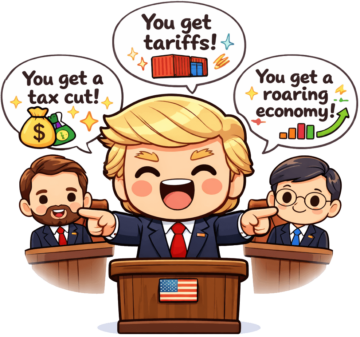
- Tariffs are staying. Trump called the Supreme Court ruling “unfortunate” and “totally wrong,” announced a new 10% global tariff under a different legal authority, and threatened to raise it to 15%. He insisted trading partners would honor existing deals.
- Inflation is over — according to Trump. He declared “there is no inflation” and said prices are falling, pointing to gasoline below $2.30/gallon in most states and core inflation at its lowest in over five years.
- Tariffs to replace income taxes. Trump floated the idea that tariff revenue could eventually substitute the income tax system — a significant long-term fiscal signal.
- Big tax cuts are coming. He touted his “big, beautiful bill,” including no tax on tips, overtime, and Social Security — all of which could affect consumer spending and growth expectations.
- Iran is in the crosshairs. Trump strongly hinted at potential military action against Iran, calling it a state sponsor of terror with growing missile capabilities — a direct geopolitical risk for oil markets.
- Stock market at all-time highs. Trump celebrated the market’s performance as proof of his economic success, framing it as a key midterm campaign talking point.
All of this — tariff defiance, Iran rhetoric, and no policy pivot — set the tone for how markets would react.
What the SOTU Potentially Means for The Markets
The State of the Union didn’t trigger dramatic one-day moves, but it did reinforce the uneasy tone already hanging over markets.
U.S. Stocks
Stocks edged higher during the speech after bouncing the day before from a sharp selloff. Still, there wasn’t much fresh fuel. The bigger overhang remains tariffs.
A 10% global tariff is already in place, and talk of a 15% increase is building. Higher import costs can squeeze margins and weigh on earnings, which helps explain why some portfolio managers are positioning more defensively. At the same time, last year’s tax stimulus could start feeding into the economy and soften any slowdown.
U.S. Bonds and Yields
Recent price action suggests investors are leaning toward a softer growth outlook as tariff uncertainty lingers, potentially keeping a bid under Treasuries and yields relatively contained.
At the same time, the fiscal backdrop complicates that move. Tax cuts and spending plans point to wider deficits and heavier Treasury issuance ahead. A growing supply of bonds can pressure the market to reprice higher in yield terms, particularly if investors demand more compensation for holding longer-dated U.S. debt.
The U.S. Dollar
The Dollar Index slipped modestly, with no surprise in the speech to spark a breakout. For now, the dollar outlook remains murky.
On the one hand, tariffs can theoretically strengthen a currency by reducing imports. On the other hand, markets are pricing in roughly three Fed rate cuts in 2026 — and lower interest rates tend to weaken the dollar.
If the tariff situation escalates and growth fears deepen, the dollar could face additional selling pressure, especially if the “Sell America” trade — where global investors dump U.S. assets — picks up momentum again.
Overall Market Risk Sentiment
Broader risk sentiment remained cautious post-SOTU. Safe haven gold had already surged above $5,000 per ounce and was pushing toward $5,200, fueled by trade uncertainty and Iran war fears. Trump’s hawkish Iran comments in the speech only reinforced those bids.
With U.S.-Iran nuclear talks scheduled in Geneva later, any breakdown in diplomacy could send oil prices surging and push sentiment sharply into risk-off territory — meaning investors flee stocks and riskier assets in favor of gold, bonds, and the Japanese yen. Bitcoin, which dipped below $66,000 mid-week, is also sensitive to these risk swings.
Promoted: Scale Your SOTU Strategy with a Decade of Reliability
As Gold tests $5,200 and global markets brace for a 15% tariff shock, navigating the 2026 macro landscape requires more than just a good entry—it requires a partner that has seen it all before.
While new firms come and go with the volatility, The5ers has spent the last 10 years perfecting a funding model that works for the trader. It’s why over 1.6 million traders worldwide trust them to provide the capital and scaling needed to turn market analysis into meaningful professional growth.
Learn more about The5ers
Disclosure: We may earn a commission from our partners if you sign up through our links, at no extra cost to you.
Key Lessons for Traders
Presidential speeches are context, not catalysts on their own. The SOTU alone didn’t cause a big move. What mattered was when it happened — right after a Supreme Court tariff ruling, with Iran tensions simmering. Always assess the backdrop, not just the headline event.
Policy uncertainty is a headwind for risk assets. When traders don’t know what tariff rate applies next week, companies can’t plan and investors stay cautious. Uncertainty tends to favor safe havens like gold and bonds over stocks.
Watch the Fed, not just the President. Trump’s tariff agenda affects inflation expectations, which shapes what the Federal Reserve does with interest rates. Fed rate cuts weaken the dollar and typically support stocks — but Fed officials this week pushed back, wanting more evidence that inflation is under control first. That tension is worth tracking.
Geopolitical rhetoric has a direct market cost. Trump’s hawkish comments on Iran pushed oil prices higher and fueled gold’s rally. If you trade commodity-linked currencies, such as the Canadian dollar (CAD), energy price moves matter enormously.
The Bottom Line
Trump’s 2026 SOTU delivered defiance — on tariffs, on the Supreme Court, and on Iran — rather than a policy reset. Markets had largely priced in “no surprises,” which is why the immediate reaction was muted.
But the underlying tensions remain very much alive: a 10% global tariff is already in effect, a 15% hike is reportedly being prepared, and U.S.-Iran nuclear talks coming soon.
Keep an eye on tariff policy developments, Fed speakers, and any escalation on the Iran front. Those carry far more short-term market punch than any single presidential speech.
Promotion: When President Trump talked the State of the Union, was your execution clinical or emotional? TradeZella’s trade replay tool lets you revisit your past trades tick-by-tick. See exactly where your entry slipped or why you hesitated, so you can dominate the next volatility spike with a data-driven playbook. Click on the link and use code “PIPS20” to save 20%!
Disclosure: To help support our content, we may earn a commission from our partners if you sign up through our links, at no extra cost to you.