


XRP is entering a stretch where on-chain cost basis, leverage, and flow data may matter more than broad market narratives.
The token is approaching a critical point after a sharp rise in realized losses, with on-chain activity showing investors moving coins below their purchase prices.
That is a classic capitulation signal. It often appears near emotional lows, when weaker holders exit and supply changes hands. It can mark the start of a recovery, but it can also mark the start of a longer repair cycle.
Capitulation is visible, but it is not a bottom on its own
Santiment’s weekly realized profit and loss data show XRP has posted its largest realized-loss spike since the November 2022 washout.
The chart below shows that the prior weekly milestone was about negative 1.93 billion in realized losses, followed by a 114% price increase over the next eight months.
Notably, the current realized loss episode is about -908 million.
That means a large cohort of holders sold or transferred coins below their cost basis, locking in losses on-chain.
This represents the kind of print traders look for late in a correction.
Capitulation events can clear supply overhang by forcing out weakly held positions, especially after a prolonged drawdown.
They often cluster around periods of maximum frustration, when price has already done enough damage to push investors into defensive decisions.
Cost basis is now the line that separates reset from weakness
Glassnode’s cost-basis metrics put a clear line under XRP’s current market structure.
As of Feb. 23, XRP’s realized price, which serves as a proxy for the aggregate average price paid for the circulating supply, stood around $1.45.
This level is important because it acts as a dividing line between expansion and contraction.
When spot trades below the realized price, the market is, on average, underwater. When spot reclaims and holds above it, the market often moves into a healthier phase.
XRP is struggling to reclaim and sustain that level.
Two other Glassnode metrics support the same read. MVRV is near 0.99, suggesting the asset is valued roughly at its cost basis, or slightly below it. SOPR is around 0.98, indicating that on-chain coins are being sold at a loss on average.
Sustained SOPR below 1 usually reflects stress behavior rather than a confident rotation.
This is the core setup.
If XRP reclaims the roughly $1.45 realized price and holds there, the market can begin to reset.
In that scenario, SOPR moving back above 1 and staying there would show that holders are no longer using rallies to exit at a loss. MVRV moving above 1 would reinforce that the market has exited the underwater zone.
If XRP fails to hold above the realized price, the opposite dynamic can continue. Holders who bought higher use strength to reduce exposure, and the token remains trapped below the aggregate cost basis.
Leverage is still heavy, and Binance inflows add a second risk signal
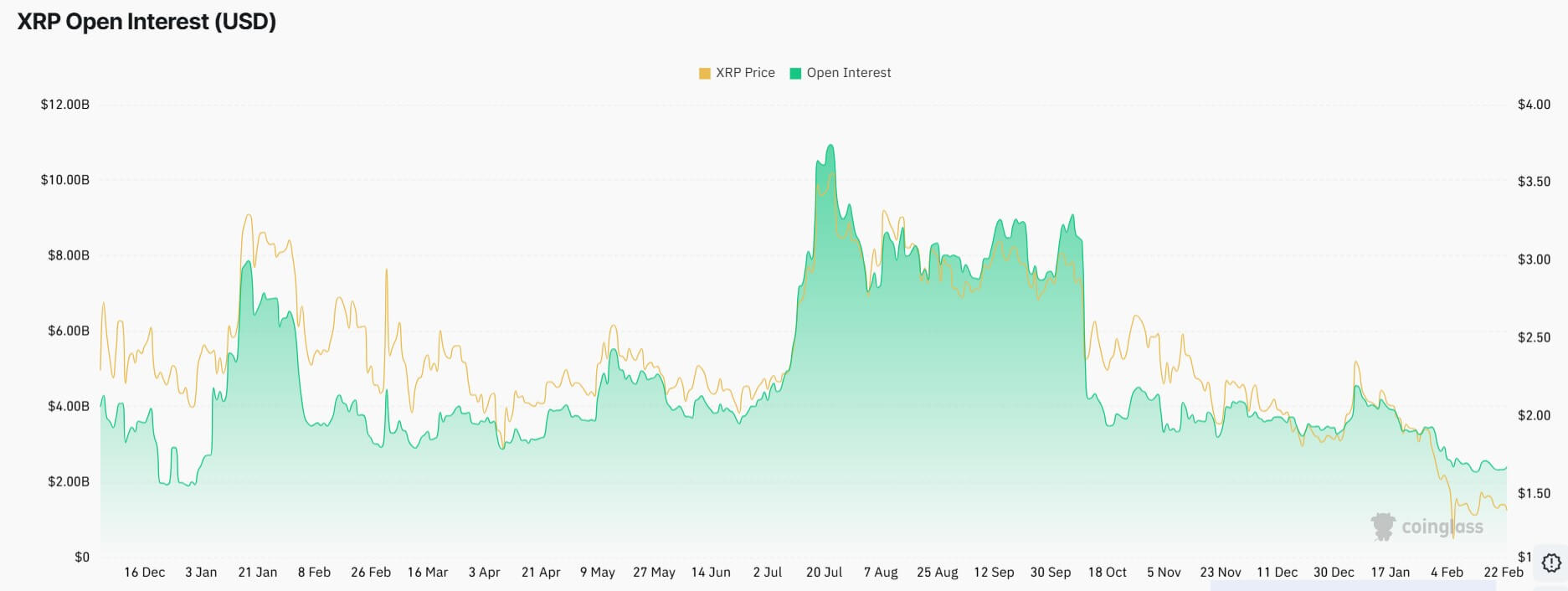
Derivatives positioning remains a major part of the story, and CoinGlass data shows leverage is still large enough to shape XRP’s next move.
CoinGlass lists XRP futures open interest at about $2.33 billion, with 24-hour futures volume around $5.24 billion. It also shows about $13.2 million in XRP futures liquidations over 24 hours.
Those are not small figures. They show that leverage is still active and that positioning can still magnify price moves in both directions.
The broader setup remains skewed defensive, with bearish funding signaling shorts are paying longs. That matters because it creates two very different paths from the same starting point.
If XRP stabilizes near the cost basis and begins to push higher, short positioning can become squeeze fuel.
In a fragile market, even a modest spot-led move can prompt short covering, accelerate upside, and quickly improve market tone.
However, if XRP continues lower while leverage stays elevated, the same structure can deepen downside volatility. Liquidation cascades can kick in, and that can push the market further away from a clean reset.
Meanwhile, spot exchange flows are also raising a near-term caution flag.
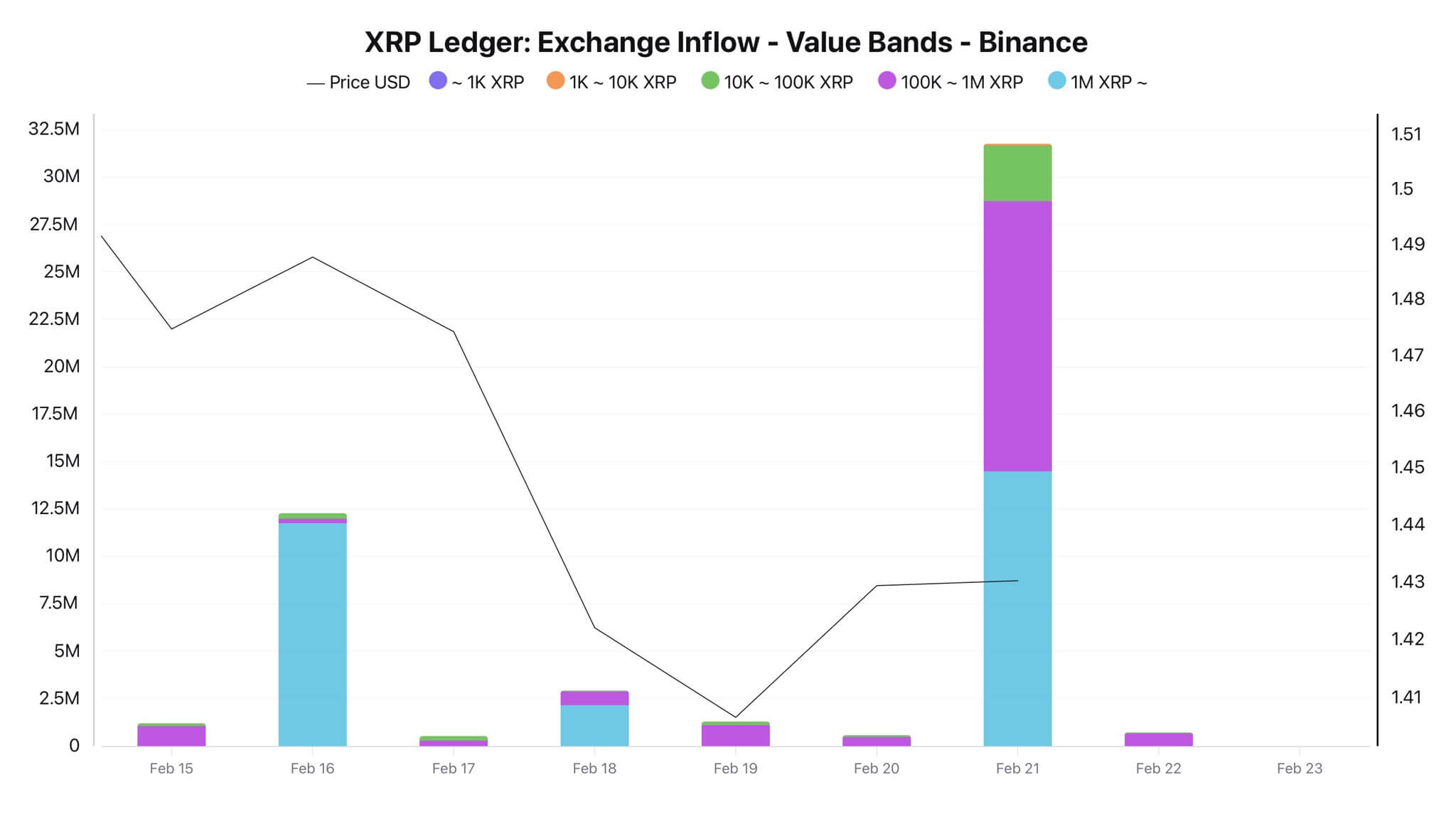
CryptoQuant data showed more than 31 million XRP moved to Binance in a single day, with the largest holder cohorts driving most of the activity.
Wallets holding 100,000 to 1 million XRP sent 14,236,825 XRP, while wallets holding more than 1 million XRP sent 14,494,865 XRP.
Smaller cohorts accounted for the rest, with 2,938,809 XRP from 10,000 to 100,000 XRP wallets, 73,630 XRP from 1,000 to 10,000 XRP wallets, and 6,543 XRP from wallets holding less than 1,000 XRP.
Taken together, the inflow was framed as nearly $45 million in potential sell-side pressure.
However, it should be noted that not every exchange inflow translates into immediate selling. Some transfers are tied to collateral, internal wallet changes, or execution planning.
Still, in a weak market, a sudden rise in exchange-bound supply, especially from larger cohorts, is a signal that traders closely watch.
If that pattern persists, it can slow any rebound attempt, even after a capitulation print.
XRP ETF flows are still positive, but momentum has slowed sharply
ETF positioning remains relevant for XRP, but the story is now about the marginal bid, not the headline.
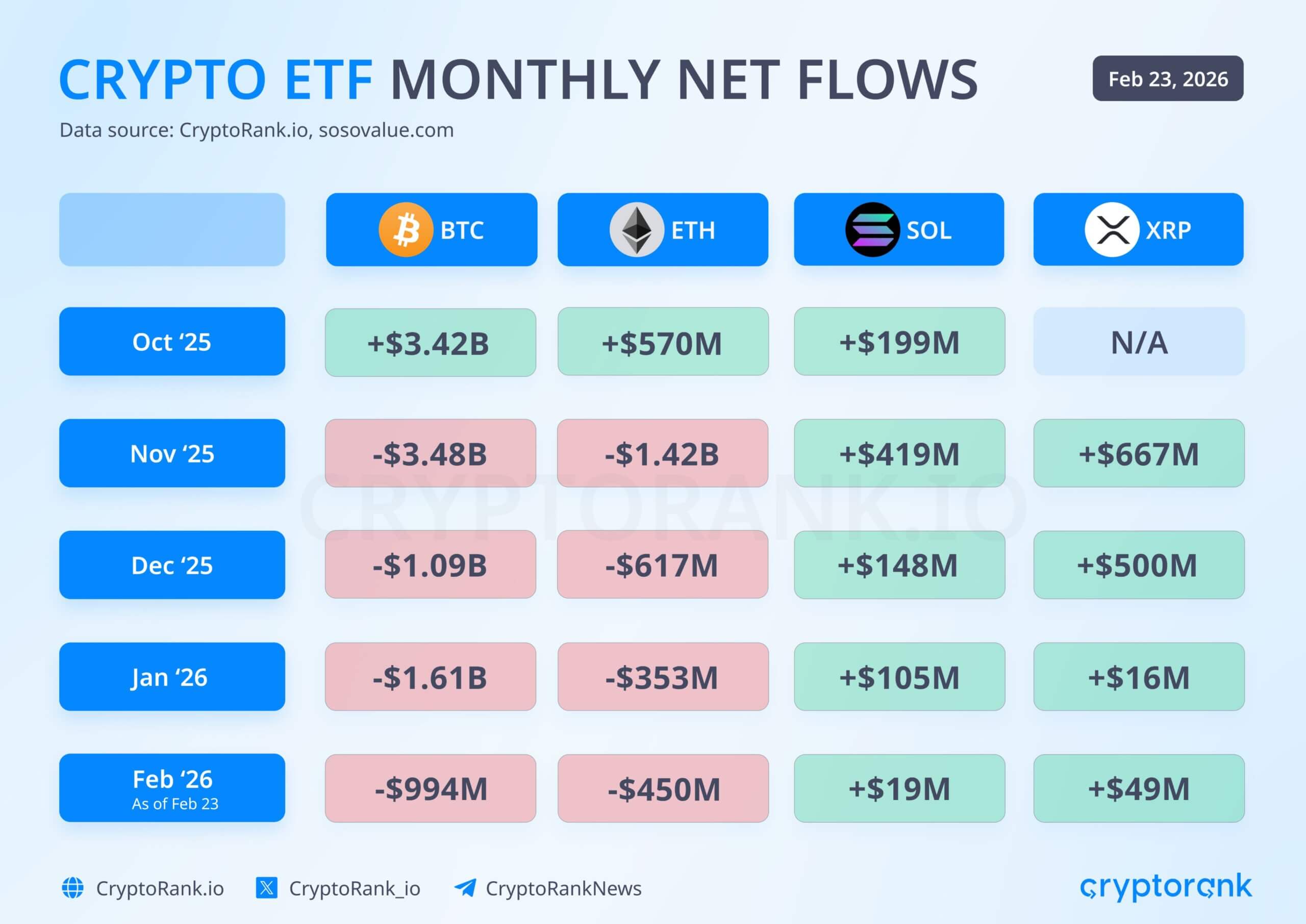
CryptoRank data shows the broader ETF backdrop has been weak, with BTC ETFs losing $7.2 billion since November and ETH funds shedding $2.8 billion, while most weeks have been negative.
That helps explain the risk-off tone across crypto and the limited follow-through in altcoins.
XRP’s ETF profile has diverged from that trend, at least in direction.
CryptoRank data indicates that XRP ETFs launched into this drawdown and have remained net positive every month since their debut.
That is important because it suggests some demand has continued to enter regulated XRP products even while the broader market has been under pressure.
The pace, however, has slowed significantly.
Monthly XRP ETF inflows dropped from $667 million to $49 million. The category has not posted a red month yet, but the deceleration is steep.
That leaves XRP in a middle ground, where ETF demand is still supportive at the margin, but not strong enough on its own to overpower a weak tape.
This is also why the next phase for XRP is less about whether ETF products exist and more about whether they continue attracting enough capital to matter during low-liquidity windows.
After capitulation, even modest inflows can have an outsized impact if supply overhead has already been reduced.
If those inflows fade further, the market may need spot demand from other channels to reclaim cost basis and hold it.
In short, ETF positioning is still part of the setup, but it is no longer a standalone bullish argument.
The next month will decide whether XRP resets or enters a longer repair phase
XRP’s setup can now be framed in three scenarios, all of them tied to the same market signals.
The first is a washout-to-rebase recovery. In this case, the realized-loss spike acts as a supply reset, XRP stabilizes near cost basis, then reclaims and consolidates above the roughly $1.45 realized price.
Confirmation would come from SOPR moving back above 1 and staying there, with leverage normalizing rather than expanding aggressively. If shorts remain crowded while spot improves, a squeeze becomes plausible.
The second is an underwater grind. Here, capitulation marks the start of a longer repair process, not the end of the correction.
XRP fails to hold above realized price, SOPR remains below 1, and MVRV stays under 1. Rallies are sold by underwater holders trying to cut exposure, and the price remains capped.
The third is a flow-driven repricing. In this path, ETF demand remains positive and becomes more important after the capitulation event reduces supply pressure. Even modest inflows can matter if the market is already tight.
The early sign would be product flows staying positive or rising while the XRP price is still flat, which would suggest demand is arriving before the price reacts.