
A coordinated attack caused the USD1 peg wobble but one exchange holds 93% supply


World Liberty Financial’s stablecoin slipped to $0.994 on Feb. 23, a 0.6% deviation that lasted minutes before recovering.
For a token backed one-to-one by dollars and government money market funds, with over $5 billion in circulation and the fifth-largest market share among stablecoins, the wobble wasn’t supposed to happen.
But it did, and the gap between “should” and “is” reveals the uncomfortable truth crypto still refuses to absorb: political connections and reserve attestations don’t create immunity from runs. They determine how quickly the discount closes.
WLFI blamed the slip on what it called “a coordinated attack,” consisting of hacked cofounder accounts, paid influencers spreading fear, and large short positions against its WLFI token.
The company emphasized that USD1’s mint-and-redeem mechanism remained intact, and reserves remained intact. DEX Screener showed a $0.994 low, followed by a quick recovery.
The machinery worked. It didn’t work smoothly enough to prevent the discount from appearing.
Two markets, one peg
The confusion lies in treating “backed one-to-one” as if it means “trades at $1.00 everywhere, always.”
Stablecoins operate in two markets. The primary market is where authorized participants mint new tokens by depositing dollars with the issuer or redeem existing tokens to get dollars back.
This is where the one-to-one backing lives, where arbitrage is supposed to restore the peg if secondary prices drift.
The secondary market is where everyone else trades: exchanges, decentralized protocols, and peer-to-peer. This is where price actually moves minute by minute, and where USD1 hit $0.994.
BitGo, the custody and issuance infrastructure behind USD1, publishes terms that acknowledge exactly this split. It will redeem tokens at par for eligible account holders, but it explicitly states it cannot guarantee stablecoins will trade at $1.00 on third-party platforms.
The gap between those two sentences is where depegs happen.
Redemption isn’t frictionless. BitGo’s terms reserve the right to impose limits or suspend minting for compliance or legal reasons. Even under normal conditions, redeeming requires onboarding, KYC checks, banking rails, and operational capacity.
None of these happens instantly.
Research from the International Monetary Fund highlights that “par redemption” often comes with minimums, fees, or processing delays that weaken the arbitrage link during stress.
A depeg is the price someone pays for immediacy: the discount reflects selling now rather than waiting to redeem later.
The Binance chokepoint
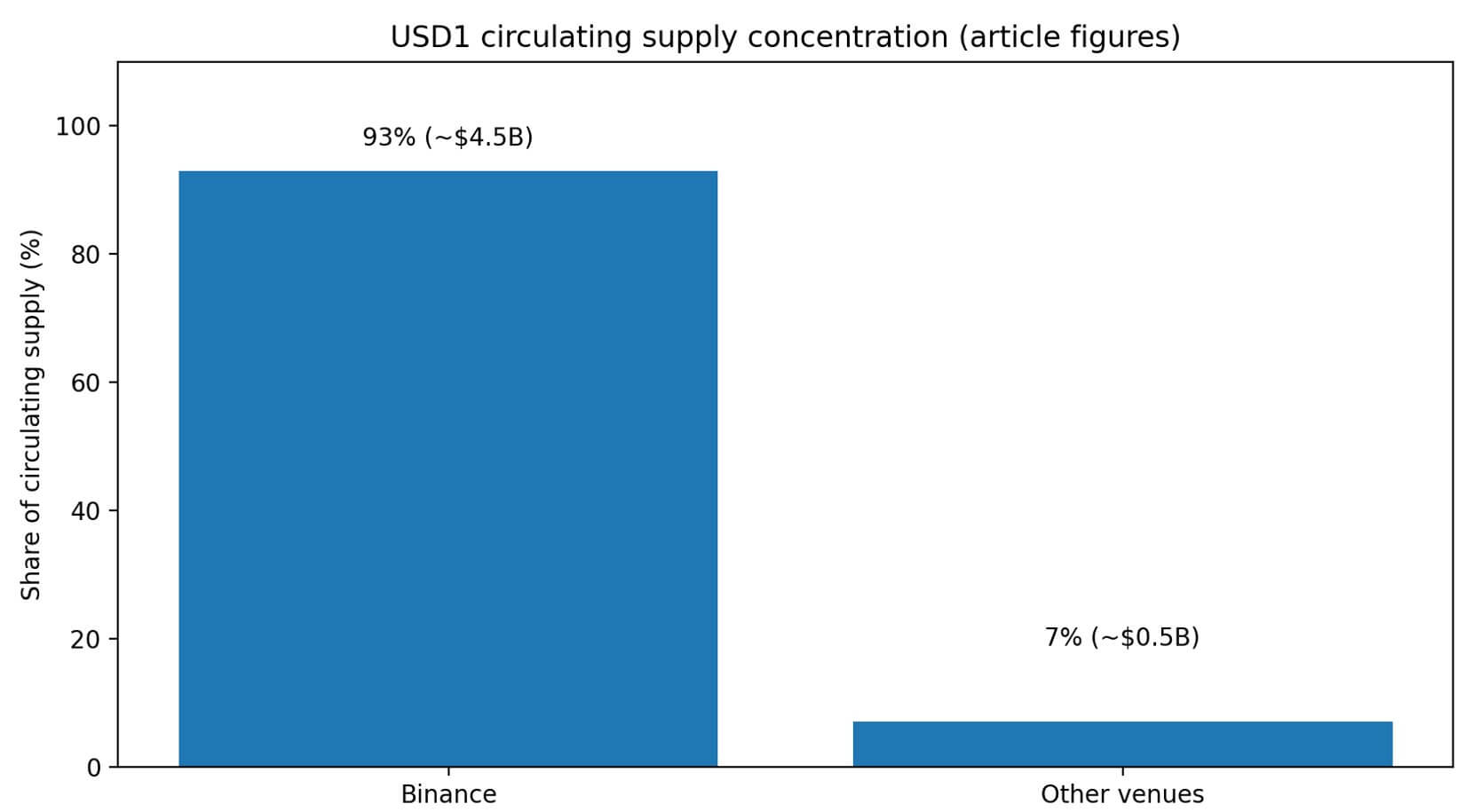
Binance holds roughly 93% of USD1’s circulating supply, about $4.5 billion of the $5 billion total, based on Arkham’s wallet tracking.
That concentration makes one exchange the de facto venue where the USD1’s peg is tested. If fear spreads and sellers flood Binance order books faster than arbitrageurs can step in, the secondary price can gap down even if primary redemption remains open.
The Feb. 23 wobble fits a “tweet shock” scenario: rumor bursts, influencer narratives, and coordinated messaging create a sudden one-sided flow. The expected range for this type of event is 0.2% to 1.0% off-peg, with recovery in minutes to hours if redemption rails stay perceived as accessible.
The $0.994 low sits squarely in that band. The speed of recovery suggests arbitrage capital stepped in once the initial wave of selling exhausted itself.
But the structure remains fragile. If the next rumor targets Binance specifically, such as custody concerns, regulatory headlines, and delisting risk, the wobble could turn into a cascade.
When one venue holds 93% of the supply, that venue becomes the peg’s single point of failure.
The expected discount in a chokepoint scenario is 1% to 5%, depending on how quickly arbitrageurs can access alternative liquidity and whether redemption access stays credible.
Reserve transparency and the information lag
USD1’s December 2025 reserve attestation, examined by Crowe LLP under AICPA criteria, showed redeemable tokens outstanding of $3.313 billion matched by redemption assets of $3.3135 billion, consisting primarily of demand deposits and government money market funds.
WLFI’s marketing materials commit to monthly reserve reporting, and BitGo’s attestation framework follows established audit standards.
The problem is timing. BitGo’s public attestation page lists months from 2025, while data aggregators show that USD1 has surpassed $5 billion in circulation. That gap creates an information vacuum that the market can weaponize during periods of fear.
Sound reserves don’t stabilize a peg if the market doubts they can be accessed, and stale data feeds that doubt.
What breaks a stablecoin that’s fully backed
Academic models decompose stablecoin discounts into three components: redemption friction, disruption risk premium, and liquidity imbalance.
Recent research finds that peg restoration works primarily through primary-market arbitrage until redemption frictions cross a nonlinear threshold. After that point, secondary liquidity becomes an amplifier rather than a stabilizer.
Applying that framework to this morning: if redemption friction sits at 0.1% and liquidity imbalance adds 0.5%, you get a 0.6% discount without any actual impairment of reserves.
Alternatively, if traders price in moderate disruption risk of around 0.3%, plus 0.3% liquidity drag, you reach the same number. Either path produces the observed $0.994 without requiring fraud or insolvency.
The deeper risk arrives when primary redemption becomes genuinely impaired, such as settlement delays, banking friction, or legal restrictions that BitGo’s terms explicitly contemplate.
USDC dropped to $0.88 during the Silicon Valley Bank crisis when markets questioned whether its banking partner could process redemptions. If USD1 faces a similar moment, the discount could widen to 5% to 15%, regardless of asset backing.
| Scenario | Trigger | Expected discount | Likely recovery | What to watch |
|---|---|---|---|---|
| Tweet shock | Rumor burst / hacked-account narrative / influencer FUD | 0.2%–1.0% off-peg | Minutes → hours | Depth + frequency of wobbles; perception of redemption access |
| Binance chokepoint | Venue-specific fear (custody, regulatory headline, delisting risk) | 1%–5% off-peg | Hours → days (if liquidity fragments) | Binance order-book depth; migration to other venues; spread widening |
| Primary rails impaired | Redemption limits, settlement delays, banking/legal friction | 5%–15% off-peg (stress) | Days+ (until convertibility restored) | Redemption queues; any limits/suspensions; freshness of reserve reporting |
No political backstop exists
The GENIUS Act created a federal framework for payment stablecoins in the US, followed by a wave of OCC national trust bank applications tied to stablecoin custody and issuance, including WLFI’s own trust bank application.
Treasury Secretary Scott Bessent suggested stablecoins could reach $2 trillion in circulation over the next decade, raising the stakes of any “too big to fail” narrative.
However, if a stablecoin linked to the sitting US president’s orbit can wobble in response to a single morning’s information shock, the idea of an implicit political backstop is a mirage.
Regulation will focus on operational convertibility, such as redemption access, disclosure cadence, exchange concentration, not vibes or proximity to power.
The lesson from Feb. 23 isn’t that USD1’s reserves failed, but that confidence and liquidity matter more than balance sheets when fear spreads faster than redemption queues clear.
Peg quality degrades with repeated wobbles, not singular events.
The question isn’t whether USD1 recovered to $1.00, but whether the next rumor produces a larger discount or a slower recovery.
The gap to $0.994 was small, the recovery was fast, and the reserves appear sound. Yet, the gap existed, and in crypto, existence is evidence. No one is too big to fail when the exit is a click and the next exchange is a transfer away.