

Bitcoin’s current bear market could worsen over the next year if the flagship digital asset fails to address concerns about quantum computing.
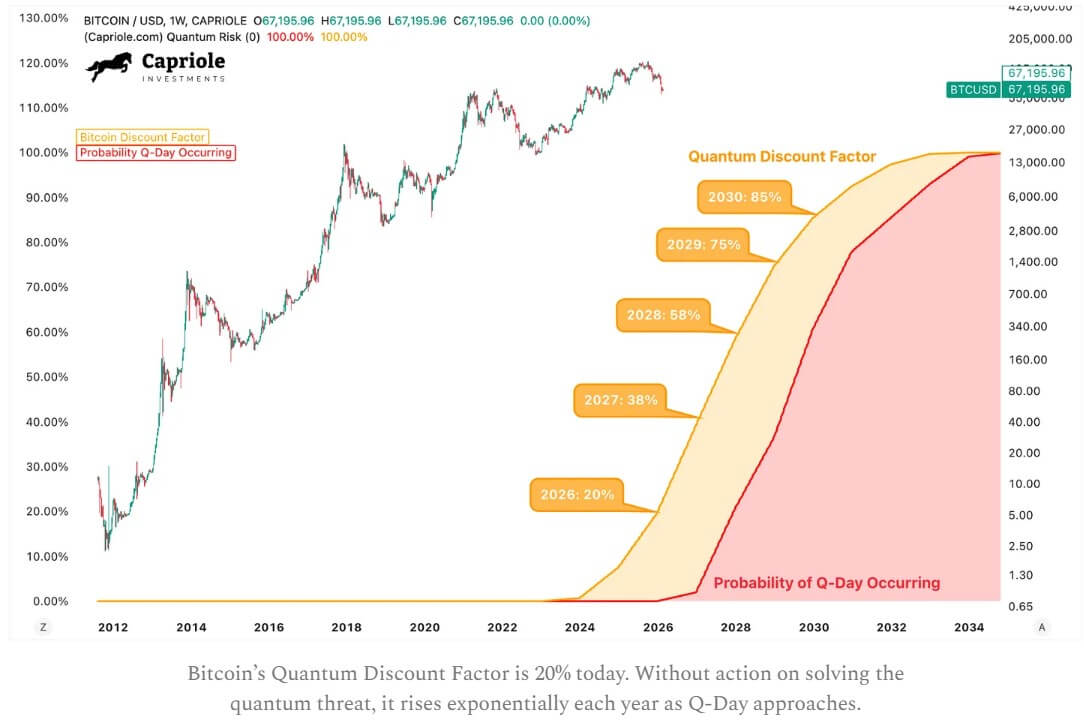
In a Feb. 20 report, Charles Edwards, Capriole founder, claimed that Bitcoin’s market value should already be discounted for quantum risk and warned that the discount could deepen quickly if the network does not move toward quantum-resistant code.
According to him:
“Bitcoin will be worth half as much in little over a year if we do not progress an upgrade to quantum proof Bitcoin. Without progress, Bitcoin’s Quantum Discount Factor jumps to 75% in 2029.”
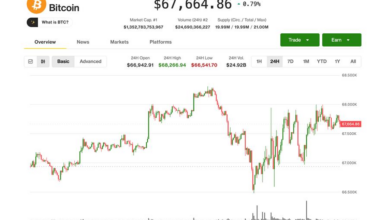
This projection implies that Bitcoin’s price could drop to around $30,000 from its current level of $68,000 by next year.
However, he warned that this could be worse, as Bitcoin’s value could fall to zero after Q-Day if the network is unable to address quantum computing threats.
Despite these fears, Edwards argues that Bitcoin’s current price is undervalued by about 30% as its current fair valuation is around $120,000, which would drop to $96,000 when accounting for quantum risk.
He wrote:
“In other words if you are a long-term investor in Bitcoin, and optimistic we will solve on the quantum threat in the next 2-3 years, then Bitcoin in the $60,000s is an attractive long-term opportunity.”
Essentially, the point is not that a quantum attack is imminent. Edwards’ framework is that markets may start marking down Bitcoin before any “Q-Day” event if investors believe the network’s governance and migration process will take years.
In his model, the risk becomes a valuation discount now because Bitcoin upgrades are slow and require broad coordination across developers, nodes, miners, exchanges, and wallet users.
Why the market can discount a future threat today
Edwards’ note argues that quantum risk has moved from a fringe topic to a timeline problem.
He cites a threshold of roughly 2,300 logical qubits as sufficient to threaten Bitcoin’s current cryptography and estimates, based on compiled industry forecasts, that a cryptographically relevant quantum event is likely by 2030 and increasingly probable by 2031.
According to him:
“Bitcoin Q-Day is likely to occur by 2030 (60% chance) and probable by 2031 (80% chance).”
However, his more immediate concern is Bitcoin’s response time.
Edwards estimates it would take roughly two years, and possibly one to three years, to move a majority of active users to quantum-resistant wallets and code, even in an aggressive scenario.
That gap between the pace of quantum progress and the pace of Bitcoin governance is the basis for his “discount factor” argument.
Meanwhile, this logic is no longer confined to crypto-native commentary.
Last year, BlackRock amended the prospectus of its iShares Bitcoin Trust ETF, explicitly warning that advances in quantum computing could render Bitcoin’s cryptography ineffective.
According to the firm, this could potentially compromise wallet security and force network-wide changes that may require broad consensus and one or more forks. The filing also says there is no assurance that those transitions would be implemented successfully or on time.
For markets, that matters because it reframes quantum computing as a coordination and governance risk rather than just a hardware risk.
Even if the technology arrives later than feared, uncertainty around readiness can still pressure valuation in the meantime.
What is at stake, and why the debate is hard
Edwards breaks the Bitcoin quantum problem into two parts.
First, migrating active users to a quantum-resistant version of Bitcoin. Second, dealing with older or exposed coins that may be vulnerable if quantum systems can recover private keys from public keys.
He estimates that 20% to 30% of the Bitcoin supply is “public key exposed,” including older output types and dormant coins, and warns that those coins could become a major source of forced supply in a worst-case scenario.
At current prices, that 20% to 30% range translates into a very large pool of value. Using Bitcoin’s 21 million supply cap and a spot price near $67,178, the at-risk range would be roughly $282 billion to $423 billion.
Notably, CoinShares’ February 2026 assessment puts numbers on the “long exposure” problem.
It estimates that exposure is concentrated in legacy Pay-to-Public-Key (P2PK) outputs, which are equivalent to roughly 1.6 million BTC, about 8% of the supply, because those formats leave public keys plainly visible.
However, the portion that could cause “appreciable market disruption” if stolen quickly is far smaller: CoinShares estimates 10,200 BTC sit in UTXOs large enough to matter in a rapid liquidation scenario.
Bitcoin has proposals, but consensus is the hard part
To solve the quantum computing threat, Edwards proposes a “dead man’s switch” concept after migration, in which coins that do not move to quantum-resistant outputs within a set window could be frozen.
He argues that the approach would better preserve network value, but also acknowledges it would be difficult to gain consensus because it cuts against Bitcoin’s “not your keys, not your coins” culture for users who lose access and cannot migrate.
He says that such a forced liquidation would undermine confidence in Bitcoin’s “hard money” thesis and could trigger a deep bear market.
Meanwhile, the Bitcoin community is not standing still, and proposals are being pushed to mitigate the risks.
A draft proposal, BIP 360, is now in the Bitcoin Improvement Proposals repository.
It introduces Pay-to-Merkle-Root (P2MR), a proposed soft fork output type designed to reduce certain long-term quantum risks and pave the way for future post-quantum signature integration.
The draft explicitly says it is a first step and notes that protection against faster “short exposure” attacks may still require post-quantum signatures.
Outside of crypto, standards bodies are also pushing institutions to start preparing.
NIST says organizations should begin migrating systems to quantum-resistant cryptography, reflecting a broader shift toward long-lead planning rather than last-minute reaction.
That supports the idea that the market debate is moving from “if” to “when and how.”
For Bitcoin investors, that leaves a narrower question than the headline suggests. The issue is not whether quantum computers can break Bitcoin today.
The issue is whether Bitcoin can show sufficient visible progress along an upgrade path to prevent quantum risk from becoming a larger discount in an already fragile market.