
The AI Panic: When $1 Trillion in Irrational Selling Creates Buying Opportunities

On February 3, 2026, legal and enterprise software-as-a-service (SaaS) stocks suffered their worst single-day losses in years, with some companies seeing double-digit percentage declines in a matter of hours.
The selloff erased $285 billion in market value across the sector!
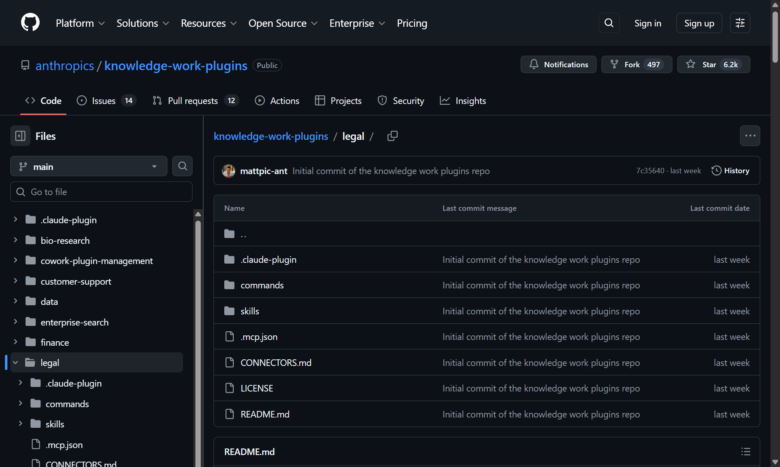
The catalyst? An open-source GitHub repository (essentially, a public folder of code and instructions anyone can view) containing text files with AI prompts.
This is the second time in roughly a year that the market nuked hundreds of billions in value based on a surface-level reading of a technical release, amplified by journalists who couldn’t be bothered to look through the actual code.
Why the SaaS Stocks Sold Off Hard
The Anthropic “legal plugin” that triggered a $285 billion rout on February 3 was a GitHub repo containing ~2,500 lines of structured prompt instructions across six subdirectories of plain text and markdown files.
No compiled binary, no proprietary legal database, no new model, no API launch.
There is no competitive advantage here that a competent developer couldn’t replicate in an afternoon.
The technology is not “magic.” The repository contained well-crafted, but ultimately straightforward, structured instructions (prompts) for tasks that legal professionals have done for decades.
It is easily replicable. Because the repo was public, the prompts could be copied, modified, and run on other models (like OpenAI or DeepSeek) within a few hours, meaning Anthropic held no defensible technological moat in that specific codebase.
The plugin’s “contract review methodology” is literally:
- Identify contract type.
- Determine which side the user is on.
- Read the full contract.
- Analyze clauses against a playbook
- Then consider it holistically.
It’s essentially a 10-point checklist that every in-house legal team already has pinned to a wall somewhere.
The “real power” comes from MCP (Model Context Protocol) connections that let the AI plug into existing workplace tools like Slack, Box, Egnyte, Atlassian, and Microsoft 365.
In other words, it reads data from other companies’ software!
This was pure market overreaction.
Billions were lost because the market reacted to fear instead of reading the code and understanding what it actually does. 🤦♂️
The DeepSeek Parallel Is Real
The pattern is nearly identical to the DeepSeek panic of January 27, 2025, which erased $750 billion+ from the S&P 500 and $590 billion from Nvidia alone in a single session.
In that case:
- The market misread a $5.6M final training cost (an operating expense for GPU. compute) and compared it to tens of billions in capex (datacenters, hardware, R&D), an apples-to-oranges comparison that showed basic financial illiteracy.
- The capabilities of DeepSeek V3/R1 had been publicly known for a month before the panic
- The selloff fully recovered within weeks as the market realized cheaper inference is actually bullish for AI adoption.
With the Anthropic legal plugin:
- The plugins were released on January 30, and the market didn’t react until February 3. This means it took the weekend news cycle and Bloomberg/Guardian headlines to spark the panic, not the actual technical release.
- Anyone could have read the GitHub repo in 10 minutes and seen it was prompt engineering, not a product launch.
- Anthropic itself published the code as open source specifically because the prompts aren’t the moat.
The Nuanced Reality
The acute selloff was irrational.
The market sold first and did actual research later, again. Bloomberg’s own newsletter title captured it: “Anthropic’s New AI Legal Tool Triggered a Selloff Without Evidence“.
JP Morgan’s Mark Murphy called it an “illogical leap to extrapolate Claude Cowork Plugins to an expectation that every company will write bespoke products to replace every layer of mission-critical enterprise software”.
Multiple analysts flagged that the plugin requires technical setup, enterprise licensing, and lacks the proprietary legal databases (Westlaw, LexisNexis case law) that are the actual moats of incumbents.
But the directional signal is real, even if the magnitude was absurd.
The reason this set of Markdown files could trigger the biggest single-day wipeout in legal tech history is that it crystallized a fear that had been building for a year:
Foundation model companies are moving from neutral infrastructure providers to application-layer competitors.
Anthropic isn’t just selling Claude as an API to legal tech vendors anymore. It’s a packaging model + workflow + connectors directly to end users, and doing it open source.
That’s a legitimate threat to the “AI wrapper” business model, even if this specific plugin is rudimentary.
The deeper concern for software companies isn’t this plugin. It’s what this plugin signals about the trajectory.
When the “business logic” of contract review can be expressed in a few text files and executed by a general-purpose model, the value proposition of a $15-20K/year per-seat legal software license comes under genuine pressure over time.
The fact that OpenAI launched its Frontier enterprise agent platform the same week reinforced the narrative that all foundation model companies are heading in this direction simultaneously.
The Takeaway
The pattern is now well-established: financial media rushed for time or lacking technical expertise publishes a breathless headline, algos and retail panic, and the actual technical substance (in this case, freely auditable on GitHub) goes unread by the people managing billions in capital.
If fund managers won’t spend 10 minutes reading a public GitHub repository before dumping billions in market cap, it raises questions about how technical diligence gets done in fast-moving markets.
The trade setup here mirrors the DeepSeek playbook: these acute selloffs in incumbent software names are likely buying opportunities in the near term.
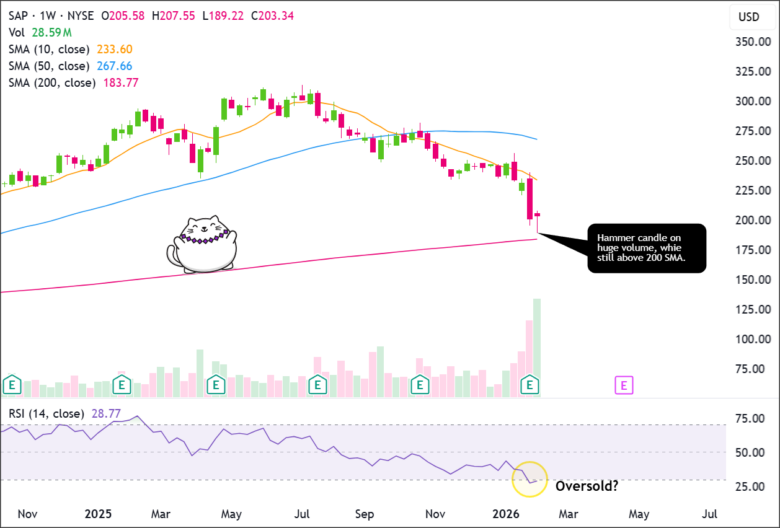
For example, take a look at SAP (SAP SE):
SAP’s ERP systems are so deeply embedded in enterprise operations that the data, workflows, and dependencies they contain cannot realistically be displaced by AI.
An ERP (Enterprise Resource Planning) is a single, central software system that acts like an “all-in-one” brain for a company, connecting everything from accounting and human resources to sales and inventory so that every department can share the same up-to-date information instantly
Decades of customized business logic and institutional knowledge are locked within SAP implementations.
Do these factors below look like AI will kill this company anytime soon?
- Multi-year switching costs: Average SAP implementation takes 2-5 years! Enterprises cannot simply “prompt” their way to a new ERP.
- Joule AI integration: SAP is embedding AI into its platform as a copilot, not competing against external AI.
- Critical business processes: Finance, supply chain, and HR workflows cannot tolerate AI hallucinations or errors that impact compliance.
- Customer lock-in: Most SAP customers remain on older versions (ECC) despite pressure to migrate, demonstrating reluctance to change even within SAP’s ecosystem.
That said, the long-term structural pressure from foundation models (from Anthropic, Google, OpenAI, DeepSeek, Alibaba, Moonshot AI, Zhipu, and MiniMax, etc.) moving up the stack is REAL and should get you thinking about the long-term outlook for traditional SaaS companies and the durability of their business models.
The market’s panic is overblown, but the threat to traditional software margins is real.
But not all SaaS companies are created equal.
While the market sold off indiscriminately, some enterprise software companies have genuine moats that AI can’t easily replicate, that go far beyond what a foundation model can threaten.
In my premium analysis, I’ve identified the AI-resistant SaaS stocks most likely to lead the recovery once the market realizes these businesses aren’t going anywhere.
If history repeats, the bounce will be sharp, and these names will likely move first.
👉 Subscribe now and become a Premium member to access the full breakdown before the rebound.
For roughly the cost of a large pizza, you can join Premium and get the full analysis. Instead of loading up on carbs, this might be a better moment to load up on these stocks.