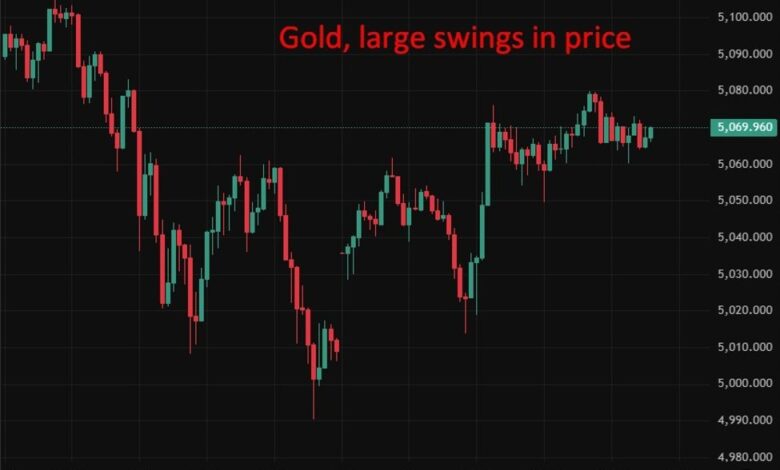
investingLive Asia-Pacific FX news wrap: Wild gold and silver price swings continue

2026-01-27 03:38:00
Summary:
-
Trump revives Asia-Pacific trade tensions by lifting tariffs on South Korean goods to 25%, before Seoul signals fast-tracked legislative action
-
Japan service-sector inflation remains firm, reinforcing wage-driven price pressure
-
UK shop price inflation jumps to a two-year high, challenging “inflation has peaked” narratives
-
Australian business conditions improve but capacity constraints remain elevated
-
China’s industrial profits return to growth, though gains are uneven and driven by foreign firms
-
Geopolitical risk lingers as reports suggest Iran’s leadership is under growing internal strain
US President Donald Trump said he will raise tariffs on South Korean goods to 25% from 15%, citing Seoul’s failure to ratify a 2025 trade deal. The move targets autos, lumber and pharmaceuticals, reviving Asia-Pacific trade tensions. Korean export-linked stocks weakened, with Hyundai Motor shares initially down around 4%.
In a later update, a South Korean ruling party official said legislation to enact US investment commitments has now been introduced and will soon be reviewed. Seoul’s trade envoy is also expected to visit Washington shortly to meet the USTR, suggesting efforts are under way to prevent further escalation.
In Japan, services inflation signals remained firm. The Bank of Japan said the services producer price index rose 2.6% y/y in December, underscoring ongoing cost pass-through driven by labour shortages. The data reinforces the BoJ’s view that wage-driven inflation pressures remain entrenched.
UK inflation pressures also resurfaced at the retail level. Shop price inflation rose to 1.5% y/y in January, its fastest pace since early 2024, according to the British Retail Consortium. The BRC said higher energy costs and increased employer National Insurance contributions continue to feed through, challenging claims that inflation has peaked.
In Australia, business activity improved in December, with the National Australia Bank survey showing business conditions rising two points to +9 and confidence edging up to +3. Sales and profits strengthened, while employment remained around acceptable levels but well below prior highs. Capacity utilisation eased only marginally to an elevated 83.2%, suggesting limited spare capacity. Wage, cost and price indicators rose slightly, though final prices remained relatively subdued compared with CPI, and retail price growth slowed to its weakest pace since 2020.
China’s industrial sector showed tentative stabilisation. Industrial profits rose 5.3% y/y in December, rebounding from November’s 13% slump and delivering the first full-year gain since 2021, albeit a modest 0.6%. The improvement was driven entirely by foreign firms, which posted a 4.2% profit rise in 2025. State-owned enterprises saw profits fall 3.9%, while private-sector profits were flat year-on-year.
On geopolitics, the The New York Times reported that President Trump has received multiple intelligence assessments suggesting Iran’s leadership is under increasing strain, potentially at its weakest point since the 1979 Islamic Revolution. The report cited several people familiar with the intelligence.
Major FX rates, even yen, traded in limited ranges.
Asia-Pac
stocks:
- Japan
(Nikkei 225) +0.4% - Hong
Kong (Hang Seng) +1.2% - Shanghai
Composite -0.01% - Australia
(S&P/ASX 200) +0.82%