






Gold just did what safe havens are supposed to do: it went vertical.
On Jan. 26, bullion surged past the psychological $5,000 barrier and briefly topped $5,100 an ounce as investors stampeded toward insurance. This move extends a historic run that saw the precious metal rise 64% in 2025, marking the metal’s biggest annual gain since 1979.
The increase shows that investors are moving aggressively against a trifecta of modern anxieties: increasing geopolitics, policy unpredictability, and an eroding sense of fiscal and institutional steadiness.
Bitcoin, meanwhile, is still wearing the “digital gold” label without getting paid like one. The largest cryptocurrency is trading around $87,950 today, down by around 2% year-to-date.
This divergence we are seeing today is not a failure of the asset class. Instead, it is simply a reflection of its current maturity. Gold has had thousands of years to build its resume as a store of value. Bitcoin has had less than two decades.
So, this is asking a lot for a teenage asset to behave with the same gravitas as a millennia-old metal during a genuine global crisis.
However, the market is watching closely. Every time gold spikes and Bitcoin falls, the correlation data gets updated. And right now, the data says the two assets are not yet speaking the same language.
The weight behind the gold rally
Gold’s rally is a flow story with deep “institutional inertia” behind it.
Market observers frame the current price action as a classic safe-haven response to geopolitical tensions and fiscal uncertainty.
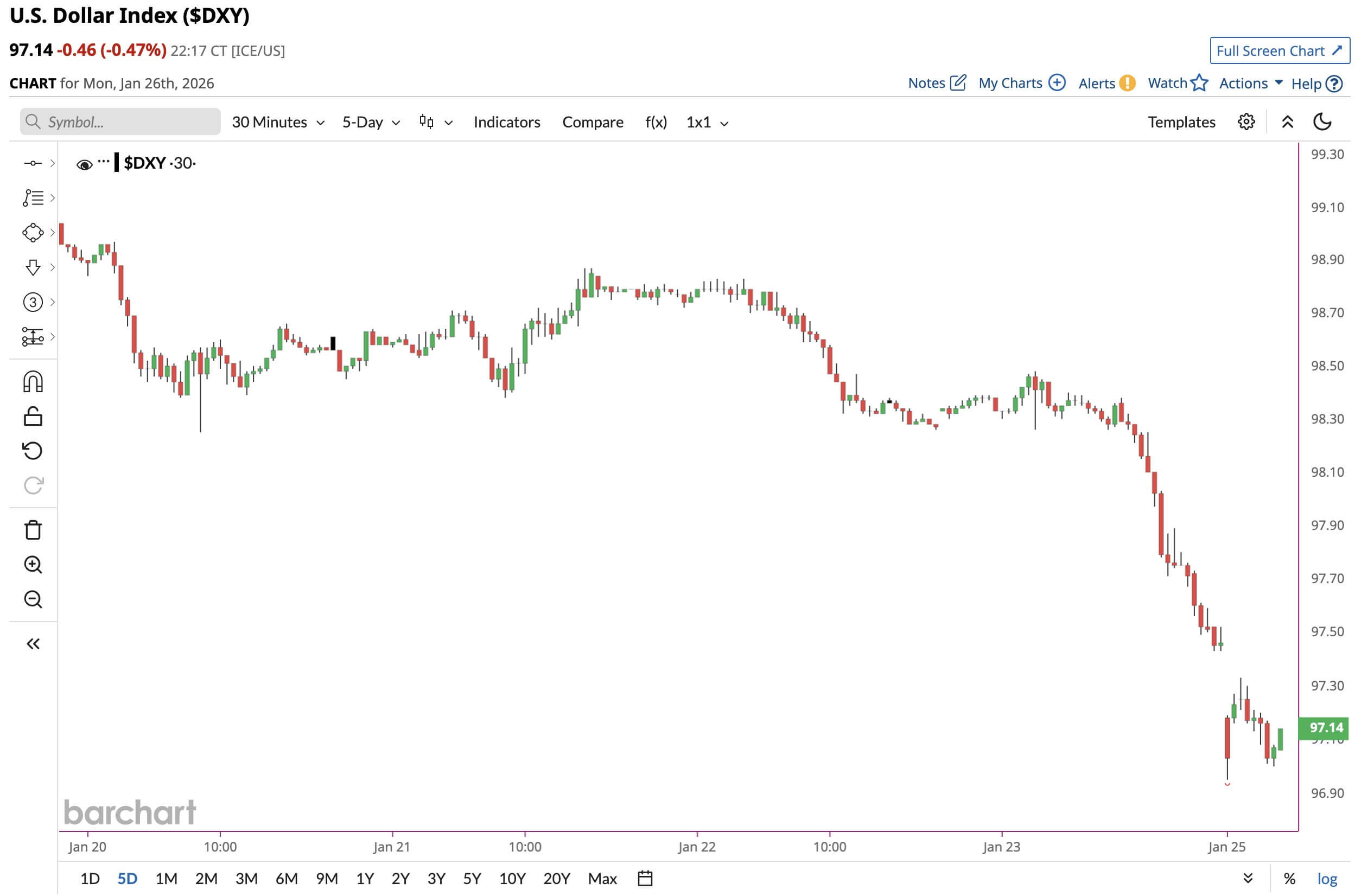
This can be linked to the weakening dollar and to central banks’ increased diversification away from the US, which helps keep the bid persistent rather than event-driven.
Crucial details reinforce the forward-looking framing: this is not only a retail panic. The rally is reinforced by ongoing central bank buying and substantial inflows into gold-backed ETFs.
Analysts are now floating scenarios in which the metal crosses $6,000 in 2026, with upside forecasts reaching as high as $7,150 if uncertainty remains elevated.
JPMorgan’s own model has been explicit about this structural tailwind. The bank expects gold to average approximately $5,055 an ounce by the fourth quarter of 2026.
This projection assumes investor demand and central-bank buying will hold around 566 tonnes per quarter in 2026.
Furthermore, JPMorgan has reiterated a $ 6,000-per-ounce target by 2028 as a longer-term objective.
The bottom line is clear. Gold is behaving like a neutral reserve asset amid credibility stress.
The buyer base, which includes central banks, traditional allocators, and ETFs, already knows how to size it in a crisis. This is a mature market reacting efficiently to stress signals.
Market plumbing gates Bitcoin’s haven status
Bitcoin’s haven narrative overlaps significantly with gold on paper. It offers scarcity, non-sovereign money status, and a theoretical hedge against debasement.
However, the transmission mechanisms for both assets differ significantly.
The divergence is most visible in the ETFs’ flow data.
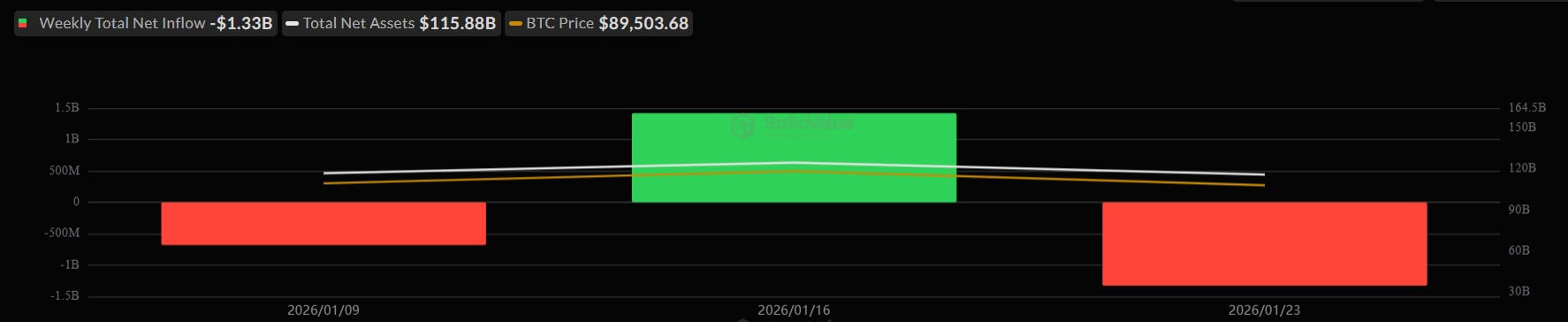
Data from SoSo Value shows that the 12 US spot BTC ETFs kicked off 2026 with roughly $1.2 billion in net inflows across the first two trading days, a volume that suggests institutions will deploy capital into BTC when the macro backdrop feels constructive.
But the subsequent activity was the opposite of “safe haven” behavior. The spot BTC ETFs posted $1.33 billion in net outflows for the week ended Jan. 23, their worst week since February 2025.
This outflow represents a classic de-risking behavior. It shows capital leaving as uncertainty rises, which is exactly the pattern gold is currently replacing.
Then there is the matter of derivatives positioning. Data from Deribits also showed that BTC markets flipped from early-year call interest back to defensive hedging. Specifically, 7-day smiles priced a premium of roughly 2.8% toward out-of-the-money puts.
This is a quantitative shorthand for the fact that traders want protection. True havens do not require investors to pay up for downside convexity every time headlines flare.
So why the difference? Because in times of stress, BTC still functions like a liquidity release valve. It trades 24/7, is easy to sell, and is often used to raise cash quickly. Gold, by contrast, is where cash hides.
How Bitcoin can flip gold
If the market is eventually going to reward “digital gold” with gold-like behavior, a few measurable shifts need to appear. These shifts ideally should occur during the next risk-off impulse, not after it has passed.
First, ETFs must turn counter-cyclical. The haven version of BTC is one where ETF flows increase during equity drawdowns and macro fear weeks. This would be a marked change from the current dynamic of swinging from early-year inflows to major weekly outflows.
Second, the options market skew must normalize. A persistent put premium (like the 2.8% near-term tilt seen recently) signals the market still expects BTC to amplify volatility rather than absorb it. A haven regime looks like a flatter skew and significantly less demand for crash insurance.
Third, volatility needs to compress structurally rather than temporarily. Gold can rally because it is “boring.” Bitcoin cannot credibly serve as the internet’s reserve asset if it still behaves like a levered macro trade whenever policy risk spikes.
Fourth, the buyer mix must broaden beyond opportunistic risk capital. Gold’s marginal buyer today includes reserve managers and long-duration allocators. BTC’s marginal buyers are still heavily influenced by ETF momentum and derivatives positioning, which can reverse quickly.
What next for Bitcoin and gold?
Looking ahead, we can identify three distinct scenarios for how this relationship between Bitcoin and gold evolves.
- Scenario A: “Gold keeps the crown; BTC stays a liquidity proxy.”
If geopolitical tension and fiscal credibility concerns persist, gold remains the first-choice hedge. BTC may grind higher on its own adoption cycle, but it won’t reliably rally on fear days. This scenario is consistent with today’s divergent flows and defensive options pricing.
- Scenario B: “Policy easing lifts BTC, without making it a haven.”
If growth slows and markets begin pricing easier financial conditions, BTC can outperform as liquidity improves and ETF demand returns. However, the driver here is still risk appetite, not capital preservation. Think of this as a “high-beta rebound” rather than a “storm shelter.”
- Scenario C: “Credibility shock plus regulatory maturity equals partial haven bid.”
The most interesting forward case is where gold’s credibility story intensifies, and BTC’s market structure matures enough that large allocators treat it as insurance rather than a trade.
Notably, Standard Chartered cut its 2026 BTC forecast from $300,000 to $150,000. The bank cited slower institutional buying through ETFs as the reason. This implies the path to “digital gold” runs through steadier institutional demand, not just narrative strength.
For now, gold is being bought as protection against institutions. Bitcoin is still being priced as a bet on them.
The moment those roles invert, when BTC attracts steady inflows because headlines are ugly and options stop charging a premium for survival, that is when “digital gold” starts tracking the real thing.