
Bitcoin regret is coming for anyone ignoring Coinbase CEO’s 5% rule as banks fight to cap gains







Coinbase CEO Brian Armstrong told Bloomberg at Davos that investors who don’t have at least 5% of their net worth in Bitcoin will “probably be pretty sad” by 2030.
Recently, Morgan Stanley’s wealth management division published portfolio guidelines capping crypto exposure at 4% maximum for even its most aggressive growth models. Both used “5%” as their anchor. Neither meant the same thing.
The post-ETF era didn’t just mainstream Bitcoin ownership, it turned position sizing into the new battleground. Financial advisors, wealth managers, and compliance officers now treat roughly 5% as a responsible ceiling for a volatile satellite holding.
Meanwhile, crypto executives are trying to reframe that same number as a minimum effective dose. The collision isn’t about whether to own Bitcoin. It’s about whether 5% means “cap your risk” or “don’t miss out.”
Sub-5% as risk budget
Multiple mainstream wealth platforms converged on allocation bands clustered under 5% over the past year, driven not by ideology but by portfolio math.
Fidelity Institutional’s advisor-facing research suggests allocations of 2% to 5%, extending to 7.5% for younger investors under optimistic adoption scenarios. The framing centers on downside containment, as Bitcoin’s structural volatility demands position sizing that won’t blow up a portfolio during drawdowns.
Morgan Stanley Wealth Management’s October 2025 report gets more granular. It recommends maximum crypto allocations by model: 0% for conservation and income portfolios, 2% for balanced growth, 3% for market growth, and 4% for opportunistic growth.
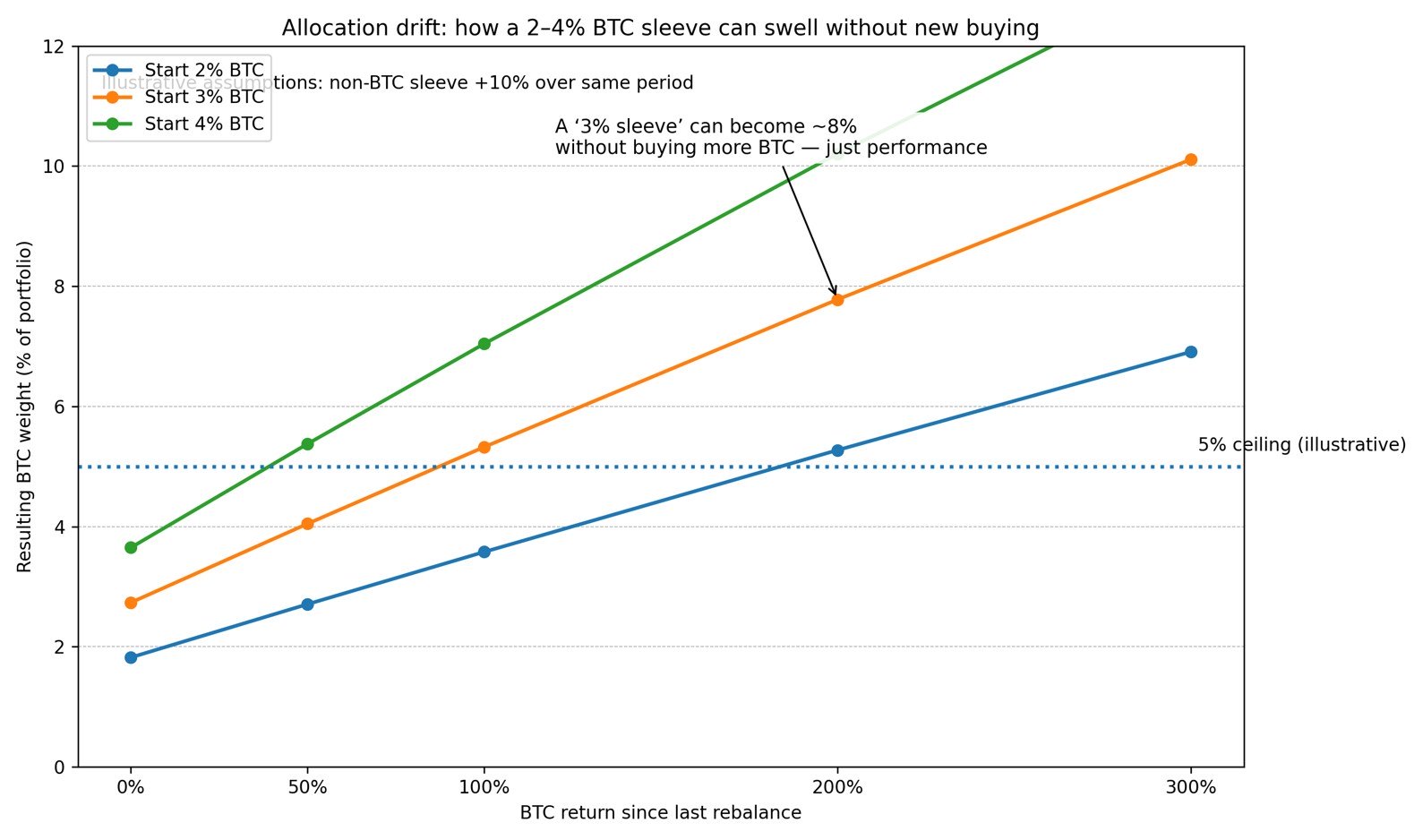
The rationale is explicit risk management, with roughly 55% annualized volatility and potential 70% maximum drawdowns at the 95th percentile. The firm emphasizes quarterly rebalancing to prevent positions from “swelling” silently as Bitcoin rallies, turning a controlled 3% sleeve into an accidental 8% overweight.
Bank of America’s chief investment officer said in December 2025 that a modest allocation of 1% to 4% in digital assets “could be appropriate” for investors comfortable with elevated volatility.
BlackRock recommended up to 2% in late 2024, warning that above that threshold “Bitcoin’s share of total portfolio risk becomes outsized,” a textbook risk-budget argument. The common thread: Bitcoin gets a seat at the table, but only as much as volatility math permits.
The Bitwise and VettaFi 2026 Benchmark Survey, fielded from October through December 2025, shows how this plays out in practice.
Among client portfolios with crypto exposure, 83% are allocated to less than 5%. The modal band sits at 2% to 4.99%, capturing 47% of advisors.
The industry didn’t coordinate on this range through central planning. It emerged from parallel risk calculations across wealth platforms, aimed at defending Bitcoin positions, to compliance committees and nervous clients after drawdowns.
When 5% becomes 20%
Armstrong’s exact phrasing matters. He didn’t say “5% of your portfolio.” He said, “5% of their net worth.” For many households, those denominators tell wildly different stories.
The Federal Reserve’s Survey of Consumer Finances documents that the balance sheet of families in the middle of the net worth distribution is “dominated by housing,” meaning net worth includes large illiquid buckets that never touch brokerage accounts.
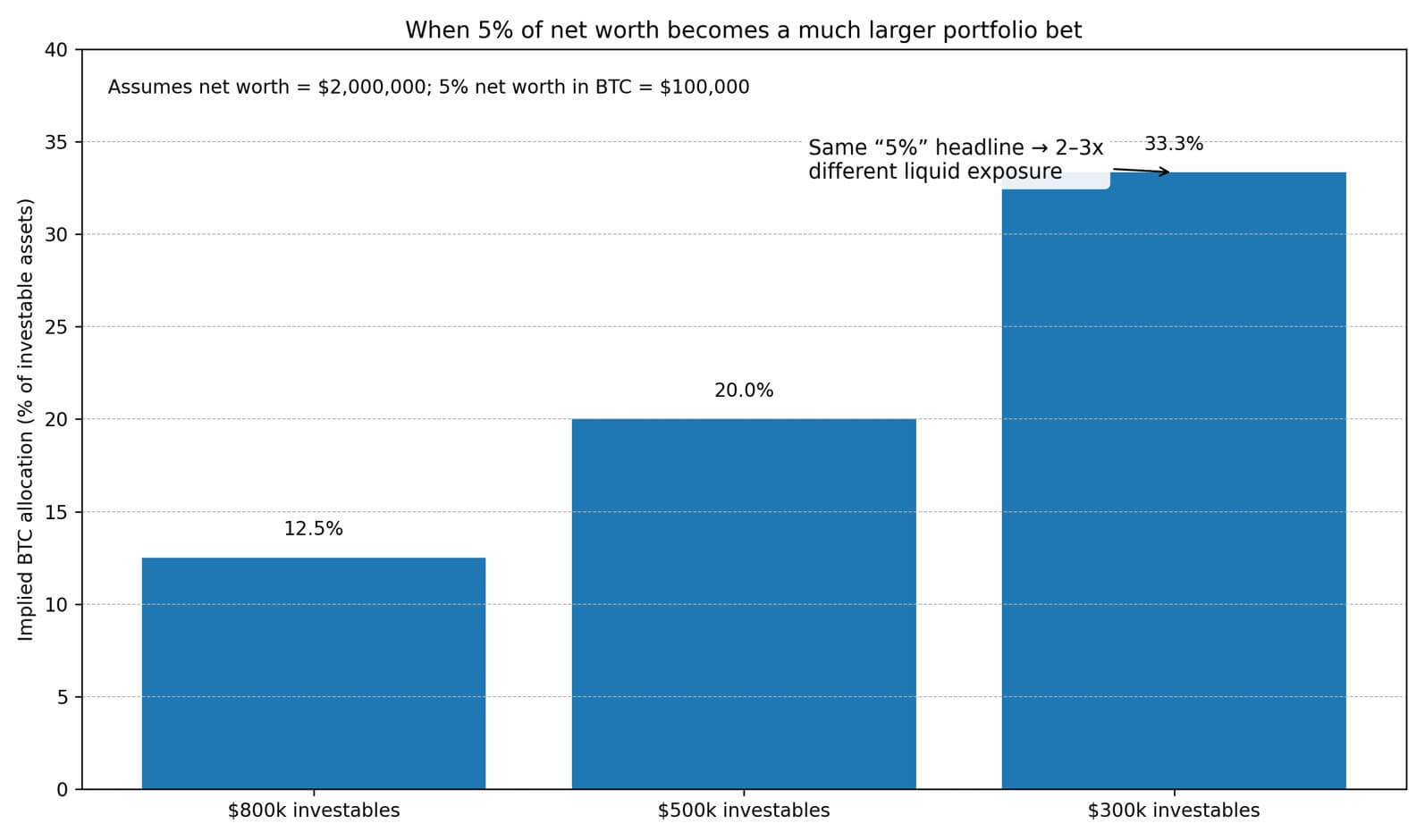
Consider illustrative math for a household with $2 million in net worth. If investable assets total $800,000, then 5% of net worth equals $100,000, which translates to 12.5% of the liquid portfolio.
If investables are $500,000, then the same $100,000 is 20% of the portfolio. At $300,000 in investables, it’s 33%. The “quiet implication” of framing Bitcoin as a net worth floor is that it can easily translate into double-digit liquid exposure, far beyond the caps wealth managers are building into their models.
This isn’t a technicality. It’s the difference between “responsible satellite allocation” and “concentrated bet.” Advisors constrained by suitability reviews and model portfolio guardrails can’t casually recommend liquid Bitcoin positions of 15% to 25%.
However, that’s precisely where “5% of net worth” lands for households whose wealth is tied up in real estate, retirement accounts with limited crypto access, or business equity.
Why the messaging diverged now
The 5% debate didn’t heat up randomly. It emerged because the market structure shifted and the industry moved from “should I?” to “how much?”
Spot Bitcoin ETF approvals in early 2024 opened access for registered investment advisors and clients who couldn’t or wouldn’t touch crypto through exchanges or custody solutions.
Fidelity explicitly frames the 2024 products as unlocking advisor-client conversations that compliance risk previously shut down. Bank of America’s move to have advisors switch from execution-only to recommendation status marks a regime change.
Bitcoin went from “we’ll let you buy it” to “here’s how much we think makes sense.”
Institutions build risk budgets, not narratives. Morgan Stanley’s emphasis on volatility simulations, drawdown scenarios, and rebalancing schedules reflects career-risk management.
The pain for a wealth advisor isn’t being wrong about Bitcoin. It’s being wrong loudly: allocating 10% to a client portfolio, watching it crash 60%, and trying to explain to compliance why the position exceeded model guidelines.
Caps and rebalancing rules are defensive scaffolding that let advisors participate without getting blamed if things go sideways.
Meanwhile, executives are selling inevitability. Armstrong’s Davos framing is a regret-minimization pitch, not a risk-budget pitch. The subtext: Bitcoin’s upside is so asymmetric that the risk of owning too little outweighs the risk of owning too much.
That gap widens when institutions finally open the pipes, because the narrative can claim, “The last excuse is gone.” If Fidelity, Morgan Stanley, and BlackRock all offer Bitcoin access, then “I couldn’t access it” ceases to be a defense for zero exposure.
Armstrong’s $1 million by 2030 projection illustrates the math behind aggressive sizing.
Bitcoin traded around $89,346.09 as of press time. Reaching $1 million by the end of 2030 implies roughly 63% compound annual growth from here, an 11.2x total return. High upside scenarios mathematically require accepting high variance, which is exactly why chief investment officers talk in caps and rebalancing rules.
The gap between 2% ceilings and 5% net worth floors is a gap between institutions managing downside and individuals chasing upside.
Caps, rebalancing, and the new gatekeepers
As banks and platforms legitimize access through recommended ETF sleeves rather than execution-only workarounds, policy shifts from permissioning to prudence.
Morgan Stanley’s October report is essentially a blueprint for where “responsible Bitcoin” discourse is heading: volatility-adjusted position limits, model-portfolio integration with explicit caps, and mandatory rebalancing to prevent silent overconcentration.
The firm treats crypto like any other high-vol satellite, such as emerging markets equities, commodities, and alternatives, where the default assumption is that unmanaged positions will drift into risk-budget violations.
The industry is converging on a sub-5% portfolio norm at the exact moment executives are trying to raise the minimum to 5%. That tension defines the post-ETF era.
Distribution is mainstreaming, so the argument moved from ownership to sizing.
Advisors can finally add Bitcoin to client portfolios without triggering compliance red flags, but they’re doing so with guardrails that crypto maximalists consider cowardly.
The denominator problem makes the collision messier. When an executive says “5% of net worth” and an advisor hears “5% of portfolio,” they’re describing positions that can differ by a factor of two or three for typical households.
The advisor is thinking about risk contribution and drawdown scenarios. The executive is thinking upside capture and regret avoidance. Both are using the same number. Neither is wrong. But they’re solving for completely different objectives.
The outcome isn’t that one side wins. It’s that “5%” becomes a Rorschach test, a point of coordination that means whatever the speaker needs it to mean.
For wealth managers building model portfolios, it’s a ceiling that keeps crypto exposure from dominating total risk. For crypto advocates pitching inevitability, it’s a floor that separates the prepared from the regretful.
The meme works because it’s vague enough to let both sides claim victory while talking past each other.