







Bitcoin price surrendered the psychological $90,000 stronghold during early Asian trading hours on Jan. 21, marking a decisive breakdown that has effectively erased the asset’s gains for the start of 2026.
According to CryptoSlate’s data, the world’s largest digital asset plummeted to a session low of $87,282 over the last 24 hours.
This downturn was not an isolated event but part of a broader, market-wide sell-off that inflicted heavy damage across the digital asset ecosystem. Major alternative cryptocurrencies, including Ethereum, XRP, Cardano, and Solana, all posted significant losses, mirroring the leader’s descent.
Meanwhile, the sharp reversal marks the culmination of a brutal two-day slide that has pushed the emerging industry back toward price levels last observed in late 2025 and shattered the bullish momentum that had characterized the opening weeks of the new year.
Leverage flushes and aggressive selling
While price corrections are standard in crypto markets, the velocity of this decline points to a toxic combination of derivatives liquidations and genuine supply shocks.
The speed of the move was most evident in the futures markets, where “liquidation cascades” (a scenario in which falling prices trigger forced sell orders, which in turn drive prices lower) accelerated the drop.
Data from CoinGlass reveals the extent of the damage. Traders holding long positions (betting on price increases) suffered more than $1.5 billion in losses over the last 48 hours.
This figure represents the capitulation of bulls who had positioned themselves for a breakout above $100,000 only to be caught offside as Bitcoin failed to sustain support near the upper $90,000s.
However, this price decline was not purely a flush of over-leveraged speculation. Unlike “scam wicks” that are quickly bought up, this move was supported by aggressive selling in the spot market, the actual exchange of assets.
CryptoQuant’s “Net Taker Volume,” a critical metric that gauges market aggression by tracking whether traders are buying or selling, printed a negative reading of -$319 million on Jan. 20.
This deeply negative figure indicated that motivated sellers were aggressively bidding to exit their positions, overwhelming the available liquidity.
Notably, this marks the second time the indicator has plunged below minus $300 million in recent days. The prior occurrence was on Jan. 16, when Bitcoin was still trading above $95,000.
Further compounding the bearish outlook is the behavior of “whale” investors.
CryptoQuant’s Whale Screener, which tracks deposits from over 100 active high-net-worth wallets, detected a surge in supply moving onto exchanges.
Whales deposited more than $400 million worth of Bitcoin into spot exchanges on Jan. 20, following a similar $500 million spike on Jan. 15.
Historically, large deposits into spot exchanges have reliably preceded selling pressure, or at least create a wall of ask liquidity that dampens any potential price recovery.
Moreover, the negative market sentiment was confirmed by the performance of spot Bitcoin ETFs over the last two days.
According to SoSo Value data, the 12 funds have seen outflows of nearly $900 million over the last two trading sessions, further exacerbating the current market downtrend.
The macro headwind and “Japanic” phenomenon
Beyond the internal mechanics of the crypto market, a complex and increasingly hostile macroeconomic backdrop is exerting severe downward pressure.
Market headlines have been dominated by a phenomenon analysts are dubbing “Japanic,” a contagion effect originating from the Japanese bond market that is destabilizing global risk assets.
Presto Research argued that the true epicenter of current market stress is Tokyo, not the United States.
According to the firm, a chaotic selloff in Japanese government bonds (JGBs) has spilled over into broader international markets, triggering a “Sell America” trade. In this environment, correlations have converged, leading equities, US Treasuries, the dollar, and Bitcoin to fall in tandem as liquidity is withdrawn from the system.
The catalyst for this volatility was a surprisingly weak auction for 20-year Japanese government bonds. The bid-to-cover ratio (a primary measure of demand) fell to 3.19 at Tuesday’s auction, down significantly from 4.1 previously.
This signals softening demand for Japanese debt at a time when the market is already jittery about Japan’s fiscal health.
The Kobeissi Letter provided further context on this capital flight, noting that Japanese insurers sold $5.2 billion of bonds with maturities of 10 years or more in December.
This marked the largest monthly sale since data collection began in 2004 and the fifth consecutive month of net sales.
As Japanese institutions (historically among the largest foreign holders of global debt) retreat to domestic safety, global liquidity tightens, leaving risk assets like Bitcoin vulnerable.
Analysts at Bitunix highlighted the duality of this moment for digital assets in a statement shared with CryptoSlate.
According to the firm, the sharp dislocation in sovereign bond markets once again highlights the fragility of traditional safe-haven assets. They noted that in the short term, simultaneous pressure on bonds and risk assets may dampen risk appetite in crypto markets.
However, Bitunix analysts also pointed toward a potential long-term pivot inherent in this chaos. Over the medium term, if the politicization of bond markets and monetary intervention become persistent features, this dynamic could reinforce the allocation case for Bitcoin as a non-sovereign asset.
They concluded that over the longer horizon, sustained erosion in global interest rate and currency stability may ultimately lead to a repricing of crypto assets’ strategic weight within portfolio allocation.
This instability has fueled intense speculation regarding the Bank of Japan’s next move ahead of the Feb. 8 snap election.
Presto Research outlines two binary outcomes: a “Liz Truss” moment, referencing the 2022 UK bond market revolt triggered by fiscal mismanagement, or a return to “fiscal dominance,” in which the central bank is forced to print money aggressively to cap yields.
Simultaneously, trade policy friction is adding another layer of uncertainty.
Matrixport notes that Bitcoin’s options market has seen a decisive shift in sentiment, with demand for “puts” (downside protection) outpacing “calls.”
The firm attributes this defensive positioning to President Donald Trump’s renewed threat of tariffs of 10% to 25% on European goods, which has prompted institutional investors to hedge against near-term macro volatility.
What’s next for Bitcoin
Despite the pervasive gloom, not all indicators point to a prolonged bear market.
Glassnode’s weekly analysis characterizes the current setup as a “momentum slip,” a cooling of an overheated market that remains statistically “above neutral.”
However, the technical reality on the charts remains precarious.
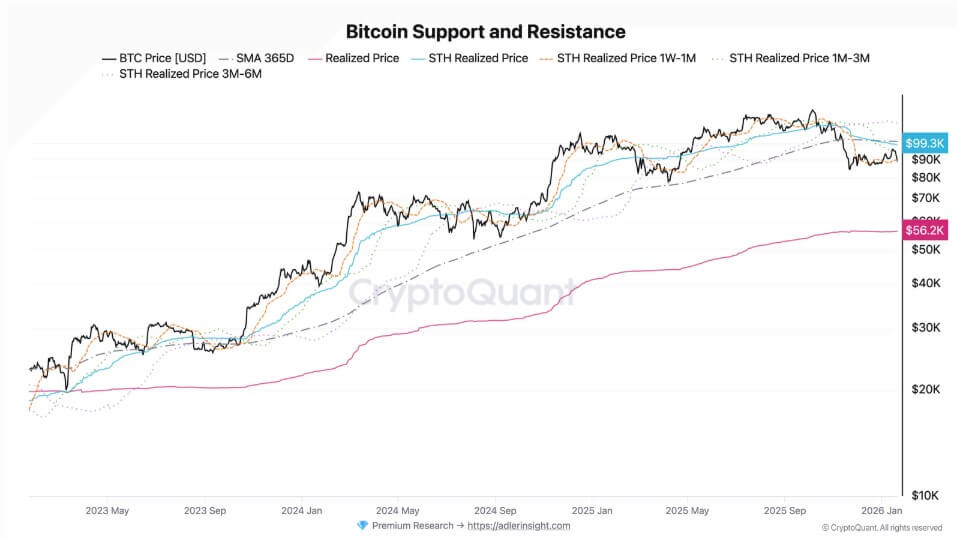
CryptoQuant analyst Axel Adler Jr. has identified the $89,800-$90,000 range as the critical line of defense for bulls.
This price range is significant because it represents the “cost basis” (the average purchase price) for the freshest buyers in the market, specifically the Short-Term Holder cohorts who entered within the last day to the last month.
Adler warns that a sustained breakdown below this band pushes these cohorts underwater simultaneously. When short-term speculators hold unrealized losses, they become highly sensitive to price drops, raising the risk of panic selling that could accelerate the downtrend.
Meanwhile, the path upward is littered with resistance, even if Bitcoin manages to bounce. The 1-month to 3-month holder cohort has a cost basis of roughly $92,500.
Since these traders are currently nursing losses, they are likely to sell into any relief rallies to break even, creating natural sell pressure.
Furthermore, the aggregated realized price for all short-term holders stands at $99,300, essentially forming a formidable ceiling that must be breached to reignite bullish conviction.
For now, Bitcoin remains in a state of delicate balance. It is caught between aggressive liquidation flushes and a hostile macro environment, with the $90,000 level serving as the dividing line between consolidation and a deeper correction.