Discord is suddenly locking down servers for the same alarming reason X just purged these crypto developers



X revised its developer API policies to ban applications that financially reward users for posting, and enforcement has already begun.
Nikita Bier, who joined X’s product team after selling his social app tbh to Meta, framed the move as part of a broader effort to reduce low-quality engagement and told displaced builders that X would help them migrate to Threads or Bluesky if needed.
Additionally, API access was cut off for offending apps, and affected developers were told to change their targets to address spam and AI-generated bot activity.
The timing matters. X faces sustained pressure to demonstrate credibility on safety and transparency, particularly as EU regulators impose fines under the Digital Services Act. Anti-spam enforcement combined with regulatory optics makes pay-to-post an easy target.
This policy shift doesn’t just affect individual apps, but also reprices the entire incentive model underpinning what’s become known as InfoFi, shorthand for information finance. The sector tried to financialize distribution by paying users to post, reply, and amplify content.
That model depended on three stacked layers: measurement systems that rank engagement and mindshare, distribution mechanisms that post or reply at scale, and payout infrastructure that rewards activity with tokens or points.
X’s action hits distribution and payouts directly while degrading measurement if products relied on API ingestion to score, verify, or prevent gaming.
What breaks when the API goes dark
Kaito, which built a product called Yap that rewarded users for posting about crypto projects, held discussions with X and then announced it would sunset the feature.
Kaito founder Yu Hu said that Kaito said Yap wasn’t aligned with the needs of “high-quality brands,” “serious content creators,” or X itself. He described the shift away from what he called a “fully permissionless distribution system” toward a more traditional, tiered marketing approach rebranded as “Kaito Studio.”
Cookie DAO, which ran a similar product called Snaps, also planned to end the feature.
Cookie stated that it was a “tough and abrupt decision” necessary to preserve the integrity of Cookie’s data layer and products.
The InfoFi category as a whole took a hit, sliding 12% in the past 24 hours, according to CoinGecko data. The core lesson is platform risk, quantified. Crypto tried to build tokenized growth loops on top of a Web2 API. X demonstrated that it can eliminate unit economics with a single policy change.
Discord as the second hardening signal
The same security logic that motivated X’s crackdown is also shaping how DeFi projects treat Discord.
Open community spaces are being downgraded into read-only lobbies while support moves to controlled, ticketed channels.
DefiLlama founder 0xngmi stated that “Discord makes it impossible to protect your users from getting scammed […] even if you ban scammers instantly, they still DM users directly.”
DefiLlama is moving toward live support chat and email, a shift corroborated by the project’s own support page.
Morpho took a similar path. Merlin Egalite, co-founder of Morpho, stated that the protocol team has been testing intercom and “it has made support 100x easier.”
The connective tissue between X and Discord is clear: X is shutting down incentive-driven posting at the API layer while Discord is being shut down as an open support surface.
Same problem: once spam and scams scale, open communication channels become attack surfaces rather than community moats.
What replaces the old stack
The migration playbook splits into two parallel tracks: replacing X-dependent distribution and replacing Discord as a primary community hub.
On the distribution side, Kaito’s pivot toward a tiered, scoped, brand-friendly model offers the clearest template. Permissioned creator programs replace open leaderboards.
Participants are vetted, deliverables are defined, and payouts are tied to outcomes rather than raw posting volume. X itself is nudging displaced builders toward Threads and Bluesky, signaling that multi-platform hedging is now table stakes.
Shifting incentives away from “posting” and toward conversion metrics like signups, on-chain activity, or referrals makes reward loops less hostage to any single platform’s API terms.
On the community and support side, Discord isn’t disappearing: it’s being repositioned.
Projects are treating it as an entry point rather than the primary support venue, routing users to ticketed systems that reduce impersonation risk and DM phishing exposure. Morpho and DefiLlama are just early examples.
| Project | Product | What changed | Why stated | Replacement / new posture |
|---|---|---|---|---|
| X (platform) | Developer API policy | Updated API terms to disallow apps that financially reward users for posting; API access already cut off for offending apps. | Reduce “reply spam” and AI-generated bot activity degrading conversations. | X told terminated developers to contact X for help transitioning to Threads or Bluesky. |
| Kaito | Yaps / Yap-to-earn + incentivized leaderboards | Announced it is sunsetting Yaps and the incentivized leaderboard model. | “Fully permissionless distribution” no longer viable / not aligned with “high-quality brands” and “serious content creators” (as described in coverage of the statement). | Pivot to Kaito Studio, described as tier-based / traditional marketing. |
| Cookie DAO | Snaps | Announced it’s time to sunset Snaps (official announcement post). | Called it a “tough and abrupt decision” to preserve the integrity of Cookie’s data layer and products (per coverage). | Implied focus shifts back to data layer/products; no like-for-like replacement announced in the cited reporting. |
| InfoFi category (market) | Category market cap (CoinGecko) | -12.0% market cap change in the last 24h (at time of capture). | N/A (market reaction) | N/A |
| DefiLlama | Discord as a support/community channel | Moving away from Discord for support; redirects users to ticketing + email/live support. | “Discord makes it impossible to protect your users from getting scammed… they still DM users directly.” | Ticketing system (explicitly promoted) + live support chat/email. |
| Morpho | Discord support | Set Discord to read-only (per DL News) and shifted support to help page + Intercom. | Reduce scam/phishing risk; “support 100x easier” with Intercom tooling (per co-founder post). | Help center + Intercom (ticketing/structured support). |
| Optimism | Discord server | Set Discord to read-only (stopping users from posting). | Needs a different approach to support its enterprise strategy; also scam pressure. | “Most interactions occur via private channels” (as quoted). |
Three regimes for InfoFi in 2026
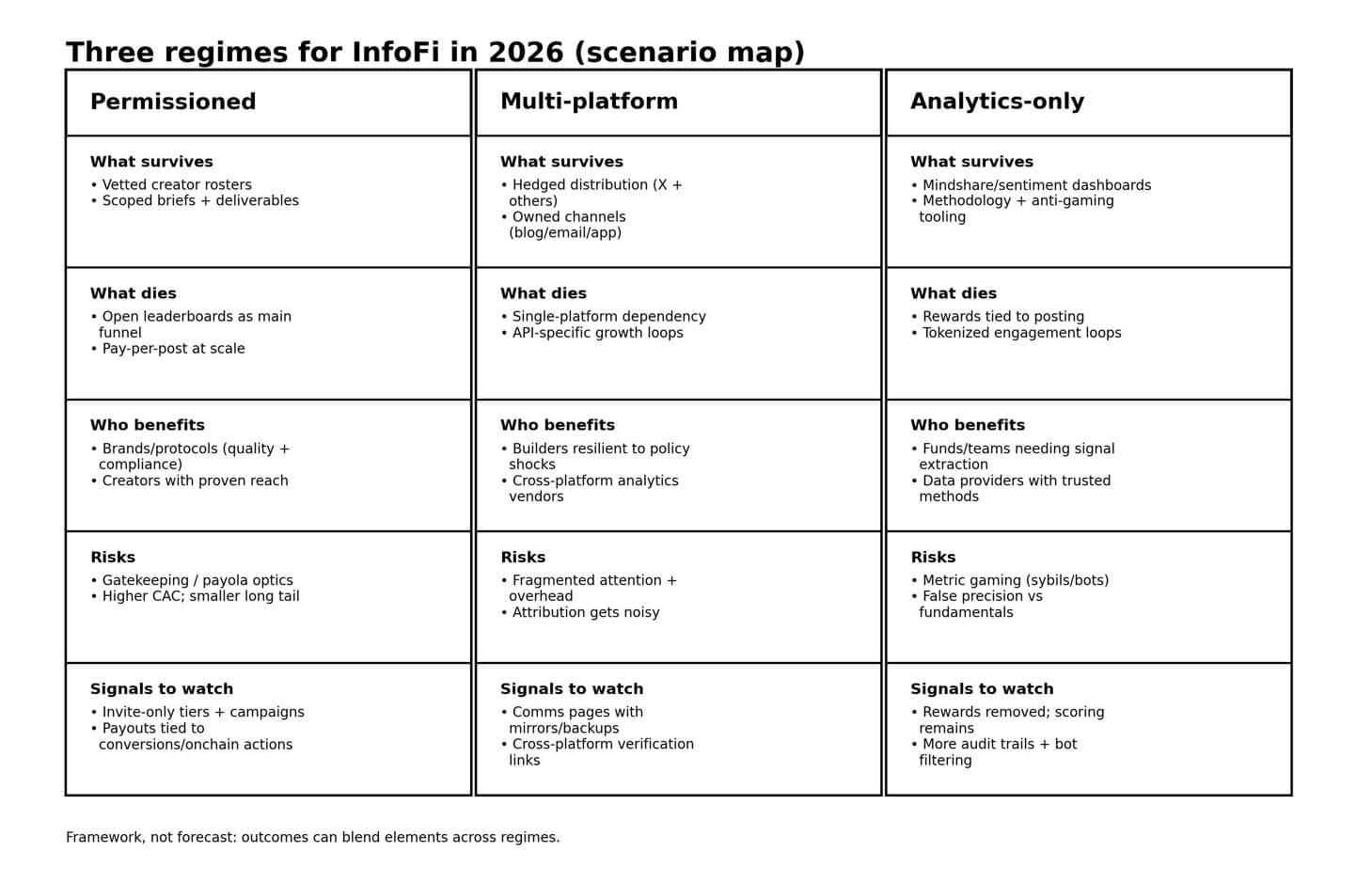
The forward trajectory for InfoFi splits into three plausible regimes.
In the first, permissioned marketing platforms dominate. Rewards move from open leaderboards to curated creator rosters with scoped deliverables.
In the second regime, multi-platform distribution becomes standard. Builders treat X as one channel among several to reduce platform risk, a practice X explicitly endorsed by suggesting that affected developers migrate to Threads and Bluesky.
In the third regime, InfoFi collapses into analytics-only products. The data layer survives, consisting of tracking mindshare, sentiment, and on-chain metrics, but payout mechanics die or move entirely off-platform.
Cookie’s emphasis on preserving “the integrity of the data layer and products” implies that measurement can be decoupled from distribution if necessary.
Discord’s evolution tracks similarly. More read-only conversions and migrations to controlled support stacks are likely, with Morpho serving as the anchor case.
Projects will continue reframing community spaces from “hangout” to “documentation plus verified announcements” as scams scale.
The bigger picture
X removing pay-to-post incentives and DeFi teams demoting Discord are both examples of threat-model-driven channel hardening.
X identified that incentivized engagement leads to spam and bot activity, which degrades platform quality. DeFi projects identified that open Discord channels enable phishing and impersonation at a scale that community moderation can’t contain.
Both responses narrow access, add friction, and shift control from open participation to managed permissions.
This isn’t a story about two unrelated platform changes. It’s crypto infrastructure acknowledging that communication surfaces designed for growth become vulnerabilities when adversarial behavior scales faster than defensive tooling.