Markets diverged on Tuesday as U.S. equities extended their rally to fresh record highs while the dollar strengthened modestly, with traders parsing softer-than-expected European inflation readings and downbeat U.S. services activity data that signaled cooling momentum heading into 2026.
Check out the forex news and economic updates you may have missed in the latest trading session!
Forex News Headlines & Data:
Broad Market Price Action:
Dollar Index, Gold, S&P 500, Oil, U.S. 10-yr Yield, Bitcoin Overlay Chart by TradingView
Tuesday’s session delivered mixed signals across asset classes as investors digested disappointing European inflation data and mixed global services sentiment (including weaker U.S. services activity) while equity markets pushed to new highs on continued artificial intelligence optimism.
U.S. equities extended their powerful start to 2026, with the S&P 500 climbing 0.63% to close around 6,944, marking a fresh record high. The index traded modestly higher through the Asian session and dipped in the early London session before accelerating during U.S. hours, particularly from the late morning through early afternoon. The rally appeared driven by continued enthusiasm for AI-related infrastructure spending, with market participants seemingly unfazed by the softer services PMI data that showed business activity expanding at the slowest pace since April 2025. The advance suggested investors remain focused on the three-year bull market narrative rather than near-term economic headwinds.
Gold posted gains of 0.99%, closing near $4,493, advancing steadily throughout the entire trading session. The precious metal rallied from its Asian open around $4,442 through the London session and continued climbing during U.S. hours, reaching intraday highs around $4,494 before settling slightly lower. The strength likely reflected a combination of safe-haven demand amid geopolitical uncertainties and positioning ahead of this week’s dense economic calendar, including key employment data and central bank commentary. The advance came despite a modestly stronger dollar, suggesting underlying demand for inflation hedges remained robust.
Bitcoin declined 1.77%, trading down to approximately $92,450 by the session close. The cryptocurrency experienced sharp volatility during the U.S. morning session, plunging from the $94,400 area to lows near $91,200 around 8:30 am ET before recovering modestly into the afternoon close. With no direct crypto-specific catalysts to point to, the selloff possibly reflected profit-taking after recent gains or concerns that traditional equities would continue attracting capital flows at crypto’s expense as the AI investment theme persists.
WTI crude oil suffered steep losses, declining 2.07% to settle around $56.76 per barrel, marking the session’s weakest performance among major assets. Oil traded relatively stable through Asian and early London hours around the $58.20 level before experiencing sharp selling pressure during the U.S. session, particularly after 8:30 am ET. The decline appeared to correlate with broader concerns about demand, possibly reflecting the softer U.S. services PMI reading that pointed to cooling economic momentum. The move also came amid ongoing positioning ahead of this week’s inventory data releases.
Treasury yields saw mostly sideways movements all session, eventually pulling back to where it began to close around 4.17%. Yields traded relatively flat through the Asian session before dipping during London hours, likely influenced by the surprisingly soft German CPI data that came in at 1.8% versus 2.2% expected—the biggest miss in recent memory. The bounce in yields during the U.S. session likely reflecting bond pressure, correlating with the softer U.S. services PMI reading, a move that was limited and reversed, possibly a reaction to comments from Richmond Fed President Tom Barkin, who reiterated that rates are now within estimates of neutral and that future changes should be “fine‑tuned,” language that reinforces the idea the hiking cycle is over and the bar for renewed tightening is high.
FX Market Behavior: U.S. Dollar vs. Majors
Overlay of USD vs. Majors Forex Chart by TradingView
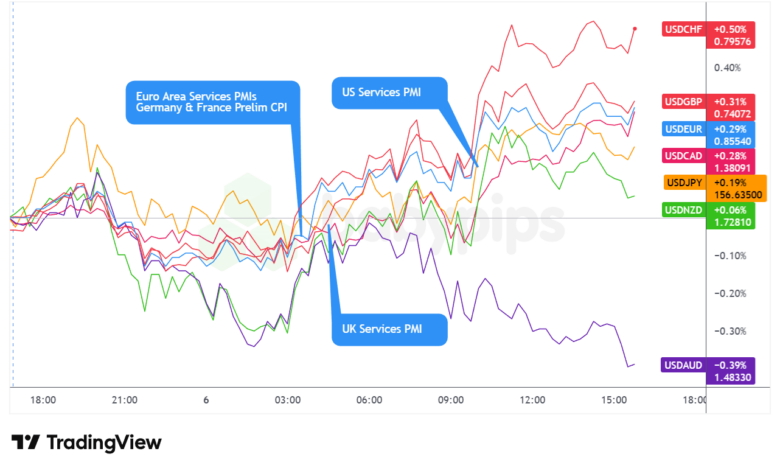
The U.S. dollar traded with a modest bullish lean throughout Tuesday’s session, ultimately emerging as a net gainer against most major currencies despite elevated intraday volatility driven by data releases across multiple regions.
During the Asian session, the dollar traded choppy and mostly bearish against major currencies, with no significant catalysts driving clear directional momentum. The moves appeared to reflect cautious positioning ahead of the day’s heavy data calendar, particularly the German CPI figures and U.S. services PMI scheduled for later in the global trading day.
The London session brought Tuesday’s most significant economic catalyst. German CPI data delivered a substantial downside surprise, printing at 1.8% year-over-year versus expectations of 2.2%—a miss of 40 basis points that marked one of the largest forecast deviations in recent years. The core CPI reading also disappointed, falling to 2.4% from 2.7% previously. French CPI similarly undershot forecasts, coming in at 0.8% year-over-year versus 0.9% expected. The eurozone services PMI readings also declined more than anticipated, with the composite reading falling to 52.4 from 53.6. Despite this wave of softer European data that would typically weaken the euro significantly, the dollar’s reaction was relatively muted, trading with only a slight bullish bias. This restrained dollar strength possibly reflected market positioning that had already anticipated dovish European data, or traders waiting for the U.S. services PMI release before committing to directional bets.
The U.S. session opened with modest dollar strength that persisted through the afternoon. The S&P Global Services PMI Final for December came in at 52.5, missing the 52.9 forecast and down sharply from 54.1 in November, marking the weakest expansion since April 2025. New business inflows rose at the weakest pace in over 18 months while employment volumes stagnated, failing to rise for the first time since February 2025. Despite this clear signal of cooling U.S. services activity, the dollar maintained its modest gains rather than weakening, possibly because traders focused on the relative growth story—with U.S. data still showing expansion while European economies struggled with stagnation.
Fed Richmond President Barkin’s comments during the session characterized the economy as being in a “delicate balance” with symmetric risks to both sides of the dual mandate, noting that interest rates are now “within the range of estimates of neutral.” His measured tone appeared to support the dollar by tempering expectations for aggressive near-term rate cuts.
At Tuesday’s close, the dollar posted net gains against most major currencies, with particularly strong performance against the European region currencies. The dollar’s resilience despite disappointing U.S. services data suggested that relative economic performance—rather than absolute data quality—remained the dominant driver of FX flows, with the U.S. economy still viewed as outperforming its developed market peers.
Upcoming Potential Catalysts on the Economic Calendar
- Australia CPI for November 2025 at 12:30 am GMT
- Australia Building Permits & Private House Approvals Prel for November 2025 at 12:30 am GMT
- Japan S&P Global Services PMI Final for December 2025 at 12:30 am GMT
- Germany Retail Sales for November 2025 at 7:00 am GMT
- France Consumer Confidence for December 2025 at 7:45 am GMT
- Euro area HCOB Construction PMI for December 2025 at 8:30 am GMT
- Germany Unemployment Rate for December 2025 at 8:55 am GMT
- U.K. S&P Global Construction PMI for December 2025 at 9:30 am GMT
- Euro area Inflation Rate Flash for December 2025 at 10:00 am GMT
- U.S. MBA 30-Year Mortgage Rate & Applications for January 2, 2026 at 12:00 pm GMT
- U.S. ADP National Employment Report for December 2025 at 1:15 pm GMT
- Canada Ivey PMI s.a for December 2025 at 3:00 pm GMT
- U.S. Factory Orders for October 2025 at 3:00 pm GMT
- U.S. ISM Services PMI for December 2025 at 3:00 pm GMT
- U.S. JOLTs Job Openings & Quits for November 2025 at 3:00 pm GMT
- U.S. EIA Crude Oil Stocks Change for January 2, 2026 at 3:30 pm GMT
- U.S. Fed Bowman Speech at 9:10 pm GMT
Wednesday’s calendar is heavily weighted toward U.S. labor market data, with the ADP National Employment Report and JOLTs Job Openings both scheduled for the afternoon session. These releases will be closely watched following Fed President Barkin’s Tuesday comments emphasizing the “delicate balance” between labor market cooling and persistent inflation risks.
The ISM Services PMI will provide additional insight into whether Tuesday’s disappointing S&P Global reading signals a genuine slowdown in the dominant services sector or merely reflects temporary weakness.
The eurozone inflation flash estimate could generate volatility in European currency pairs, particularly if the data reinforces Tuesday’s surprisingly soft German CPI reading. Markets remain sensitive to any signals that might shift the trajectory of central bank policy expectations as traders assess whether the disinflation narrative is gaining traction or if persistent price pressures will keep monetary policy restrictive for longer.
Stay frosty out there, forex friends, and don’t forget to check out our Forex Correlation Calculator when planning to take on risk!