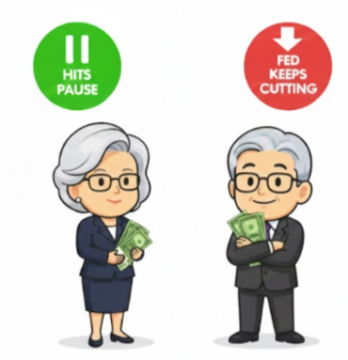
When the European Central Bank held its December meeting, President Christine Lagarde delivered a message that caught some traders off guard: the ECB is in a “good place” and plans to stay there. Meanwhile, across the Atlantic, the Federal Reserve cut interest rates for the third consecutive time and signaled more cuts could be coming in 2026.
This divergence between two of the world’s most powerful central banks isn’t just monetary policy wonkery—it’s likely influencing currency markets and may be creating opportunities (and risks) for forex traders. When the ECB closed out 2025 by holding its deposit facility rate at 2.0% on December 18, 2025, it marked the fourth straight meeting without a rate change. The Fed, on the other hand, cut rates to 3.5%-3.75% just days earlier and hasn’t ruled out more cuts ahead.
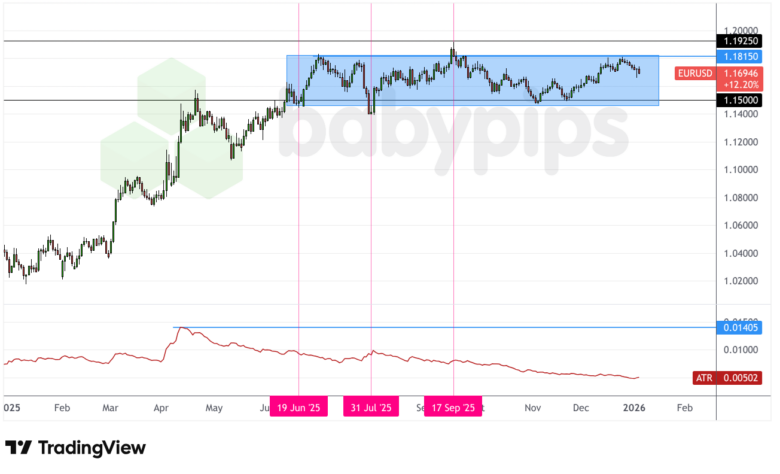
For new traders trying to understand why EUR/USD is hovering near 1.17-1.18 and struggling to break through resistance at 1.1800, this central bank policy divergence is one of the key factors that may be influencing price action.
So… What’s Actually Happening Here?
Let’s break this down in plain English. Central banks use interest rates as their main tool to manage their economies—think of rates as the price of money. When a central bank raises rates, it typically makes borrowing more expensive, which tends to slow down spending and can help cool inflation. When it cuts rates, borrowing generally becomes cheaper, often encouraging spending and investment.
Here’s where it gets interesting: the ECB and the Fed aren’t required to move together. They’re looking at different economies, different inflation situations, and different growth outlooks. Right now, they’re making opposite calls.
The ECB’s stance: After cutting rates earlier in 2025, the ECB has held steady since June. At its December meeting, the central bank kept three key rates unchanged and confirmed that eurozone inflation is expected to average 2.1% in 2025, then drop to 1.9% in 2026 and 1.8% in 2027—right around the ECB’s 2% target. Core inflation (which strips out volatile food and energy prices) stood at 2.4% in November 2025, also holding steady from the previous month.
The Fed’s stance: The Federal Reserve has cut rates three times in 2025, bringing its benchmark rate down from 4.0%-4.25% in September to 3.5%-3.75% by December. According to the Fed’s December “dot plot” (a chart showing where Fed officials think rates should go), the median projection suggests only one more cut in 2026, bringing rates to around 3.25%-3.5% by year-end. But here’s the catch: the Fed remains divided, with some officials wanting to pause and others favoring more aggressive cuts.
The result? A narrowing interest rate differential that appears to be keeping the euro elevated against the dollar.
Why Is the ECB Standing Pat?
The ECB’s decision to hold rates appears to come down to two factors that would make Goldilocks proud: inflation that’s not too hot, and growth that’s not too cold.
Inflation is close to target. Eurozone inflation came in at 2.1% in November 2025, essentially right at the ECB’s 2% target. While services inflation remains sticky at 3.5% (the highest since April 2025), energy prices are falling and food inflation is moderating. The ECB’s staff projections show inflation averaging 1.9% in 2026—slightly below target—which likely gives the central bank confidence that price pressures are under control.
When inflation is near target, central banks typically have less urgency to act. The ECB essentially looked at the data and said, “We’re good here.”
Growth is holding up better than expected. The European economy surprised to the upside in recent months. The ECB revised its growth forecast higher to 1.4% for 2025, up from earlier projections, with domestic demand (consumer spending and business investment) expected to be the main engine going forward. That’s largely attributed to increased infrastructure spending and defense budgets across Europe.
Here’s the important part for traders: when a central bank sees inflation near target and growth that’s stable—not great, but not terrible—they often choose to sit tight rather than risk overshooting in either direction.
President Lagarde emphasized this at her December press conference, noting the ECB is following a “data-dependent and meeting-by-meeting approach” with “no predetermined path.” Translation: they’re comfortable waiting to see what happens next rather than cutting preemptively.
There’s also a technical consideration. The ECB’s deposit facility rate at 2.0% is considered close to “neutral”—the level that neither stimulates nor restricts the economy. Some economists believe the ECB may have already done enough cutting and that further reductions could risk overheating parts of the economy or potentially creating financial imbalances.
What Does This Mean for Currency Markets?
This is where theory meets your trading account.
Interest rate differentials are thought to drive a significant portion of currency movements, especially over the medium term. When one country offers higher interest rates than another, it tends to attract capital flows seeking better returns. This increased demand for the higher-yielding currency often pushes its value up relative to currencies with lower rates.
Right now, even after three rate cuts, the Fed’s benchmark rate of 3.5%-3.75% is still well above the ECB’s 2.0%. But the direction may matter just as much as the absolute level. The Fed is cutting while the ECB is holding, which means that rate differential is narrowing. Money markets currently assign less than a 10% probability that the ECB will cut rates by February 2026, while futures markets are pricing in roughly two more Fed cuts during 2026.
This dynamic appears to have helped push EUR/USD up roughly 13% over the past year, from lows near 1.0200 in early 2025 to current levels around 1.17-1.18. However, the pair has struggled repeatedly to break cleanly above 1.1800, which has become a key psychological resistance level.
Here’s why: EUR/USD isn’t just reacting to rate differentials. The pair also appears to be weighing growth prospects, political uncertainty (hello, tariff threats), and broader risk sentiment. While the narrowing rate gap may support the euro, concerns about Europe’s structural economic challenges and the potential for trade friction likely continue to create headwinds.
The technical picture tells the story: EUR/USD has been locked in a range between roughly 1.15 and 1.18 since mid-2025. Breakouts above 1.1800 have repeatedly failed, suggesting that while the trend may favor euro strength, buyers aren’t confident enough yet to push significantly higher.
The Bottom Line: Key Takeaways
What new traders need to understand:
- Central banks don’t move in lockstep. The ECB and Fed face different economic conditions and can make different policy decisions. This creates divergence, which may directly impact currency pairs like EUR/USD.
- Near-target inflation gives the ECB room to pause. With eurozone inflation at 2.1% and forecasted to stay near the 2% target, the ECB likely doesn’t feel pressure to cut rates further right now. This contrasts sharply with the Fed, which is still working to bring inflation down from elevated levels.
- Rate differentials matter—but direction matters more. Even though U.S. rates remain higher than European rates, the narrowing of that gap (Fed cutting while ECB holds) appears to have been supportive of the euro. But this isn’t a straight line—other factors like growth, trade policy, and market sentiment probably also play major roles.
- Policy divergence may create trading opportunities and risks. When central banks diverge, currency pairs can trend for extended periods. But these trends are rarely smooth, and false breakouts are common when markets get ahead of themselves.
- The 1.1800 level is the line in the sand for EUR/USD. Multiple failed attempts to break above this level suggest strong resistance. A sustained move above 1.1800 could signal renewed euro strength, while a breakdown below 1.1700 might indicate a deeper correction.
- Volatility has declined significantly. EUR/USD daily ATR peaked at 140 pips per day to roughly 50 pips per day now. The markets ain’t moving like they used to; adjust risk and trade management strategies accordingly.
What to Watch Next
If you’re trading EUR/USD or just trying to understand where it’s headed in the medium to longer term, keep your eye on these upcoming events:
From the ECB:
- Next ECB meeting: January 30, 2026. Watch for any shift in Lagarde’s tone. If she drops the “good place” language or expresses concern about growth, markets may price in potential future cuts. If she sounds confident and reiterates that policy is appropriate, the euro could hold its recent gains.
- Eurozone inflation data: The December 2025 flash estimate is due January 7, 2026. Watch whether inflation stays near 2.1% or shows any surprises in either direction.
- Economic growth indicators: Pay attention to German factory orders, industrial production, and business confidence surveys. Germany is the eurozone’s largest economy, and any significant weakness there might pressure the ECB to reconsider its stance.
From the Fed:
- Next Fed meeting: January 28-29, 2026. Markets currently give less than 20% odds of a January rate cut, but the meeting statement and Chair Powell’s press conference will likely be crucial for gauging the Fed’s intentions for the rest of 2026.
- U.S. jobs report: December employment data is due January 10, 2026. Strong job growth or falling unemployment might give the Fed more reason to pause rate cuts, potentially supporting the dollar. Weak data would probably do the opposite.
- Fed Chair succession: President Trump is expected to announce his nominee to replace Jerome Powell (whose term expires May 15, 2026) sometime in January. A more dovish appointee could accelerate rate cut expectations.
Key dates to mark on your calendar:
- January 7: Eurozone December inflation flash estimate
- January 10: U.S. December jobs report
- January 28-29: Fed meeting
- January 30: ECB meeting
For EUR/USD, the simple question to ask yourself with each data release is: does this make the Fed more or less likely to cut rates, and does this make the ECB more or less likely to hold steady? When those answers point in opposite directions, the rate differential may widen (or narrow), and currencies often move accordingly.
Central bank policy divergence isn’t just an abstract concept—it’s likely one of the engines driving major currency trends right now. Understanding why the ECB is holding while the Fed keeps cutting gives you a framework for interpreting economic data and anticipating where EUR/USD might head next.
This article is for educational purposes only. It does not constitute financial advice. Trading involves substantial risk, and past performance is not indicative of future results. Always do your own research and consider consulting with a qualified financial advisor.
This content is strictly for informational purposes only and does not constitute as investment advice. Trading any financial market involves risk. Please read our Risk Disclosure to make sure you understand the risks involved.