

2025-12-19 13:22:00
An interview with Simon Massey, CEO & Co-Founder, Funded Trading Plus
As 2026 approaches, traders and trading firms are operating in a market environment defined less by certainty and more by competing narratives. Artificial intelligence, geopolitical risk, shifting monetary policy, and growing concerns around market concentration have created conditions where volatility feels permanently “on standby”.
To explore what this could mean for retail traders – and how to think about risk in a fast-moving landscape – we sat down with Simon Massey, CEO and Co-Founder of Funded Trading Plus. Simon began trading in 2010 and has spent the past decade-plus around active trading communities and trader education. In recent years, he has also been outspoken about the importance of transparency and fair dealing in the funded trading space, where trust can matter as much as the strategy itself.
“The biggest mistake traders make is anchoring themselves to a single narrative,” Massey says. “In an environment like this, preparation matters far more than prediction.”
The AI Boom: Bubble or Structural Shift?
One of the most persistent questions heading into 2026 is whether the widely discussed AI boom represents a genuine technological transformation – or a fragile bubble driven by concentration risk.
A significant portion of recent US market performance has been carried by a small cluster of large technology firms. These companies are heavily intertwined through capital flows, partnerships, and shared exposure to AI infrastructure. If valuations are being supported more by momentum than by underlying fundamentals, the potential for sharp dislocations increases.
Markets, however, have a long history of remaining irrational longer than participants expect. Even if a bubble exists, timing its unwinding is notoriously difficult.
“The smarter approach isn’t trying to call the top,” Massey explains. “It’s understanding that if sentiment shifts, volatility will arrive quickly and aggressively.”
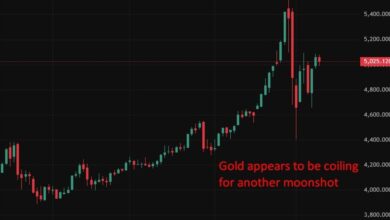
He also points to how different “risk-off” narratives behaved toward the end of 2025. Crypto, for example, traded largely sideways in that period, challenging the assumption that digital assets consistently act as a safe haven during uncertainty. In contrast, gold and other precious metals continued to push toward all-time highs, reinforcing their role as traditional volatility hedges.
The implication for traders isn’t to pick the “correct” narrative – it’s to plan for multiple regimes, including sharp reversals, liquidity gaps, and periods where correlations snap into place.
Manual Decision-Making Still Matters in a Machine-Driven Market
Algorithmic trading already accounts for a substantial share of global market volume, particularly at the institutional level. The race for execution speed – through proximity hosting, fibre-optic optimisation, and infrastructure investment – has been under way for years.
At the retail and funded trader level, however, the reality is more nuanced.
While expert advisors and partially automated systems remain popular, many of the most consistently profitable traders continue to execute manually. The reason is straightforward: retail algorithms cannot realistically compete with institutional infrastructure on ultra-short timeframes.
Instead, successful traders often operate on slightly longer horizons, focusing on market structure, risk management, and patience rather than microsecond execution. As a result, algorithmic trading is unlikely to “replace” discretionary trading in this segment. Through 2026, the balance between the two is likely to remain broadly similar – with the edge increasingly found in process, discipline, and risk controls rather than pure speed.
Overconcentration Is Emerging as a Hidden Risk
Gold has become a dominant instrument in many trading environments, accounting for an outsized share of volume for a wide range of traders. While that reflects genuine opportunity, it also introduces a meaningful behavioural risk.
“When traders focus too heavily on a single market, they start forcing trades that aren’t really there,” says Massey. “Overconcentration breaks discipline long before it breaks performance.”
Looking ahead, Simon expects foreign exchange markets may present renewed opportunity. FX volatility has been relatively muted at points, but underlying tensions – particularly around US dollar policy – suggest this may not persist indefinitely. Political pressure for a weaker dollar can exist at the same time as structural forces pushing in the opposite direction, creating conditions for sharp, directional moves.
“Equity indices remain equally sensitive to macro shocks. We’ve already seen how quickly daily ranges can expand when geopolitical tensions rise or policy expectations shift. If AI-related volatility or broader economic shocks re-emerge, indices may once again offer significant trading opportunity – but also sharper drawdowns for traders who are over-leveraged or under-prepared.”
The key takeaway for 2026 is diversification – not indiscriminate trading, but maintaining a small basket of well-understood markets rather than relying entirely on a single asset.
Flexibility Will Matter More Than Forecasts
Global economic conditions will continue to shape market behaviour. A synchronised global slowdown tends to generate significantly more volatility than isolated regional issues, particularly as correlations between asset classes increase under stress.
There are also wildcard developments that can shift expectations quickly. A potential resolution to major geopolitical conflicts, for example, could remove a persistent drag on parts of the global economy – changing the outlook for risk assets and regional currencies in a way that few traders price in ahead of time.
“The danger for traders is becoming emotionally attached to a view,” Massey notes. “Markets rarely behave according to what ‘should’ happen.”
In practice, that means the most durable edge often looks unglamorous: position sizing that survives surprises, risk limits that are actually respected, and the humility to step aside when market conditions no longer match your playbook.
Trust Will Define the Next Phase of Funded Trading
Beyond the markets themselves, Massey believes trust remains one of the most critical issues facing the funded trading industry.
Despite its rapid growth, the sector still varies widely in standards, transparency, and operational maturity. For traders, that creates a practical question: how do you evaluate whether a firm is likely to behave consistently – especially when conditions get difficult?
Massey points to a few basics that still matter:
-
Clear ownership and accountability (who runs the firm, and are they visible?)
-
A published business address and clear support channels
-
Transparent terms and conditions that are easy to find and understand
-
A track record of communication with the trading community
-
Consistent proof of payouts over time, not just marketing claims
Review platforms and trader communities can provide useful signals too – particularly when recurring themes emerge over a long period, rather than in sudden bursts.
Traders should also be cautious of offers that appear unsustainably generous. Artificially cheap programmes and unrealistic promises can be a red flag for business models that may not be built to last.
“Trust is earned when the rules stay stable and the communication stays clear – especially when the market isn’t,” Massey says.
Consistency Over Hype
In recent years, hundreds of funded trading firms have launched – and many have disappeared just as quickly. Competitive pressure has been intense, and the temptation to win attention through price wars or headline-grabbing claims is strong.
But Massey argues that longevity tends to come from the opposite approach: consistency.
“Stability is underrated,” he says. “If you want traders to take you seriously, the rules can’t feel like they change with the wind. At Funded Trading Plus we’ve had certain trading challenges running since 2021, it’s the simple rules that keeps people coming back”.
For traders, the parallel lesson is familiar: systems that work tend to be repeatable, boring, and resilient. Hype is loud, but process is what compounds.
A Message to Traders for 2026
There will be opportunities in 2026 – almost certainly more than enough. But opportunity alone does not guarantee success.
Traders should avoid over-fixation on any single market, remain adaptable to changing conditions, and resist the urge to force trades when valid setups are absent. Above all, maintaining discipline, realism, and trust – both in one’s strategy and in chosen trading partners – will matter far more than predicting the next headline-driven move.
If you’re tightening your fundamentals for the year ahead, Funded Trading Plus has created a free Forex 101 guide focused on the core skills that matter most in changing market conditions – risk management, discipline, market structure, and avoiding common behavioural traps. The guide is designed to help traders build a process that adapts to volatility rather than chasing predictions. You can access the Forex 101 guide here: https://www.fundedtradingplus.com/propiq-forex-101-download-your-free-traders-guide/
Disclaimer: This article was submitted by an advertiser. The views expressed are those of the author and do not necessarily reflect the views of Finance Magnates.