February’s U.S. inflation figures landed right on the mark — but in a market already consumed by a shooting war in the Middle East, “as expected” barely registered before traders moved on.
The dollar climbed anyway.
Let’s see how it all played out!
Watchlists are price outlook & strategy discussions supported by both fundamental & technical analysis, a crucial step towards creating a high-quality discretionary trade idea before working on a risk & trade management plan.
If you’d like to follow our “Watchlist” picks right when they are published throughout the week, check out our BabyPips Premium subscribe page to learn more!
The Setup
What We Were Watching: U.S. CPI Reports (February 2026)
- Expectation: U.S. headline CPI to rise 0.3% m/m, holding the annual rate at 2.4%; core CPI expected at 0.2% m/m and 2.5% y/y
- Data outcome: Both headline and core came in exactly as forecast — no upside or downside surprise
- Market environment surrounding the event: Broad risk sentiment leaned cautious as traders priced in elevated inflation expectations from the ongoing U.S.-Israel war on Iran and its hawkish implications for the Fed’s rate path.
Event Outcome
The Bureau of Labor Statistics reported that U.S. headline CPI rose 0.3% m/m in February 2026, holding the annual inflation rate steady at 2.4% — both matching consensus forecasts exactly. Core CPI (ex-food and energy) printed 0.2% m/m and 2.5% y/y, also in line with estimates and representing a slight monthly deceleration from January’s 0.3% core reading.
Key Takeaways:
- Headline CPI: +0.3% m/m as expected; +2.4% y/y, unchanged from January
- Core CPI: +0.2% m/m (down from 0.3% in January); +2.5% y/y as expected
- Shelter: Rose 0.2% for the month, the largest single contributor to headline inflation; annual shelter inflation slowed to 3.0%
- Food: Up 0.4% m/m, 3.1% y/y
- Energy: Gained 0.6%, driven by a 0.8% rise in gasoline and an 11.1% surge in fuel oil
- Apparel: Jumped 1.3% — the largest monthly gain since September 2018 — reflecting continued tariff pass-through
- Used vehicles: Fell 0.4% for the third consecutive monthly decline
- Critical caveat: The data predates the U.S.-Israel strikes on Iran on February 28, meaning the energy shock that has since pushed gasoline prices up roughly 20% will not appear until the March report
The dollar was already edging higher ahead of the 8:30 AM ET release as rising oil prices and geopolitical tension kept risk sentiment cautious. The dollar briefly popped on the headline before quickly pulling back, since the in-line data offered no new catalyst.
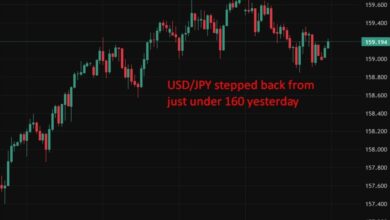
From around 10:30 AM onward, the Greenback resumed its broader climb as Treasury yields pushed higher. By the U.S. close, the dollar had extended gains against most major currencies, with USD/JPY leading the advance while USD/CHF also climbed more than 0.20% on the day.
Fundamental Bias Triggered: With CPI landing right on expectations, the report offered no new catalyst, while the Iran conflict, surging oil, and rising inflation fears kept markets focused on risks ahead rather than February’s backward-looking data. We considered the outcome net neutral and slightly lower weight of influence on USD relative to broad market sentiment.
Promotion: Top-tier catalysts like the U.S. CPI report can trigger emotional execution. TradeZella AI powered journal turns your raw data into a high-performance playbook. Sync your broker, replay your trades bar-by-bar, and use the Playbook Designer to ensure that next time a central bank surprises the market, you’re executing with clinical precision.
Click on the link to learn more and use code “PIPS20” to save 20% off first purchase!
Disclosure: We may earn a commission from our partners if you sign up through our links, at no extra cost to you.
Broad Market and Exogenous Drivers:
Geopolitical Shakeup (Mon–Tues): The week opened in risk-off mode following reports that Israel had struck Iranian oil storage facilities over the weekend, triggering massive fires across Tehran and further tightening the Strait of Hormuz blockade. Iran’s new hardline Supreme Leader — Mojtaba Khamenei, son of the assassinated Ayatollah — signaled Tehran’s intent to fight on, while Trump posted on social media that $100 crude was “a very small price to pay.” Safe-haven demand surged early Monday, only to partially reverse when Trump told CBS the conflict was “very complete, pretty much” — a comment that drained urgency from defensive positioning. Upbeat U.S. existing home sales data helped stabilize sentiment through Tuesday’s session.
CPI and Escalation Reinforce Each Other (Wed): February’s CPI data hit the tape in line with expectations. The initial dollar reaction was brief — a pop followed almost immediately by a pullback as the report offered no new narrative. But from roughly 10:30 AM onward, the Greenback resumed its climb on rising Treasury yields and renewed Strait of Hormuz headlines, with in-line inflation data interpreted as reinforcing the case for the Fed to hold firm. USD/JPY led the advance while USD/CHF and EUR/USD also moved in the dollar’s favor by more than 0.20% on the day.
Dollar Dominance Accelerates (Thurs–Fri): The back half of the week saw the dollar’s weekly thesis crystallize. A stronger-than-expected January trade balance, solid housing starts, and in-line jobless claims delivered a data-driven lift Thursday afternoon. Friday brought the week’s most decisive catalysts: Trump pledged to hit Iran “very hard,” and Iran’s Supreme Leader vowed to keep the Strait effectively shut. A hotter-than-expected core PCE and a downward-revised Q4 GDP reading only deepened the stagflationary narrative — pushing Fed rate cut expectations toward September and reinforcing the dollar as both a safe-haven and a structural beneficiary of elevated energy prices given America’s status as a net energy exporter. The dollar closed the week as the top-performing major currency, its second consecutive weekly advance since the Iran conflict began.
USD/CHF: Bearish USD Event Outcome + Risk-off Scenario = Arguably good odds of a net positive outcome
USD/CHF 1-hour Forex Chart Faster with TradingView
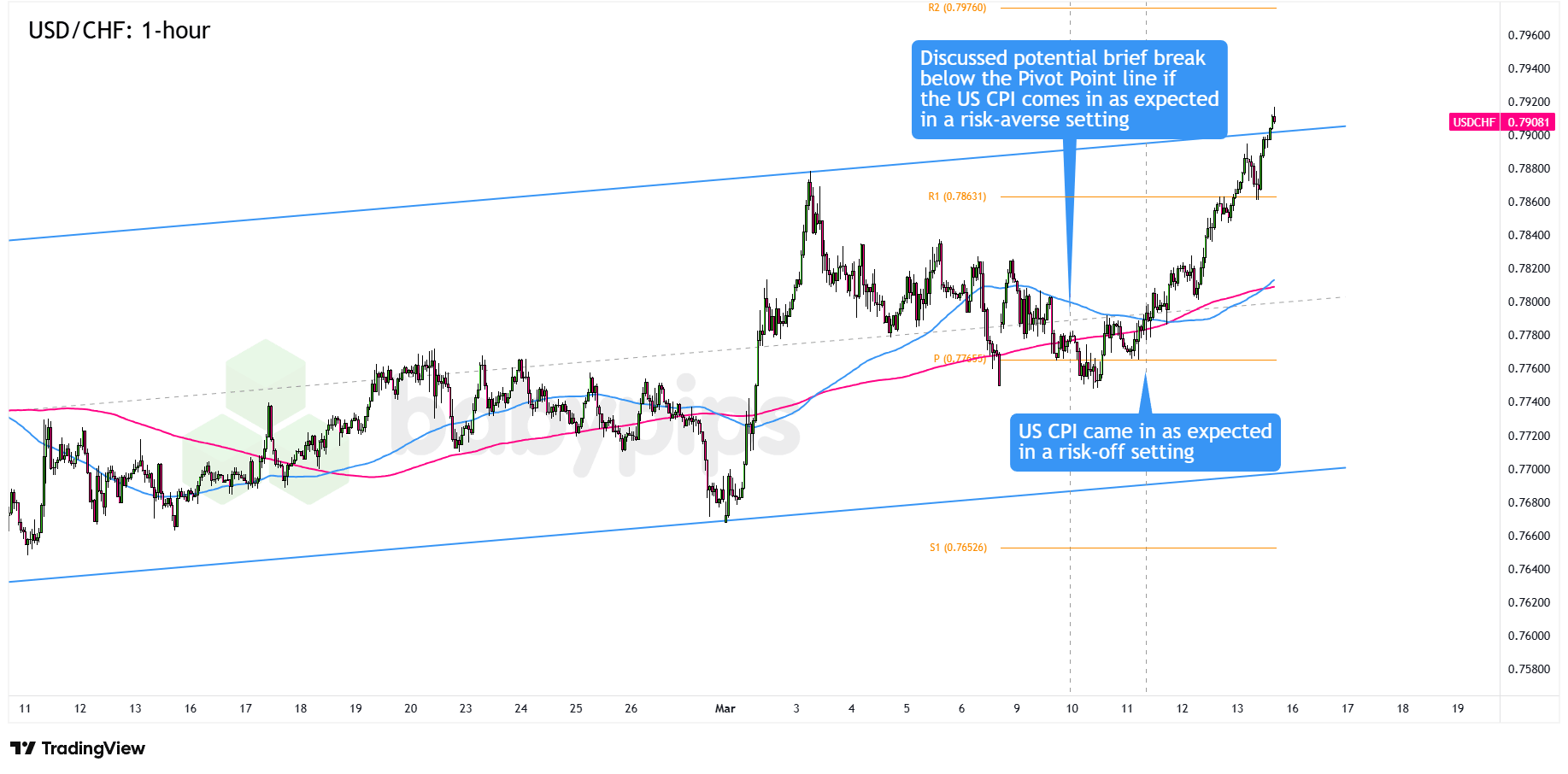
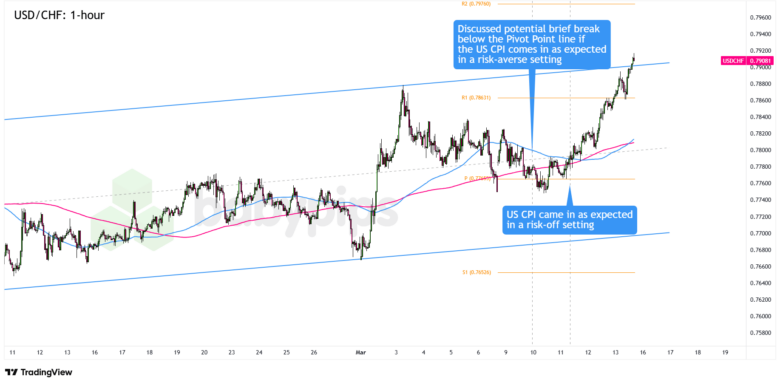
The original watchlist, guided by the Event Guide’s view that an in-line or slightly soft CPI would have limited impact on the dollar, flagged USD/CHF as a potential dip buying opportunity. With the pair trending higher inside an ascending channel, analysts were watching for a pullback toward the mid-channel zone near the Pivot Point (0.7766) as an area where bulls might step back in and continue the broader uptrend.
By the time Wednesday’s CPI report rolled around, the technical part of the setup had already played out. USD/CHF had dipped into the 0.7750 to 0.7766 mid-channel area before the data even hit the tape, effectively front-running the anticipated entry zone.
As expected, the market reaction to an expected release was fairly muted. The real complication was the broader environment. The U.S.-Israel war on Iran, shifting Fed rate expectations, and the competing safe-haven roles of the dollar and the franc created a complex backdrop. We had already framed the idea as low conviction because both currencies had legitimate claims to defensive flows.
In the end, relative demand favored the dollar. The Swiss National Bank’s long-standing willingness to lean against franc strength, combined with very low Swiss inflation, kept CHF buyers cautious. At the same time, the dollar drew support from the calm before the storm inflation narrative and a less dovish Fed interpretation.
USD/CHF pushed higher through the back half of the week, broke above the 0.7827 to 0.7839 resistance cluster, and finished at fresh March highs above 0.7900.
Because price reached the planned entry area and then moved in the expected direction, this watchlist likely supported a positive outcome for traders who bought the dip with modest sizing, consistent with the original low conviction framing.
Promoted: Capitalize on the News Events Without Risking Your Own Funds.
In a geopolitical shock regime, the major currencies, gold and the S&P 500 can swing wildly intraday. Why risk your personal capital during extreme volatility?
Most proprietary firms terminate your evaluation account if you execute a trade during a major macroeconomic release, but FundedNext permits news trading across all models. Test your thesis with up to $300,000 in simulated capital, or take advantage of their Free Trial to experience the platform risk-free.Explore FundedNext and Start Your Free Trial!
Disclosure: We may earn a commission from our partners if you sign up through our links.
Not Eligible to Move Beyond Watchlist – NZD/USD & Bullish USD Setups
NZD/USD: Bearish USD Event Outcome + Risk-On Scenario
NZD/USD 1-hour Forex Chart Faster with TradingView
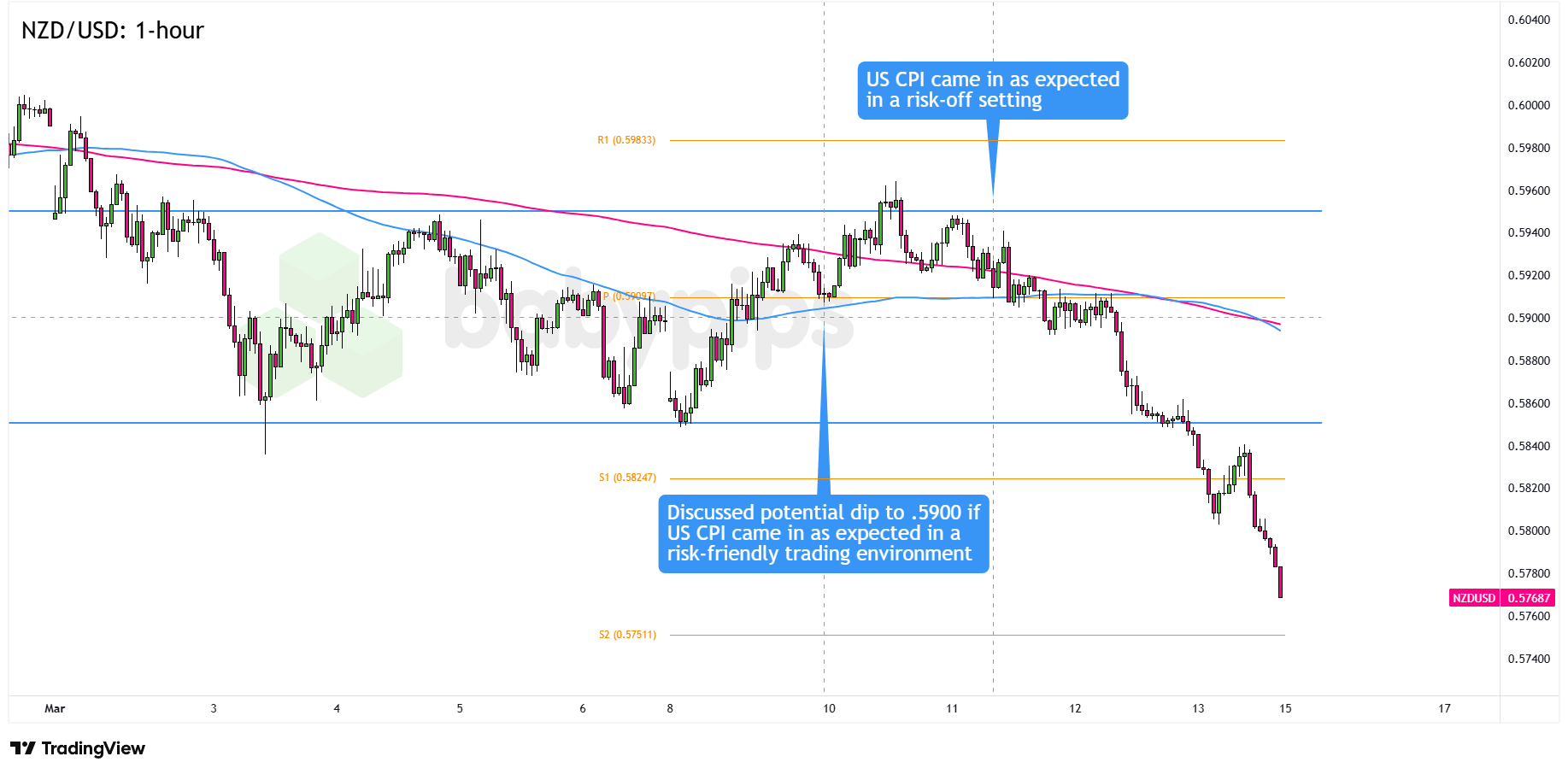
Our analysts had looked for an in line CPI print paired with calmer geopolitical headlines to attract buyers near the 0.5900 Pivot Point (0.5909). From there, NZD/USD could have pushed back toward the 0.5950 resistance area and possibly the R1 (0.5983) level.
The CPI report did come in as expected, so the fundamental condition checked out. The broader environment did not cooperate. Geopolitical tensions ramped up through the back half of the week as new Strait of Hormuz headlines hit the wires, core PCE came sticky high, and Trump vowed to hit Iran harder. That combination sent traders rushing back into the U.S. dollar for safety, effectively invalidating the setup before it could move beyond the watchlist stage.
NZD/USD did slip and consolidate after the CPI release, but instead of stabilizing, the pair broke below 0.5900, picked up speed through S1 (0.5825), and was trading under 0.5780 by Friday’s close.
USD/JPY: Bullish USD Event Outcome + Risk-On Scenario
USD/JPY 1-hour Forex Chart Faster with TradingView
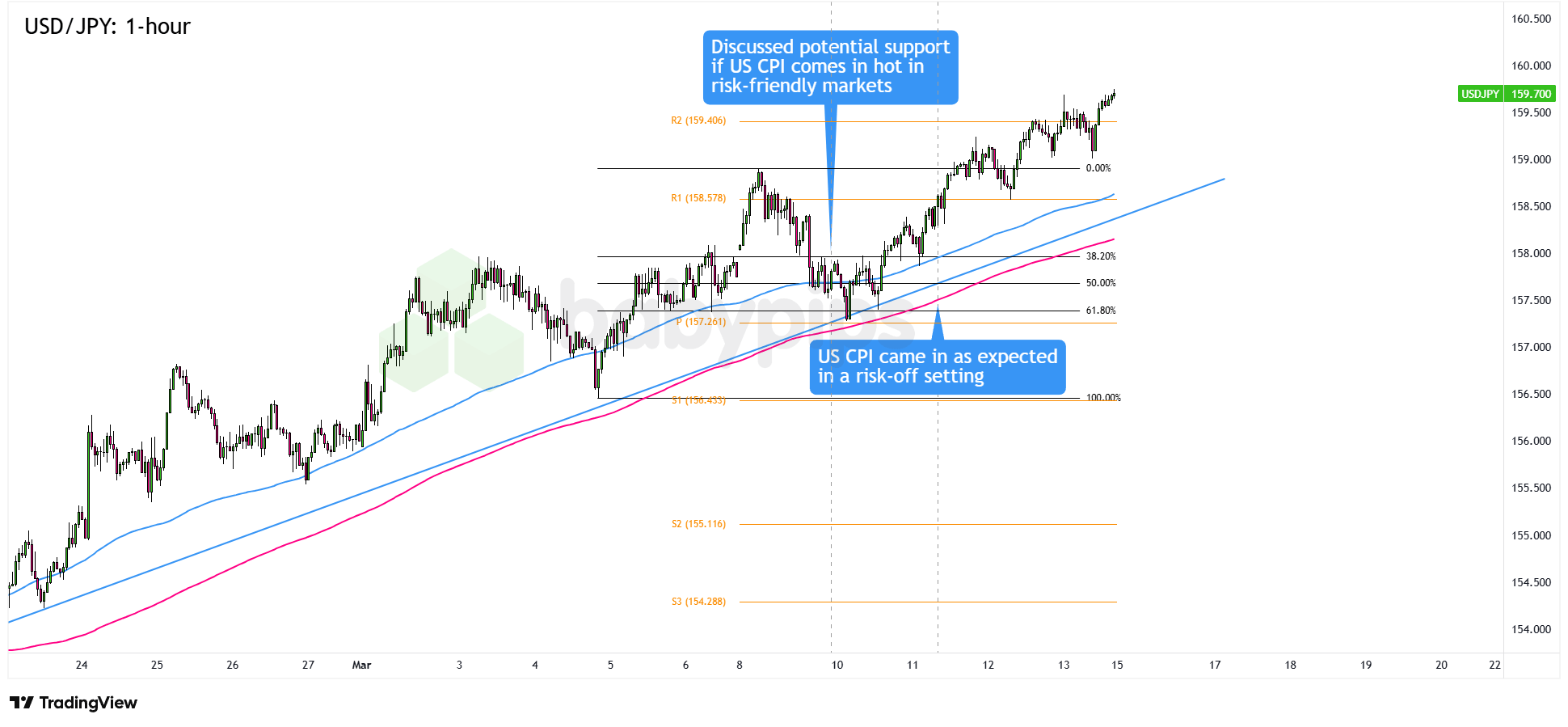
Our watchlist idea on USD/JPY focused on a steady uptrend, with the pair in the middle of a possible bullish correction to its rising trend line and Fib levels, projecting a bounce in the event that the U.S. CPI turns out hot enough to stoke Fed tightening expectations.
Although the actual results came in line with estimates, these didn’t seem enough to impress dollar bulls. The pair initially had a positive reaction to the CPI report, getting an additional boost from rising Treasury yields during the same session. Instead markets remained laser-focused on geopolitical developments that posed greater risks to the U.S. economy.
Still, USD/JPY carried on with its steady climb for the remainder of the week, keeping its head above the trend line support and pre-CPI levels while risk flows favored the safe-haven dollar while the yen reeled from Japan’s larger exposure to the oil crisis. Price even extended its rally past the swing high at the 159.00 handle, which then turned to support as dollar strength prevailed on upbeat mid-tier data printed later on.
GBP/USD: Bullish USD Event Outcome + Risk-Off Scenario
GBP/USD 1-hour Forex Chart Faster with TradingView
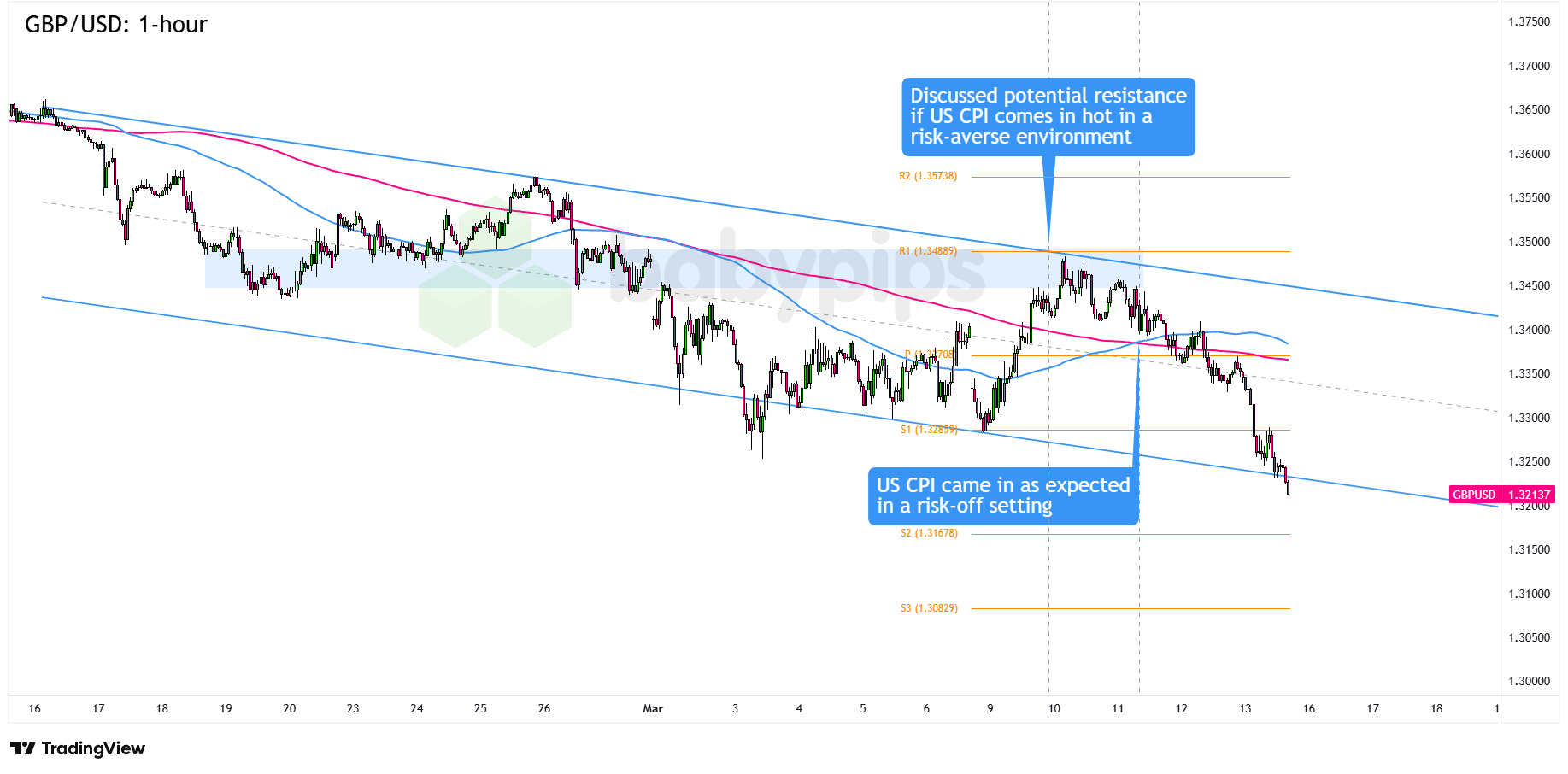
Our bearish GBP/USD watchlist idea was based on a descending channel resistance test ahead of the U.S. CPI release, predicting that the area of interest could hold as a ceiling if the actual figures beat estimates.
The pair hovered around the channel top ahead of the target event, which then simply came in line with consensus and did little to influence Fed policy expectations. Still, the U.S. dollar was able to find support thanks to rising Treasury yields and persistent safe-haven flows stemming from elevated geopolitical tensions.
GBP/USD retreated from the channel top as the week progressed with strong focus on the ongoing US-Iran conflict. Stronger than expected mid-tier U.S. data (trade balance, jobless claims, housing starts) added downside pressure during the back half of the week, though stagflationary woes also added to the risk-off vibe.
The Verdict
USD/CHF did react to the technical levels our analysts identified, dipping into the 0.7750–0.7766 mid-channel and Pivot Point zone before extending the uptrend and closing the week at favorable prices above 0.7900. The low-conviction framing was appropriate given the complexity of the environment, and traders who sized accordingly and engaged the dip had a reasonable pathway to a positive result.
Keep in mind that the entry zone was reached before the CPI release rather than as a direct response to it, which is a reminder that in geopolitically charged markets, anticipated technical levels can get tested on their own timeline.
Overall, we’d rate this week’s USD/CHF watchlist discussions as “likely” supportive of a potential positive outcome for those who engaged the dip toward the mid-channel and Pivot Point zone, given that price respected the identified technical levels and the longer-term uptrend reasserted itself by the weekly close.
Key Takeaways:
A Calendar Event Can Be Secondary When Geopolitics Dominate
An in-line CPI print in a normal environment would typically produce muted, range-bound price action. In a market already consumed by geopolitical headlines and skyrocketing oil prices, even a perfectly on-consensus release gets reinterpreted through the lens of forward inflation risk. When geopolitical forces are this dominant, the event itself may be pre-empted before the number even prints.
Competing Safe-Havens Require a Relative Strength Assessment
USD/CHF is rarely a clean directional trade in high-stress environments because both currencies attract safety flows simultaneously. When evaluating setups on pairs where both legs can move for the same reason, the more useful question is not simply “Is this risk-off?” but rather “Which safe-haven is absorbing more of the risk premium and why?” The SNB’s intervention posture and Swiss inflation dynamics answered that question decisively in the dollar’s favor this week.
Promoted: How Do Professionals Trade Tariff News?
You’ve seen the retail reaction to the tariff whiplash—now see the institutional one. Brent Donnelly’s “The Art of Currency Trading” (4.7 ⭐; 517 reviews on Amazon) bridges the gap between the news headlines you read and the execution on your screen. It’s a practical, “no-fluff” guide to how professional FX desks navigate the exact type of geopolitical volatility described in today’s report.
Learn more about “The Art of Currency Trading” at Amazon
Disclosure: We may earn a commission from our partners if you sign up through our links, at no extra cost to you.