

South Korea’s move to suspend Bithumb over AML failures turns a local compliance case into a market-structure story.
Enforcement against the country’s second-largest exchange threatens to reroute retail flows, deepen venue concentration, and degrade one of crypto’s most-watched regional pricing signals: the kimchi premium.
Compliance case hits market plumbing
The Korea Financial Intelligence Unit sent Bithumb a preliminary notice of a six-month partial business suspension for alleged anti-money laundering and know-your-customer failures, including transactions involving unreported overseas virtual asset service providers.
Local reporting indicates the measure would primarily restrict new customers’ external crypto transfers while existing users retain normal Korean won trading and deposit access. A sanctions review could occur as early as March.
The proposed action follows a February incident in which Bithumb mistakenly credited users with 620,000 Bitcoin, triggering a 17% plunge in BTC/KRW on the platform before prices recovered.
Regulators established an emergency response unit and stated that the error exposed structural vulnerabilities in virtual-asset markets.
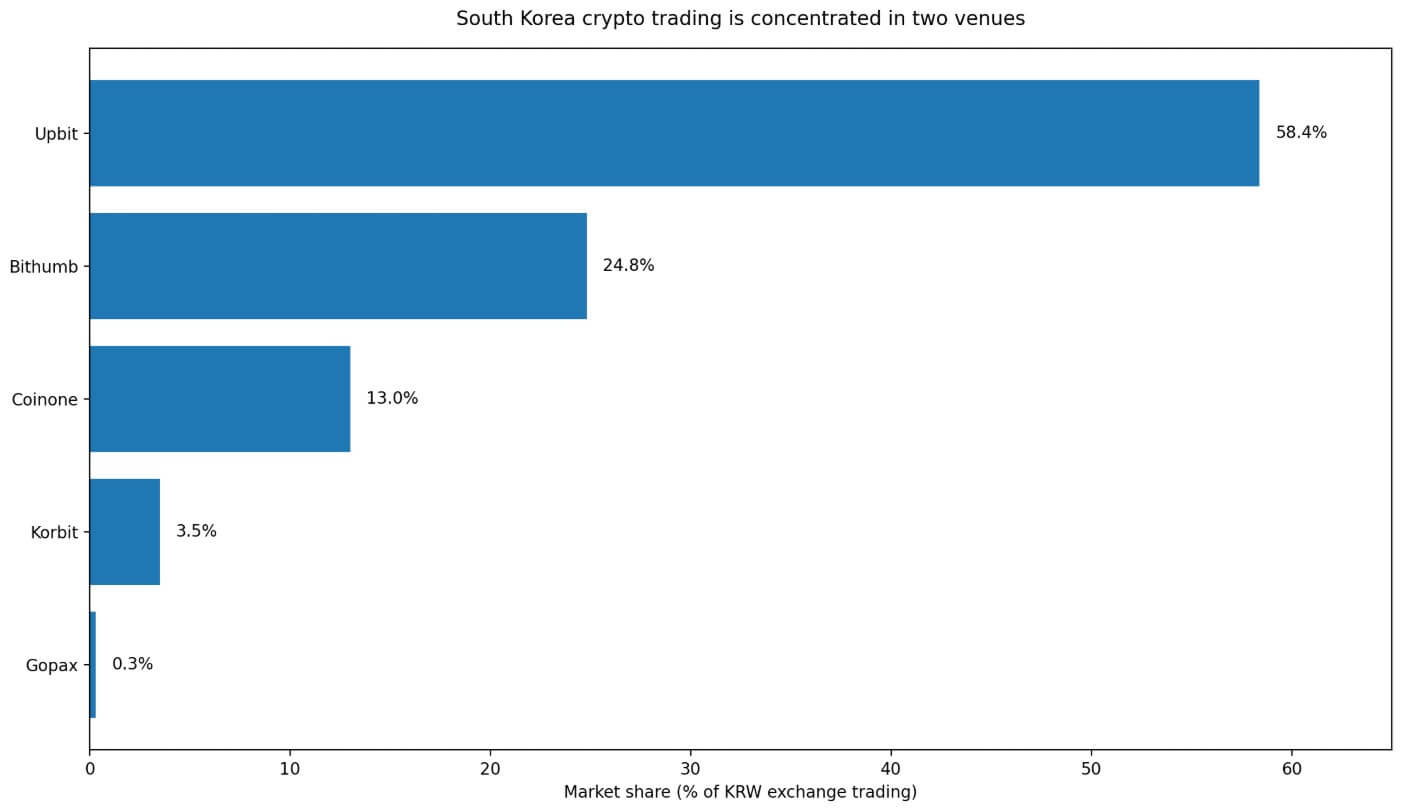
Bithumb remains Korea’s second-largest exchange even after recent turbulence. As of February, CoinGecko data showed that Upbit commanded 58.4% of won-exchange trading, Bithumb 24.8%, Coinone 13%, Korbit 3.5%, and Gopax 0.3%.
Kaiko research indicates Upbit and Bithumb together account for roughly 96% of Korean crypto volume, making any constraint on either venue a matter of market architecture rather than isolated regulatory cleanup.
Enforcement against a top venue creates broader pressure
Korea’s market punches above its weight globally. Korean won-denominated trading reached $663 billion in 2025, and roughly one in three South Korean adults owns crypto, according to Kaiko.
That concentration creates a feedback loop: when trust in a major venue fractures, users respond quickly. Korea Times reported Bithumb’s market share fell from 31.5% on Jan. 5 to the low-20% range after the February error.
Korea operates with unusually high venue concentration. Upbit alone accounted for approximately 70% of Korean trading volume in 2025, per Kaiko’s liquidity analysis.
When regulation constrains a venue holding a quarter of the remaining volume, retail flow reroutes. Coinone and Korbit absorbed some spillover, but the primary beneficiary was Upbit, which further centralizes Korean price discovery.
That centralization creates a second problem: the kimchi premium becomes harder to read.
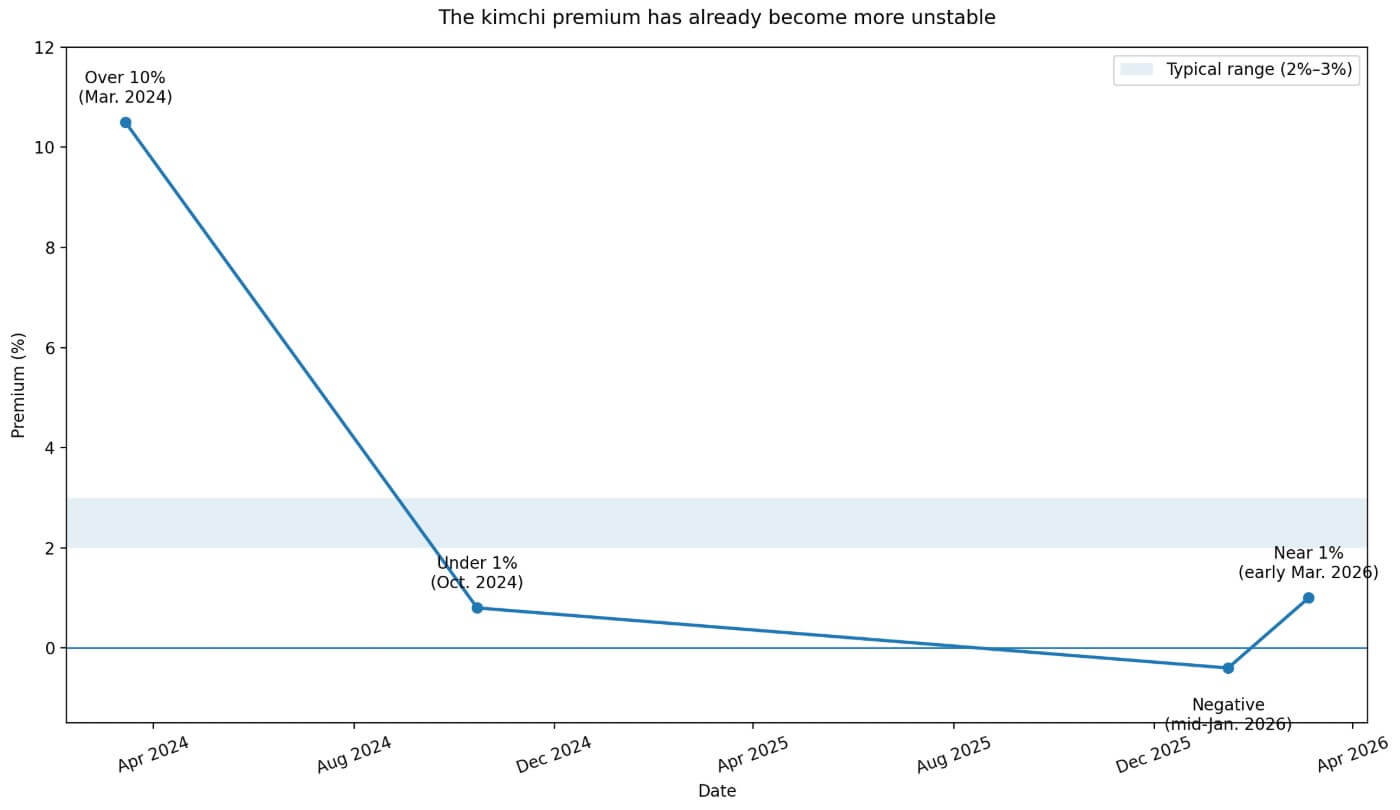
The premium, which is the spread between Korean won-denominated Bitcoin prices and global dollar-based prices, typically averages 2% to 3% due to capital controls that hinder arbitrage.
It stood near 1% in early March after dipping into negative territory in mid-January.
Kaiko noted the premium ranged from over 10% in March 2024 to under 1% by October 2024, making it one of crypto’s most volatile regional sentiment gauges.
As a result, the concern is that partial enforcement against a major venue makes the premium reflect market plumbing and access friction as much as genuine retail demand.
If Bithumb is sidelined for new-user transfers, the spread begins to capture bottleneck effects alongside enthusiasm.
Seoul tests controls without breaking the signal value
Bithumb is not an isolated case. Upbit previously faced a three-month partial suspension affecting new customers, along with a 35.2 billion won fine.
Korbit received a 2.73 billion won fine and a warning. Coinone and Gopax were also reported under review. The Korea Financial Intelligence Unit launched a task force in late 2025 to tighten anti-money laundering rules ahead of the Financial Action Task Force’s 2028 mutual evaluation.
Seoul is moving in two directions simultaneously. It has gradually opened the market to corporate participation while tightening compliance standards, including plans to extend the travel rule below the current 100 million won threshold.
That dual approach makes Bithumb a visible node in a broader effort to formalize crypto as financial infrastructure.
Additionally, the regulatory strategy creates tension. South Korea wants bank-grade compliance in crypto while relying on a small number of exchanges to handle a huge share of retail demand.
Tightening enforcement strengthens legitimacy, but risks distorting the market signals traders watch most closely.
| Exchange | Regulatory action | Penalty / restriction | Why it matters |
|---|---|---|---|
| Bithumb | Preliminary six-month partial suspension notice | New-customer external transfers at risk | No. 2 exchange; systemically important to Korean market structure |
| Upbit | Prior partial suspension | Three months affecting new customers + 35.2 billion won fine | Shows regulatory precedent against a top venue |
| Korbit | Fine and warning | 2.73 billion won fine | Signals broader sector scrutiny beyond the top two |
| Coinone | Under review | Reported review / scrutiny | Supports the case for sector-wide enforcement pressure |
| Gopax | Under review | Reported review / scrutiny | Reinforces that AML tightening is not isolated to one exchange |
Retail capital reroutes when local rails feel restrictive
South Korea’s user base continued to expand even as activity cooled.
The Korea Financial Intelligence Unit reported the number of users eligible to trade rose by 1.07 million in the first half of 2025, while daily volume fell 12% and deposits fell 42% from the prior half-year.
The data suggest a market that remained broad while becoming more fragile, with this fragility having an offshore dimension. Tiger Research and CoinGecko estimated that approximately 160 trillion won moved from Korean exchanges to overseas platforms in 2025.
When local access feels constrained, South Korean crypto capital reroutes. A Bithumb sanction could accelerate that de-localization.
The timing amplifies the gravity, as South Korea just endured a sharp equity selloff.
Reuters reported the KOSPI fell 18.4% over two sessions on March 3-4, the won briefly weakened past 1,500 per dollar, and foreign investors pulled a record $13.67 billion from Korean markets in February.
In that environment, changes to domestic crypto rails matter more because retail capital is already searching for alternative risk expressions.
What Bithumb’s constraint means for Bitcoin’s South Korean tell
For Bitcoin, the Bithumb story is impactful because Korean pricing has long functioned as a fast retail-sentiment tell.
That becomes especially relevant when institutional forecasts diverge sharply.
Tiger Research’s January model placed Bitcoin’s first-quarter 2026 target at $185,500 with $84,000 support and $98,000 resistance, while Standard Chartered warned in February that BTC could fall to $50,000 in the coming months and cut its year-end target to $100,000.
In a market with that much macro uncertainty, losing confidence in one of the cleanest regional retail tells becomes a bigger issue.
The kimchi premium’s value lies in its ability to capture shifts in Korean retail positioning before those shifts appear in global volume. If enforcement makes that signal noisier, Bitcoin traders lose a forward indicator.
The base case resembles the Upbit precedent: a partial sanction focused on new-user transfer activity rather than a full operational freeze.
Bithumb likely remains viable but weaker, with market share settling around 20-25%, more spillover to Upbit and Coinone, and the kimchi premium holding roughly in a 0-2% band.
The signal survives but becomes less clean because venue concentration rises.
The bear case sees sustained erosion of confidence. If the sanctions stick and Bithumb’s share drops into the high teens, some South Korean capital moves offshore while domestic price signals deteriorate further.
The premium could persistently stay below 1% if confidence cools, or print short bursts if access bottlenecks at fewer venues.
Enforcement collides with market plumbing
South Korea’s proposed action against Bithumb raises a sharper concern: Seoul can either tighten compliance standards or preserve clean retail signals.
However, attempting both simultaneously tests whether a highly concentrated market can absorb regulatory pressure without losing the transparency that made it valuable.
Bithumb still holds a quarter of South Korean won-exchange volume, and constraining a top venue can reroute flow, deepen concentration, and make South Korean price action a less reliable read on Bitcoin demand.