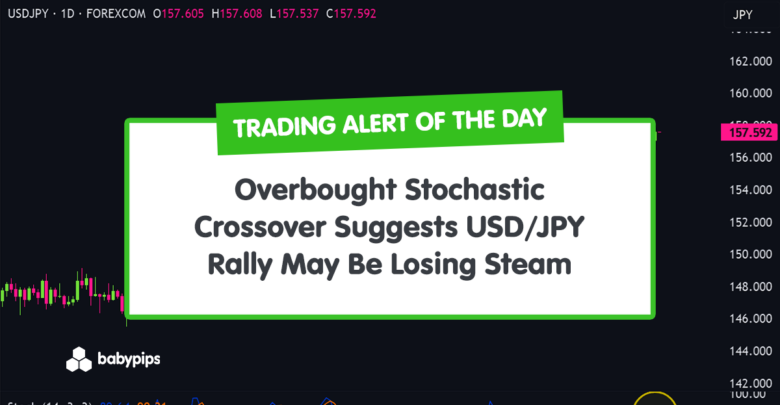
TA Alert of the Day: Overbought Stochastic Crossover Suggests USD/JPY Rally May Be Losing Steam

2026-03-05 22:20:00
USD/JPY is still holding near recent highs, but momentum conditions are starting to look more fragile.
A bearish Stochastic crossover has appeared while the oscillator remains in overbought territory, a combination that often gets traders’ attention.
When these shifts occur near key price areas, follow-through (or lack of it) can become clearer over the next few sessions.
This is the type of setup where confirmation matters as much as the signal itself.
Welcome to “TA Alert of the Day.” Each day after the market close, MarketMilk scans for popular technical indicator alerts. We use these alerts as the basis for a mini-lesson, breaking down what each alert means, why it matters, and how traders might interpret it. The goal is to help beginner traders not only spot these alerts but also understand the logic behind them and how they can inform trading decisions.
What MarketMilk Has Detected
MarketMilk detected a bearish Stochastic (14,3,3) crossover on the daily chart, where %K crossed below %D (from 90.72/88.02 to 90.58/90.67).
Notably, both lines are still above 80, indicating overbought momentum rather than a trend reversal by default.
This crossover is occurring after USD/JPY rebounded sharply from the late-January swing low near 152.21 and pushed back into the 157.3–158.2 zone that has acted as a recent inflection area.
Price is also trading not far from the mid-January peak near 159.19, which stands out as a higher resistance reference in this 65-bar window.
What This Signals
Traditionally, a %K below %D crossover while both are above 80 can attract attention as an early sign that upside momentum is decelerating.
In many markets, this condition often marks a transition from “strong push” to “slower grind,” and if the move is sustained, it can coincide with a pullback or consolidation from elevated levels, especially when the price is pressing into prior resistance zones.
However, this same pattern can also represent a bullish trend cooling off without reversing.
In strong uptrends, Stochastic can remain elevated for extended periods, and bearish crossovers above 80 sometimes occur repeatedly while price continues to hold up (or quickly re-accelerates).
In that scenario, the crossover becomes more of a “momentum reset” than a sell signal, particularly if USD/JPY keeps defending nearby supports.
The outcome depends heavily on follow-through in price action, the market’s response around nearby support/resistance, and whether momentum continues to deteriorate (e.g., Stochastic slipping under 80 and failing to recover).
How It Works
The Stochastic Oscillator (14,3,3) compares the latest close to the recent high-low range over a lookback period (here, 14), then smooths the result into %K and its moving average signal line %D.
Values near 80–100 indicate overbought momentum (price closing near the top of its recent range), while values near 0–20 indicate oversold momentum.
A bearish crossover occurs when %K crosses below %D, suggesting the most recent momentum is weakening relative to its smoothed trend. When this happens above 80, traders often treat it as a “momentum rollover” warning, not a guaranteed reversal.
Important: Overbought momentum is not the same as “overvalued,” and bearish Stochastic signals can appear early (or multiple times) during persistent uptrends. Reliability often improves when the crossover aligns with price rejection at resistance, a break of a nearby support level, or broader confirmation from trend structure.
What to Look For Before Acting
Do not assume a reversal is imminent. Consider these factors:
✓ Whether USD/JPY rejects the 157.7–158.2 area (multiple recent highs cluster here) with weak daily closes
✓ A break and daily close below nearby support around 157.05 (recent pivot area) to validate downside follow-through
✓ Whether price revisits and holds the 156.45–156.50 area (current-bar low zone) or slices through it quickly
✓ Stochastic behavior after the cross: continued weakening (e.g., dropping below 80) versus a quick recross back upward
✓ Evidence of lower highs / lower lows developing on the daily structure rather than a sideways pause
✓ Confluence with the next downside reference zones from the recent swing structure (e.g., 155.80–156.10 area seen repeatedly in February)
✓ Alignment with the Weekly chart trend context (higher timeframe confirmation should not be the same timeframe)
✓ Event risk typical for USD/JPY drivers (e.g., upcoming central bank communications, rate expectations, key US data) that can override oscillator signals
Risk Considerations
⚠️ Overbought can persist: Stochastic can stay elevated in trending conditions, making early bearish crosses prone to whipsaw
⚠️ False-signal risk near highs: price may briefly dip after the crossover and then resume the uptrend (a “momentum reset”)
⚠️ Event-driven volatility: USD/JPY can gap or spike on macro headlines, reducing the usefulness of oscillator timing
⚠️ Crossover without structure: if no support breaks occur, the signal may have limited practical value
Potential Next Steps
The Stochastic oscillator is deep in overbought territory, suggesting the rally is stretched in the very short term. But overbought readings during strong trends often lead to consolidation rather than immediate reversals.
Add USD/JPY to a watchlist and monitor whether price confirms the momentum rollover with a clear break of nearby support (rather than only an oscillator cross).
If price holds firm above recent pivots and Stochastic stabilizes or turns back up, treat the signal as a caution flag rather than a trade trigger.
If you do trade this, consider position sizing and predefined exits that account for daily-range swings and headline risk, and avoid relying on Stochastic alone for directional conviction.
Trade Idea (Bearish Rejection Scenario)
Setup:
Look for rejection in the 158.00–158.50 resistance area, especially if price prints a bearish daily candle and momentum begins to roll over.
Entry:
Enter short on a daily close below 156.50, confirming that the rejection from resistance is gaining traction.
If price instead closes decisively above 158.50, stand aside as that would invalidate the bearish setup.
Stop Loss:
Stop on a daily close above 159.20 (invalidation = confirmed breakout and continuation higher).
Take Profit:
First target: 155.50–156.00.
Second target: 153.00–153.50 if downside momentum accelerates.
Bottom line:
USDJPY is pressing into resistance with momentum stretched. Rejection below 158.50 could trigger another pullback toward mid-range support, while a breakout would open the door for a move back toward 160.
This content is strictly for informational purposes only and does not constitute as investment advice. Trading any financial market involves risk. Please read our Risk Disclosure to make sure you understand the risks involved.