XRP rewrites the playbook so altcoin ETF approvals could surge in late 2026 after a wave of futures listings






XRP served as the proof of concept in an assembly manual for altcoin ETFs.
In a Mar. 2 post, Bitnomial argued that the real crypto-ETF shift isn’t the SEC’s faster timelines, but that regulated futures on CFTC-designated contract markets have become the practical prerequisite for new crypto ETF listings.
XRP has moved from the centerpiece of the SEC’s “unregistered securities” enforcement agenda to having the regulated-futures rails and US-listed ETF wrappers that the new rulebook rewards.
What looked like a courtroom battle became an infrastructure checklist.
What actually changed
The SEC’s generic listing standards, approved in September 2025, let exchanges list qualifying Commodity-Based Trust Shares without filing a bespoke 19b-4 proposed rule change each time.
That compressed approval timelines from roughly 240 days to around 75. The practical gate, emphasized by Bitnomial and multiple reports, is that having CFTC-regulated futures trading for at least six months triggers access to this expedited path.
Bitnomial frames it as new math: DCM futures launch, accrue six months of history, file under generic standards, reach listing in approximately 75 days.
That’s a structured pathway that didn’t exist when earlier altcoin ETF filings faced a multi-year limbo.
Why XRP is the blueprint
XRP didn’t become “safe.” It became productizable.
The SEC ended its Ripple lawsuit, but the court’s framework still treated certain institutional XRP sales as securities, with a $125 million penalty and injunction remaining.
Public exchange sales weren’t classified the same way, creating operational room even as broader questions lingered.
Meanwhile, XRP built the regulated derivatives rails.
| Date | Milestone | Why it matters for ETF eligibility (1 line) |
|---|---|---|
| 2020 | SEC files lawsuit against Ripple (XRP as enforcement centerpiece) | Establishes XRP as a high-profile “regulatory risk” asset—baseline context for how dramatic the later productization shift is. |
| March 2025 | Bitnomial launches CFTC-regulated XRP futures | Creates U.S.-regulated futures rails on a CFTC-regulated venue—starts the “regulated market infrastructure” clock. |
| May 2025 | CME launches cash-settled XRP futures (CME CF XRP-Dollar Reference Rate) | Adds benchmark pricing + institutional derivatives plumbing (reference rate + clearing ecosystem), strengthening surveillance/liquidity narratives. |
| Sept 2025 | SEC generic listing standards approved | Compresses the ETF path by letting exchanges list qualifying commodity-based trust shares without bespoke 19b-4, turning approvals into a checklist process. |
| Sept 2025 | XRPR debuts (first U.S.-listed spot XRP ETF) | Proof the wrapper can go live once product + infrastructure boxes are checked—broadens access via brokerage channels and AP market-making. |
| 2025 (launch/listing as cited) | Franklin XRP ETF (XRPZ) introduced | Reinforces that XRP is “productizable” for multiple issuers—signals growing comfort with the ETF wrapper once futures/benchmark infrastructure exists. |
Bitnomial launched the first CFTC-regulated XRP futures in March 2025, and CME followed with cash-settled XRP futures in May 2025, tied to the CME CF XRP-Dollar Reference Rate.
By September 2025, REX-Osprey’s XRPR debuted as the first US-listed spot XRP ETF, and Franklin Templeton launched its Franklin XRP ETF (XRPZ).
The transformation wasn’t regulatory absolution. It was infrastructure maturation.
XRP went from a token the SEC used to define what shouldn’t be sold as a security to one with derivatives scaffolding, benchmark pricing, and clearing relationships that fit the new ETF eligibility framework.
Once futures were traded for six months, generic listing standards made ETF approval a process question rather than a philosophical battle.
The assembly line
Bitnomial’s post functions as operational guidance.
The four-step pipeline: get futures listing on a CFTC-regulated DCM, accrue roughly six months of regulated futures history, use SEC generic listing standards to compress exchange-side approval to around 75 days, then launch the ETF wrapper to unlock brokerage access and authorized participant market-making.
The Sept. 17 SEC press release explicitly states exchanges may list and trade qualifying Commodity-Based Trust Shares without first submitting a proposed rule change under Section 19(b). This is the mechanism that created multi-month delays.
The implications are structural. Under the old regime, issuers filed ETFs and hoped for the best.
Under the new regime, issuers have a defined sequence: secure DCM listing, let futures establish surveillance and liquidity benchmarks, then file into the generic lane.
The shift moves power toward entities controlling that infrastructure: DCMs, derivatives clearing organizations, and benchmark administrators.
Who becomes the kingmaker
If Bitnomial’s DCM-first pathway becomes standard practice, DCMs and clearing organizations will serve as clock-starters for ETF eligibility.
Benchmark administrators like CME CF become essential infrastructure. Tokens that can’t secure futures listings on regulated venues face a longer, less certain path.
CME’s product expansion signals that this shift is underway.
The exchange announced futures on Cardano, Chainlink, and Stellar for Feb. 9, and is moving toward 24/7 crypto derivatives trading starting May 29.
What this means for markets
Issuer incentives flip. Instead of “file and pray,” the strategy becomes “build infrastructure first.”
Token foundations now have reason to prioritize regulated futures listings as the first step. Futures-first means liquidity and hedging capacity can develop before spot ETF demand arrives.
A regulated futures market creates arbitrage tools, tighter spreads, and continuous price discovery, which can improve the quality of market-making once an ETF launches.
However, this creates reflexivity risk. If token ecosystems treat DCM futures listings as the critical milestone, a feedback loop emerges: futures listing triggers ETF speculation, which attracts market-making interest, which increases filing pressure.
That’s beneficial for liquidity, but concentrates power in a small set of regulated venues.
Tokens that can’t access those venues due to regulatory uncertainty, insufficient market capitalization, or technical incompatibility get left behind.
The financial engineering implications are clearer than the price implications.
Futures-first means more participants can hedge and more institutional allocators can access exposure through familiar wrappers.
Whether that translates into sustained price appreciation depends on actual demand, not just product availability.
Who’s next
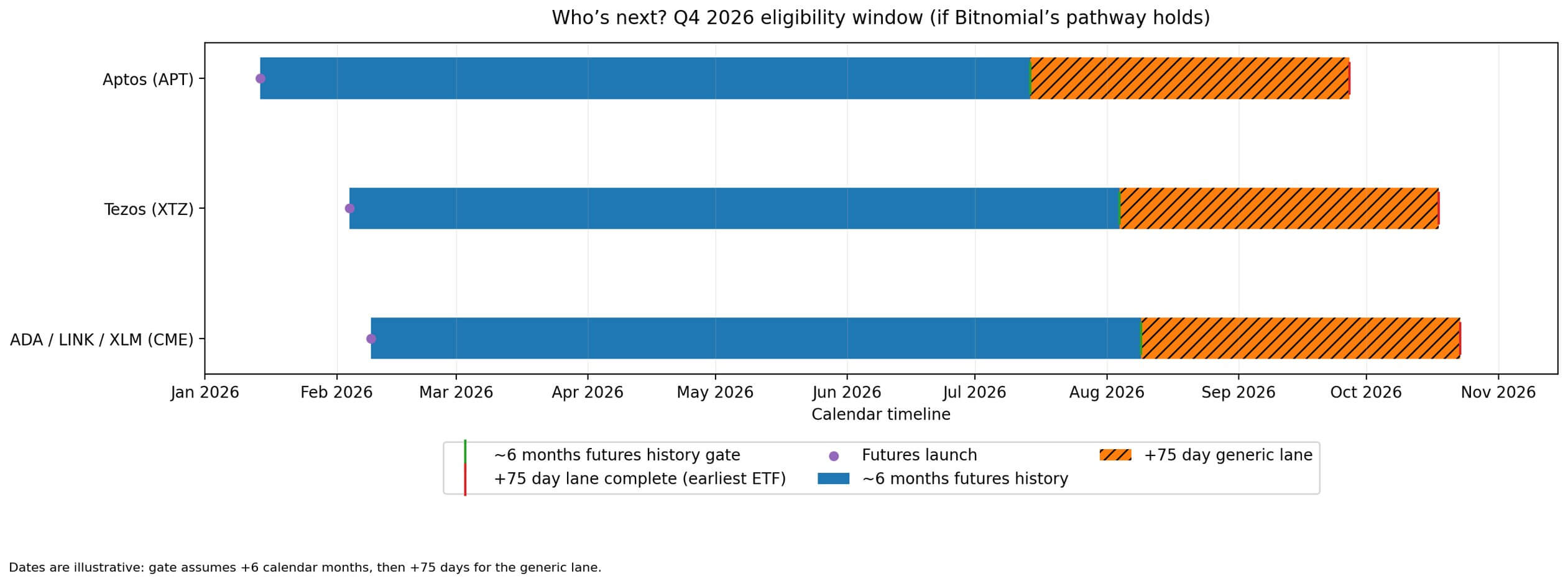
Using Bitnomial’s nine-month math, consisting of six months of futures history plus 75 days for generic listing approval, several tokens enter the eligibility window in the fourth quarter of 2026.
Aptos futures launched on Bitnomial on Jan. 14, putting the earliest ETF listing around late September.
Tezos futures launched Feb. 4, pointing to mid-October ETF eligibility. CME’s launch of futures for Cardano, Chainlink, and Stellar on Feb. 9 enables potential ETF listings in late October.
These timelines assume the pathway functions as described.
Yet, the calendar establishes the fourth quarter as the window when multiple non-BTC/ETH tickers could enter the ETF market.
The pattern to watch: DCM listings clustering in the first quarter should produce ETF filings clustering in the third quarter and launches clustering in the fourth quarter.
The credibility check
Bitnomial is an interested party. Its business model benefits if “the path starts on a DCM” becomes market consensus, so the framing emphasizes futures venues more than alternative pathways.
The SEC’s generic listing standards exist independent of Bitnomial’s interpretation, and the six-month futures threshold appears in other reports that mention regulatory provisions.
Generic listing standards streamline the approval process, but don’t erase the underlying complexity of token regulation.
XRP’s legal history demonstrates that ETF eligibility can advance even when the asset’s broader regulatory story remains unsettled.
The injunction from the Ripple case, the $125 million penalty, and the court’s treatment of institutional sales as securities all persist, yet XRP has multiple US-listed ETF products.
That tension, comprising regulatory uncertainty alongside product availability, will shape how other tokens navigate the same pathway.
The assembly manual works for tokens that fit the template: liquid enough to support futures, compliant enough to attract DCM listings, and mature enough to meet the six-month history requirement.
What’s actually at stake
XRP went from the SEC’s signature enforcement case to an ETF case study because it became a productizable asset.
The lawsuit was settled in a way that left room for regulated products to proceed.
The futures infrastructure required DCMs to make commercial decisions that CFTC-regulated XRP derivatives were viable. The ETF wrappers arrived because generic listing standards created a procedural pathway that futures history could satisfy.
The template is replicable, but only for tokens that can follow the sequence.
Build a regulated futures infrastructure, let it mature for six months, file under generic standards, and reach the market in roughly 75 days. That’s the assembly manual Bitnomial published, and XRP is the proof that it can work even for assets with complicated regulatory histories.
For markets, the shift is structural. Altcoin ETFs are no longer a distant possibility contingent on the SEC’s mood swings. They’re an infrastructure problem with a defined solution, and the entities controlling that infrastructure now determine who gets access and when.
XRP didn’t become safe. It became eligible. And eligibility, it turns out, is what matters.