
2026-02-25 23:21:00
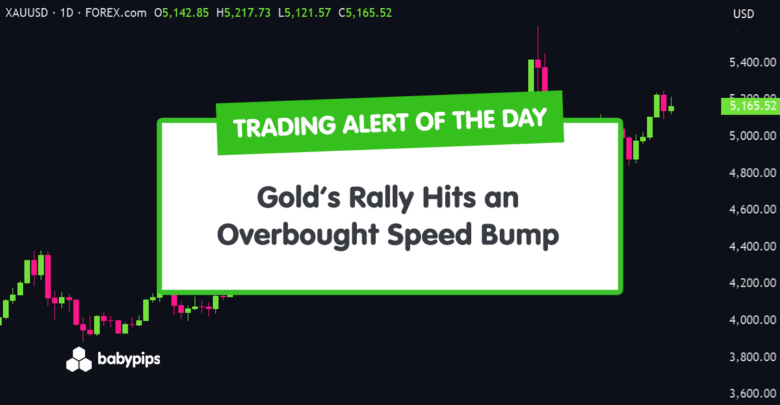
Gold (XAU/USD) has pushed back upward, but the momentum backdrop is starting to look less cooperative.
A fresh shift inside the Stochastic oscillator is hinting that the latest advance may be losing some internal strength.
This is the type of development that can appear near short-term peaks, yet it can also show up mid-trend before another leg higher.
The next few daily candles around nearby support/resistance will help clarify which interpretation fits best.
Welcome to “TA Alert of the Day.” Each day after the market close, MarketMilk scans for popular technical indicator alerts. We use these alerts as the basis for a mini-lesson, breaking down what each alert means, why it matters, and how traders might interpret it. The goal is to help beginner traders not only spot these alerts but also understand the logic behind them and how they can inform trading decisions.
What MarketMilk Has Detected
Gold remains in a strong broader uptrend, but short-term momentum is now stretched as price approaches prior highs and the Stochastic oscillator pushes into overbought territory.
MarketMilk detected a bearish Stochastic crossover on the 1D chart: %K crossed below %D (previous close: K 91.92 / D 87.32; current close: K 88.56 / D 90.92).
Notably, both lines remain above 80, which places this signal in an area commonly associated with overbought momentum.
Price action has been volatile. After a strong rally into late January (peaking near 5597.54 on 2026-01-28), XAU/USD saw a sharp selloff to the mid-4600s and then rebounded into the 5200–5250 area.
The current crossover occurs while price is still relatively close to that recent rebound high (5249.74 on 2026-02-23), with nearby support developing around 5090–5100 and deeper support evident near 4860–4885.
What This Signals
Traditionally, a Stochastic %K cross below %D while above 80 is treated as a momentum cooling signal.
It can attract sellers or prompt profit-taking because it suggests that upside momentum is slowing, even ifthe price has not yet broken down. If the move is sustained, traders often look for follow-through via weaker closes and a rotation toward prior support zones.
However, this same pattern can also represent a brief reset within a strong uptrend.
In trending markets, Stochastic can remain elevated for extended periods, and bearish crossovers above 80 sometimes resolve as sideways consolidation rather than a meaningful decline, especially if price continues to hold higher lows or quickly reclaims nearby resistance.
The outcome depends heavily on follow-through price action, where the signal occurs relative to major levels (notably 5249–5250 resistance and 5090–5100 support), and whether momentum continues to fade (e.g., Stochastic drifting down toward the midline) or snaps back upward.
Context and confirmation are essential, particularly after the recent “spike-and-reversal” behavior seen from late January into early February.
How It Works
The Stochastic (14,3,3) oscillator compares the current close to the recent high-low range over the last 14 periods, then smooths the result to produce %K (faster line) and %D (signal line).
Readings above 80 are typically labeled overbought momentum, while readings below 20 are labeled oversold momentum.
A bearish crossover happens when %K drops below %D, suggesting that the most recent price thrust is losing speed relative to the smoothed trend of momentum.
This is not a directional guarantee. Rather, it’s an internal “tempo change” that traders often pair with support/resistance and candle structure.
Important: Overbought momentum does not mean price must fall. In strong trends, Stochastic can stay above 80 for long stretches, and crossovers can whipsaw. Signals tend to be more informative when they align with a clear resistance test, a failed breakout, or a shift in market structure (like lower highs/lower lows).
What to Look For Before Acting
Do not assume an immediate downside reversal. Consider these factors:
✅ Whether XAU/USD can hold above 5120–5140 (recent swing area) or starts closing below it
✅ A clean retest behavior near 5090–5100: bounce (support holds) vs. break (support fails)
✅ Whether price can reclaim and sustain above 5249–5250 (recent rebound high); failure there can validate the “cooling” view
✅ Stochastic follow-through: %K and %D continuing to roll over toward 50 vs. quickly turning back up above 80
✅ Candle evidence on the daily chart (e.g., lower highs, bearish engulfing follow-through, or repeated long upper wicks near 5200+)
✅ Broader trend check on the Weekly timeframe: is the market trending or mean-reverting around prior highs?
✅ Volatility conditions: after the late-Jan spike and early-Feb drop, confirm whether ranges are expanding again (often increases whipsaw risk)
✅ Macro/event sensitivity typical for XAU/USD: upcoming inflation/real-yield drivers and risk sentiment that can amplify false oscillator signals
Risk Considerations
⚠️ Trend persistence risk: in strong uptrends, overbought momentum can persist and bearish crossovers can fail quickly
⚠️ Whipsaw risk: Stochastic crossovers can flip repeatedly when price chops within a range
⚠️ Level proximity risk: price is still near the 5200–5250 zone; sudden breakouts can invalidate bearish momentum reads
⚠️ Event-driven gaps/swings: XAU/USD can move sharply on macro headlines, reducing the reliability of oscillator-only triggers
Potential Next Steps
Keep XAU/USD on a watchlist and monitor how the price behaves around 5249–5250 (resistance) and 5090–5100 (support).
If you trade mean-reversion signals, consider waiting for price confirmation (such as a lower close sequence or a clear support break) rather than acting on the crossover alone.
If you trade trends, watch for signs that the pullback is only a consolidation (support holds and momentum stabilizes). In all cases, use predefined risk controls because oscillator signals can be early, and early signals can be wrong.
Trade Idea (Bullish Continuation Scenario)
Setup:
Look for continuation higher if the price can break and hold above the recent swing high around 5,220, confirming buyers are back in control after the consolidation.
Entry:
Enter long on a daily close above 5,220.
Or enter on a controlled pullback into 5,000–5,050 (the base of the recent range) if price stabilizes there and turns back up.
If price pokes above ~5,220 but then quickly falls back into the range (failed breakout), stand aside and wait for either a cleaner breakout later or a deeper pullback.
Stop Loss:
For breakout entries: stop on a daily close back below ~5,120 (invalidation = breakout failed and price is slipping back into the prior range).
For pullback entries: stop on a daily close below ~4,950 (invalidation = support didn’t hold and range is breaking down).
Take Profit:
First target: 5,300–5,350.
Second target: 5,500-5,600 if momentum expands and the market transitions from range back into trend mode.
Bottom line:
Gold is consolidating under a clear pivot near 5,220. A confirmed break above that level favors continuation, while 5,000–5,050 is the key “buy-the-dip” area that needs to hold for the bullish structure to stay intact.
Trade Idea (Bearish Pullback Scenario)
Setup:
Look for a pullback if price fails to clear ~5,220 and starts rolling over, especially with stochastic already pushed into overbought territory.
Entry:
Enter short on a bearish rejection at ~5,220, followed by a daily close back below ~5,120 (confirmation sellers regained control).
If price doesn’t reject and instead holds above ~5,220, stand aside — that shifts the odds toward the bullish continuation scenario.
Stop Loss:
Stop on a daily close above ~5,250 (invalidation = buyers absorbed supply and the “failed breakout / rejection” idea is wrong).
Take Profit:
First target: 5,000–5,050 (range support).
Second target: 4,850–4,900 if the range breaks and downside momentum expands.
Bottom line:
Both ideas revolve around the same pivot. Above ~5,220 = strength and continuation risk. Below ~5,120 after rejection = pullback risk. If 5,000–5,050 breaks, the chart shifts from “consolidation” to “deeper correction.”
This content is strictly for informational purposes only and does not constitute as investment advice. Trading any financial market involves risk. Please read our Risk Disclosure to make sure you understand the risks involved.