
2026-02-23 17:28:00
Here’s a question most traders never think about: Where does a president actually get the legal authority to slap tariffs on imports?
Most people assume it’s simple — the president wants tariffs, so there are tariffs.
But last weekend proved that’s not how it works.
In the span of 48 hours, the Supreme Court struck down Trump’s entire tariff regime, Trump fired back with a new one, and then raised it — all before Monday morning.
Understanding why that happened is one of the most useful things a beginning trader can learn right now.
A Quick Civics Refresher
The U.S. Constitution is pretty clear: Congress controls taxation. Tariffs are taxes on imports. So technically, every time a president wants to impose them, they need a law from Congress giving them permission.
The problem is that getting Congress to act is slow. So over the decades, Congress passed several laws delegating some of that tariff power to the president — but each one comes with different conditions, limits, and guardrails. Think of them as different credit cards in the president’s wallet. Some have high limits and no expiry. Others are capped and temporary.
Trump’s first choice — and the one the Supreme Court just cut up — was the most powerful card in that wallet.
What Was IEEPA, and Why Did the Court Kill It?
The administration’s original legal foundation was the International Emergency Economic Powers Act (IEEPA). Passed in 1977, it was designed to help presidents respond quickly to national security threats, mainly by freezing foreign assets or restricting financial transactions.
The White House argued that IEEPA’s authority to regulate importation included the authority to impose tariffs. After declaring national emergencies tied to trade deficits and fentanyl trafficking, it used IEEPA to justify a broad tariff structure.
On February 20, 2026, the Supreme Court rejected that interpretation in a 6 to 3 ruling. Chief Justice John Roberts wrote that IEEPA does not authorize the president to impose tariffs.
The law does not explicitly grant taxing power, and under the major questions doctrine, Congress must clearly state when it is handing over authority as sweeping as taxing imports across the entire economy.
In short, the Court said Congress never clearly gave that power through IEEPA.
The consequences are significant. An estimated 160 to 175 billion dollars in tariffs collected since 2025 may now face refund claims. That alone creates fiscal and legal uncertainty that markets must factor in.
Enter Section 122 — The Backup Card
Within hours of the ruling, Trump announced he was reaching for a different legal authority: Section 122 of the Trade Act of 1974.
Unlike IEEPA, Section 122 explicitly allows the president to impose a temporary import surcharge to address a large and serious balance of payments deficit. In plain terms, it can be used when the United States is importing far more than it exports and policymakers believe that the imbalance threatens economic stability.
The keyword there is temporary.
Congress built Section 122 as an emergency stabilizer, not a permanent trade policy tool. It comes with two hard limits baked in:
-
- Rate cap: Maximum 15%. No more, no less.
- Time limit: 150 days — expiring around July 23, 2026 — after which Congress must vote to extend it, or it disappears.
Trump started at 10% on Friday evening — confirmed in a Truth Social post — then bumped it to the legal ceiling of 15% the very next morning on Saturday. Section 122 had never been used by any president before this moment.
Promoted: How Do Professionals Trade Tariff News?
You’ve seen the retail reaction to the tariff whiplash—now see the institutional one. Brent Donnelly’s “The Art of Currency Trading” (4.7 stars & 517 reviews on Amazon) bridges the gap between the news headlines you read and the execution on your screen. It’s a practical, “no-fluff” guide to how professional FX desks navigate the exact type of geopolitical volatility described in today’s report.
Learn more about “The Art of Currency Trading” at Amazon
Disclosure: We may earn a commission from our partners if you sign up through our links, at no extra cost to you.
So, Why Does Any of This Matter for Your Trading?
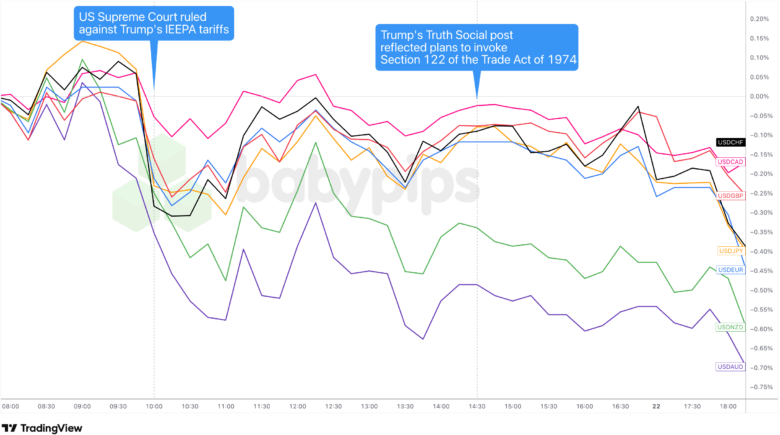
Because legal trade uncertainty IS market uncertainty. Let’s take a look at how the U.S. dollar reacted on Friday:
USD 15-minute Forex Chart Faster with TradingView
The Supreme Court ruling drop (~10:00 AM EST): The moment the decision hit, the dollar sold off hard across the board. Every major USD pair fell sharply within the first 30 minutes. The biggest losers were the commodity-linked currencies. The logic was simple: no tariffs means less inflation pressure, less trade friction, and less reason to hold dollars as a safe haven. For trade-sensitive currencies like the Aussie and Kiwi, a lower-tariff world is directly good for business.
The partial recovery (10:30 AM–2:30 PM EST): Markets don’t stay in one direction when the picture is complicated. As traders digested the news and Trump’s press conference signaled a swift counter-move was coming, most USD pairs clawed back roughly half their losses. USDCAD and USDCHF, being less trade-sensitive, recovered the most. USDAUD and USDNZD stayed under heavier pressure — a sign the market was still pricing in some tariff relief for commodity economies.
The Section 122 announcement (~2:30 PM EST): When it became clear Trump was invoking a replacement tariff authority rather than retreating, the recovery stalled. The rest of the afternoon showed choppy, directionless trading — nobody quite sure whether to price in “tariffs are back” or “but they expire in 150 days.”
The takeaway isn’t just about one day’s price action. Trade-sensitive currencies — those tied to commodity exports and global supply chains, like the AUD, NZD, CAD — will likely remain the most reactive to every twist in this story.
Promoted: Love your setup but hate your account size? Get funded with Maven Trading. Challenges start at just $13 with no time limits, meaning you can wait for the perfect confirmation on trade-sensitive currencies like the Aussie or Loonie without the pressure of a ticking clock.
Learn More About Maven Trading Today!
Disclosure: We may earn a commission from our partners if you sign up through our links, at no extra cost to you.
The 150-Day Race
The Section 122 tariffs are a bridge, not a destination.
Legal experts widely believe the administration is using the 150-day window to fast-track Section 301 investigations (targeting countries with “unfair” trade practices) and Section 232 reviews (targeting national security threats). Both can produce more permanent tariffs — but they require formal investigations, public comment periods, and months of procedural work.
The race is simple: can the administration build durable legal replacements before the Section 122 clock runs out in July? And if it can’t, will Congress step in and extend the tariffs? That latter question is especially fraught — it’s an election year, and tariffs poll badly with consumers who’ve watched prices rise for the better part of two years.
Every twist in that story — investigation outcomes, Congressional votes, fresh legal challenges to Section 122 itself — will move markets. Trade-sensitive currencies like the AUD, NZD, CAD, and MXN will be the first to feel it.
The Bottom Line
Last weekend went beyond political theater. It offered a real-time example of how legal constraints on executive authority can quickly spill over into financial markets and fuel volatility.
The Supreme Court reminded everyone — including traders — that presidential authority has guardrails, and when those guardrails snap into place, markets move.
For now, the tariff story has shifted from the courtroom to a 150-day countdown. July 23, 2026 is the next hard deadline.
Between here and there, assume uncertainty is the baseline — and trade accordingly.
Promotion: When the tariff news hit and the dollar pivoted, was your execution clinical or emotional? TradeZella’s trade replay tool lets you revisit your past trades tick-by-tick. See exactly where your entry slipped or why you hesitated, so you can dominate the next volatility spike with a data-driven playbook. Click on the link and use code “PIPS20” to save 20%!
Disclosure: To help support our content, we may earn a commission from our partners if you sign up through our links, at no extra cost to you.