The AI margin machine: Why a 200 bps improvement in a 3% margin business is a game changer

2026-02-17 20:11:00
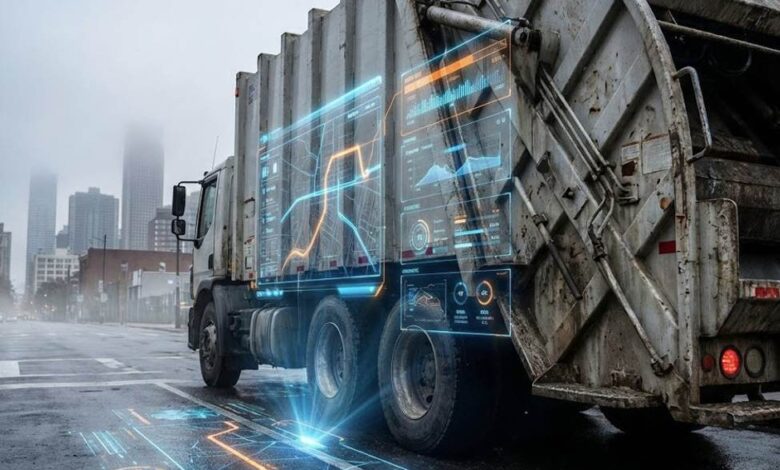
A new CIBC equity research note caught my eye this week. It’s about the waste industry — not exactly the sexiest corner of the market — but it lays out a framework that I think applies to a much broader set of companies. The core idea: AI can add 130 to 270 basis points of EBITDA margin over the next five years to companies that haul garbage. And if it can do that for waste, it can do it across a huge swath of old economy businesses.
This connects directly to the HALO trade I’ve been writing about — Heavy Assets, Low Obsolescence — or RAMP – -Real Assets, Margin Potential — But I want to sharpen it further. There is an opportunity in owning things AI can’t replace but also benefit from AI optimization — the fatter the cost structure, the more there is to optimize.
The math that matters
Here’s the thing about margins that the market is slow to appreciate: a 200 basis point improvement means completely different things depending on where you start.
A SaaS company running 40% EBITDA margins that squeezes out another 200 bps? That’s nice — a 5% improvement to the bottom line. But a pipeline operator or waste hauler running 5% margins that picks up 200 bps? That’s a 40% improvement in profitability. Same basis points, wildly different impact on earnings, cash flow and multiples.
The CIBC framework
What I like about the CIBC note is that it doesn’t just wave its hands about “AI efficiency.” It breaks down the specific cost lines and estimates how much each one contributes. Here’s their framework applied to waste companies, but think of it as a template:
Fuel and route optimization (12-45 bps): AI-assisted route planning, load consolidation, and driver coaching can cut fuel costs by 12-15% in the medium term. For waste companies, fuel runs 1-3% of revenue after surcharges. The savings are modest per line item but they’re real and immediate. This applies to any fleet-heavy business.
Labour and scheduling (42-60 bps): This is the big one. AI-driven routing and labour planning can reduce driver hours, overtime and idle time. CIBC conservatively estimates 5% savings on driver labour costs, which run 8.5-12% of revenue. They note that research from UPS and McKinsey suggests 10-20% is achievable longer term but discount that because warehouse automation gains don’t fully translate to field operations. Fair enough — but even the conservative estimate is meaningful.
Predictive maintenance (20-50 bps): Instead of scheduled maintenance or waiting for something to break, AI monitors equipment and predicts failures before they happen. This alone can cut maintenance costs by 2.5-5%. Maintenance often costs 8-10% of revenue so it’s meaningful.
Customer service automation (14-17 bps): AI chatbots and voice bots can reduce call centre staffing by 20-25%. This is already happening everywhere. Small line item for waste (~0.7% of revenue) but essentially free margin.
Back office / SG&A (9-55 bps): Billing, document processing, accounting workflows — the boring stuff that employs a lot of people. CIBC suggests 1-5% savings in the medium term on SG&A that runs 9-11% of revenue. The range is wide because it depends on how aggressively companies deploy automation.
Dynamic pricing (18-30 bps): AI can optimize pricing at the customer or route level using real-time data. For waste companies, the upside is modest because much of their revenue is locked into municipal contracts. But in more competitive industries like airlines, this could be significantly larger.
Customer retention (15 bps): AI identifies customers at risk of churning and enables proactive outreach. Another small but additive line item.
Add it all up: 130-272 bps of EBITDA margin expansion over five years. And CIBC explicitly says this isn’t exhaustive — landfill energy optimization and other opportunities aren’t even included.
Now apply this framework across the old economy
The waste industry is a great case study, but let me walk through where I think this framework hits hardest.
Airlines (net margins: 2-5%)
This is maybe the single best application. Airlines are massive, complex operations running on razor-thin margins where fuel (20-25% of costs) and labour (30-35% of costs) dominate the expense structure. The global airline industry generated about $1 trillion in revenue in 2025 on net margins of roughly 3%.
The AI opportunity map:
- Fuel optimization through better route planning, altitude management, and weight distribution. Even 2% fuel savings on an airline spending $10 billion annually on jet fuel (that’s how much DAL spent last year) is $200 million straight to the bottom line.
- Crew scheduling and labour optimization — airlines employ tens of thousands of pilots, cabin crew, and ground staff with incredibly complex scheduling constraints. AI can optimize this better than any human planner
- Predictive maintenance on engines and airframes, reducing AOG (aircraft on ground) events that cost $150,000+ per day
- Dynamic pricing — airlines already do this but AI takes it to another level, pricing not just seats but ancillary revenue in real time
- Operations management — gate assignments, turnaround optimization, disruption recovery
I’d estimate 150-300 bps of margin opportunity here. On a $50 billion revenue airline, that’s $750 million to $1.5 billion in additional EBITDA. Look at Delta, United, and AIG as potential beneficiaries.
Railways (operating ratio: 60-65%)
North American Class I railroads are already incredibly efficient operators — they measure themselves by operating ratio (lower is better) and the industry has converged around 60-65%. But there’s still runway on the railway.
Union Pacific and Norfolk Southern just announced an $85 billion merger to create the first coast-to-coast railroad. The combined entity would have about $36 billion in revenue and $18 billion in EBITDA. They’re targeting $2.75 billion in annual synergies, but AI-driven optimization on top of that could be substantial:
- Train scheduling and network optimization — moving more freight with fewer trains
- Predictive maintenance on track, rolling stock and signals
- Fuel efficiency through better speed management and consist optimization
- Yard operations — automating classification and reducing dwell times
- Demand forecasting to better allocate resources
Railroads already invest heavily in technology but the AI layer could push operating ratios toward the mid-50s over time. Every 100 bps of OR improvement on $36 billion of revenue is $360 million. Look at Union Pacific, CSX, and Canadian National.
Utilities (EBITDA margins: 30-40%, but net margins: 8-12%)
Utilities are interesting because while EBITDA margins look healthy, the net margins are thin after you account for massive depreciation on their asset bases and interest on the debt that financed them. The opportunity:
- Grid optimization — AI can predict demand patterns and manage distributed energy resources far better than traditional SCADA systems
- Outage prediction and prevention — reducing truck rolls and emergency repair costs
- Vegetation management — using satellite imagery and AI to prioritize tree trimming (this is actually a massive cost for utilities)
- Customer service automation — utilities handle millions of customer interactions per year
- Energy trading and procurement — better forecasting of generation needs
Companies like NextEra Energy, Duke Energy, and Southern Company are already investing here. A 100-200 bps improvement on net margins would be highly meaningful for stocks that are valued on dividend growth.
Shipping and logistics (EBITDA margins: 5-15%)
Container shipping, bulk carriers, and freight logistics companies are perfect candidates:
- Voyage optimization — speed, route, and fuel management
- Port and terminal operations — container stacking, crane scheduling, yard management
- Fleet maintenance — predictive models for engines and hulls
- Demand forecasting and capacity management
- Documentation and customs processing — massive back-office cost that’s ripe for automation
Look at Maersk, Hapag-Lloyd, and XPO Logistics. These are companies moving physical stuff around the world with enormous operational complexity and relatively thin margins.
Mining and commodity production (margins vary wildly with commodity prices)
When copper is at $5/lb, everyone looks like a shrewd operator. When it’s at $3, the margin pressure is brutal. AI can help smooth the cycle:
- Ore grade optimization — AI can identify the highest-value extraction paths
- Equipment maintenance — mining trucks and processing equipment are enormously expensive to repair
- Energy management — mining is incredibly energy intensive. The business is essentially ‘crushing rock’
- Safety improvements — which directly reduces costs from incidents and downtime
- Processing optimization — improving recovery rates even marginally is worth millions
Companies like BHP, Rio Tinto, Freeport-McMoRan, and Barrick Gold all have massive operational surface area for AI to improve.
Construction and building materials (EBITDA margins: 10-20%)
Companies like Vulcan Materials, Martin Marietta, CRH, and Caterpillar operate in industries where logistics, equipment utilization, and project planning drive profitability:
- Equipment fleet optimization and predictive maintenance
- Project planning and resource allocation
- Supply chain and logistics for moving heavy materials
- Safety management
- Estimating and bidding — AI can dramatically improve the accuracy of project bids, which is where a lot of money is made or lost
Here’s another point CIBC makes that I think is underappreciated: AI adoption further widens the competitive moat for large operators.
In waste, the big four (Waste Management, Republic Services, GFL Environmental, Waste Connections) can afford to invest in AI platforms that smaller operators can’t. The same is true in every industry I’ve listed above. The largest airlines, railroads, miners and utilities will capture these efficiency gains first, and that will make it even harder for smaller competitors to compete.
CIBC argues this will accelerate M&A activity as smaller operators sell rather than try to keep up. I think this is exactly right, and it applies far beyond waste. This is AI as a consolidation accelerant.
The VC desert is the new moat
One more point worth repeating: venture capital has spent the last 15 years funding software and tech startups. There’s no money and no expertise flowing into building new railroads, airlines, refineries, or waste companies. Nobody is starting a new Class I railroad. The barriers to entry in these industries were already enormous — massive capital requirements, regulatory approvals, decades of relationship-building. AI doesn’t lower those barriers; it raises them by giving incumbents another advantage.
The bottom line
The market is spending all its energy figuring out which software companies will be disrupted by AI. I think the bigger trade is in companies that won’t be disrupted by AI but will be made dramatically-to-marginally more profitable by it. There is no need to wade into the software battleground, especially when it’s so volatile.
The CIBC waste framework gives us a roadmap: identify the cost lines, estimate the AI-driven savings, and add up the margin impact. When you do that exercise across airlines, railroads, utilities, shipping, mining and construction, you find 100-300 bps of potential margin improvement in businesses where that kind of uplift is transformational.
These are HALO stocks. Heavy Assets, Low Obsolescence. Or if you prefer, RAMP stocks: Real Assets, Margin Potential. Or TANK stocks: Tangible Assets, Not Killable.
Whatever you call them, I think this is the most underappreciated AI trade in the market right now.