
Bitcoin bears could sleepwalk into a $8.65 billion trap as options max pain expiry nears $90,000


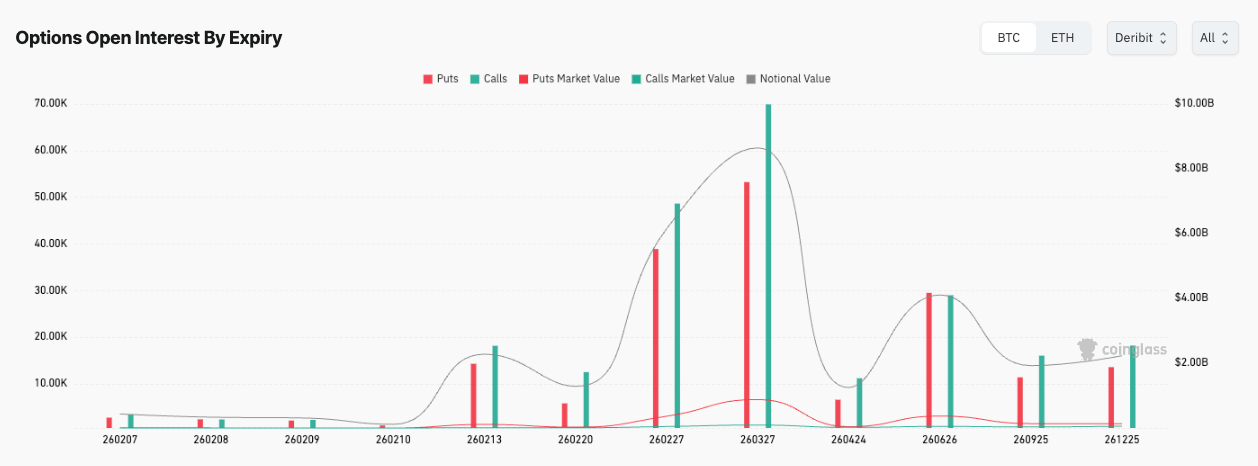


Bitcoin’s next big options gravity well sits on Mar. 27 (260327), and the reason is simple: this is where the market has parked a thick stack of conditional bets that will need to be unwound, rolled forward, or paid out as the clock runs down.
The Mar. 27 expiry carries about $8.65B in notional OI and flags $90,000 as max pain, a rough reference point for where, in aggregate, option holders would feel the most pain at settlement.
The broader options complex is enormous, with total BTC options open interest around $31.99B across exchanges, led by Deribit at roughly $25.56B, with the rest split across CME, OKX, Binance, and Bybit.
That concentration can shape how price behaves on the way there, particularly when liquidity thins and hedging flows start to matter more than anyone wants to admit.
Options can often sound like some kind of private language of institutional traders, which is convenient right up until they start influencing spot price. Our goal here is to translate a crowded derivatives calendar into something legible: where the bets are concentrated, how that concentration can change behavior in spot markets, and why March 27 stands out.
March 27 and the shape of the bets
On Mar. 27 (260327), data shows more calls than puts, roughly 69.85K calls versus 53.25K puts, with puts carrying far more market value than calls in that moment.
That combination might look strange and even contradictory, until you translate it into everyday incentives.
Calls can be plentiful because they offer defined-risk upside exposure that feels emotionally painless to hold, while puts can be more expensive because downside protection is often bought closer to where it actually hurts, and it tends to get repriced more aggressively when the market is nervous.
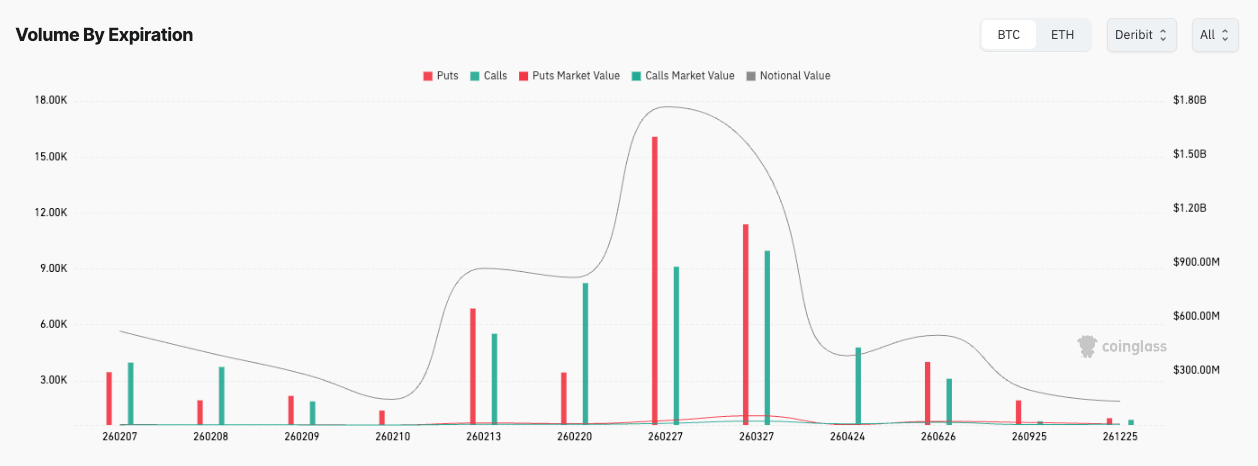
The volume data adds a second clue about what was happening at the margin. For the same Mar. 27 expiry, CoinGlass data shows puts around 17.98K versus calls around 10.46K in trading volume, again with puts carrying the heavier market value.
That tells us the flow that day leans more toward paying for protection than chasing upside, even while the outstanding inventory still looks call-heavy on count.
Now place that against spot and the broader pile.
March can feel far away in calendar terms, especially when the market is this volatile, but in options terms, it’s close enough to exert gravity once nearer expiries finish shuffling positions forward.
When one date holds several billion in notional, it becomes a focal point for rolling, hedging, and all of the other quiet mechanical work market makers do to stay roughly neutral as customers buy and sell convexity. While this doesn’t guarantee a particular price, it does increase the odds of price behaving as if there are invisible grooves in the road, because in a derivatives-heavy market, hedging flows can add friction in some ranges and remove it in others.
That brings us to max pain. It’s a bookkeeping-style calculation across strikes, not a law of nature and not a trading signal with a motor attached.
It can be a useful reference in the way a median can be useful, as a single marker that tells you something about the distribution, but it’s blunt, and blunt tools are almost never the ones moving price.
What tends to matter more is where positions are crowded by strike, because crowding changes how much hedging needs to happen when spot moves. CoinGlass data shows a put/call ratio around 0.44, one more hint that the distribution is lopsided rather than smooth, and lopsided is the whole point because it’s how a date stops being a calendar fact and becomes a market event.
There’s a simple, non-trader way to hold all of this without turning it into fortune-telling.
As March approaches, crowded strikes can behave like zones where price movement feels oddly damped, then oddly jumpy, because the hedging response is not steady.
If Bitcoin wanders into a heavily populated region, the market’s automatic risk management can reinforce a range, and if Bitcoin moves hard enough to escape it, those same mechanics can flip into something that amplifies momentum instead of resisting it.
What’s gamma doing while everyone argues about max pain
If options talk has a single word that scares off otherwise capable people, it’s gamma, which is unfortunate because the idea is straightforward when you keep it tied to consequences rather than algebra.
Options have deltas, meaning their value changes with price, and gamma describes how quickly that sensitivity changes as price moves.
Dealers who sit on the other side of customer trades often hedge to reduce directional risk, and the practical version is that hedging can turn them into automatic buyers on dips and sellers on rallies near crowded strikes. This is one of the clearest explanations for why price can look magnetized to certain regions.
The reason this matters for a large expiry like Mar. 27 is that hedging intensity isn’t constant through time.
As expiry approaches, near-the-money options tend to become more sensitive, and that can make hedging adjustments more frequent and more meaningful in size. That’s where the idea of pinning comes from, the observation that price can spend suspiciously long periods hovering near certain strikes as hedgers lean against small moves.
It’s often just a risk-control habit showing up in the tape, and it becomes easier to notice when open interest is large and concentrated.
CryptoSlate has covered similar episodes as the options market has matured, emphasizing that expiry effects are most visible when positioning is heavy and clustered, also noting that the calm can disappear after settlement as hedging pressure resets and new positions get rebuilt.
More traditional market reporting often treats max pain as a reference point while focusing attention on how expiry, positioning, and volatility interact.
The key is that the mechanism itself isn’t mystical. A large options stack creates a second layer of trading activity that reacts to spot moves, and sometimes that reactive layer is large enough to be felt by everyone, including people who never touch derivatives.
Options greeks charts, with their stepped shapes, are a visual reminder that sensitivity changes in regimes rather than smoothly. They suggest exposure is concentrated around specific strike regions, so the hedging response can change character as spot crosses those zones.
That’s why a single headline number like max pain is usually less informative than a sense of where open interest is thickest, because the thick zones are where hedging flows are most likely to show up as real buying or selling, regardless of what the settlement meme says.
February reshuffles, June anchors, March decides
Mar. 27 is the main event in your snapshot, but the supporting beats matter because they help explain how the March setup can change before it arrives.
The same max pain view shows a meaningful late-February expiry, Feb. 27 (260227), at about $6.14B notional with max pain around $85,000.
It also shows notable size further out, including a high concentration at late June (Jun 26, 260626), which serves as a reminder that positioning is not only about the next few weeks, it is also about the market’s longer-dated posture.
February matters because it’s close enough to force real decisions.
Traders who don’t want positions to expire often roll them, and rolling isn’t just a calendar action, it’s a change in where exposure sits.
If February positions get rolled into March, the March pile grows heavier, and the gravity well can deepen. If February positions are closed or shifted to different strikes, March can look less crowded than it does today, and the options map will change in a way that has nothing to do with headlines and everything to do with inventory management.
Either way, February is a likely moment for hedges to be adjusted and for the strike distribution to be reshaped, which is why it deserves attention even in a March-focused story.
June matters for a different reason. Far-dated size tends to decay more slowly and can function like an anchor for risk limits, which can affect how aggressively desks manage near-dated risk in March.
The presence of meaningful longer-dated positioning suggests the market is warehousing views about where Bitcoin could be by early summer. That kind of positioning doesn’t dictate day-to-day price, but it can influence the tone of the market around March, including how quickly hedges are rolled forward and how much risk dealers are willing to wear.
So the practical takeaway is that the headline numbers aren’t the story on their own.
The $8.65B notional on Mar. 27 and the $90,000 max pain marker tell you there’s a crowded event on the calendar, but the mechanism worth watching is where the crowd is standing by strike and how hedging pressure behaves as time shrinks.
The path to March runs through February, when positions can be reshuffled, and it stretches toward June, where longer-dated size can shape how the market carries risk.
None of this replaces macro, flows, or fundamentals, and it doesn’t need to. It’s a layer of explanation for why Bitcoin can look oddly well-behaved.
When the options stack is this large, you can often see the outlines of the next pressure point in advance, as long as you treat max pain as a rough signpost and focus instead on the crowding that can make price feel sticky in one moment and surprisingly slippery in the next.