






Bitcoin experienced a steep decline over the last 24 hours, pushing its price to approximately $60,000 amid an accelerated selloff comparable to the 2022 FTX collapse.
BTC had recovered to $69,800 as of press time, according to CryptoSlate data.
Still, Glassnode data helped frame the extent to which the price had slipped relative to widely watched on-chain reference points.
With the spot price plunging, the key on-chain price models were far higher, including the STH cost basis at $94,000, the Active Investors Mean at $86,800, and the True Market Mean at $80,100.
Meanwhile, the flagship digital asset’s realized price sat at $55,600.
In light of this, the price move prompted traders to search for a single “smoking gun,” even as the available evidence pointed to a more mechanical unwind.
X fills the gap with theories, but little evidence
As Bitcoin prices fell rapidly, social media became a clearinghouse for speculation, with narratives moving almost as fast as the price.
Traders on X floated multiple explanations for the slide, including rumors of a hidden Hong Kong hedge fund blowup, yen-funding stress, and even quantum security fears.
However, those claims share a common problem: they are difficult to verify in real time, and none has been accompanied by publicly documented evidence that would, on its own, explain the size and timing of the move.
That does not mean every rumor is false, but the pattern is familiar in fast-moving markets. A sharp liquidation event creates a narrative vacuum, and the internet attempts to fill it, often before the underlying drivers can be measured with any clarity.
In light of this, CryptoSlate’s more durable explanation for the past 24 hours lies in observable plumbing, ETF flow pressure, forced leveraged positions, and on-chain data showing large holders moving coins onto exchanges.
It is less cinematic than a single-surprise catalyst, but it better matches how crypto selloffs tend to propagate once they begin.
ETF outflows and a liquidation cascade hit the bid
The cleanest, most measurable headwind has been persistent selling via US spot Bitcoin ETFs.
Over the past four months, spot Bitcoin ETFs have seen net outflows of more than $6 billion, according to SoSo Value data.
In practice, such sustained withdrawal matters because it changes who is standing on the other side of the trade. When inflows are strong, the market can lean on a steady, price-insensitive buyer. When outflows persist, that support becomes intermittent, and dips can feel like they have fewer natural bids.
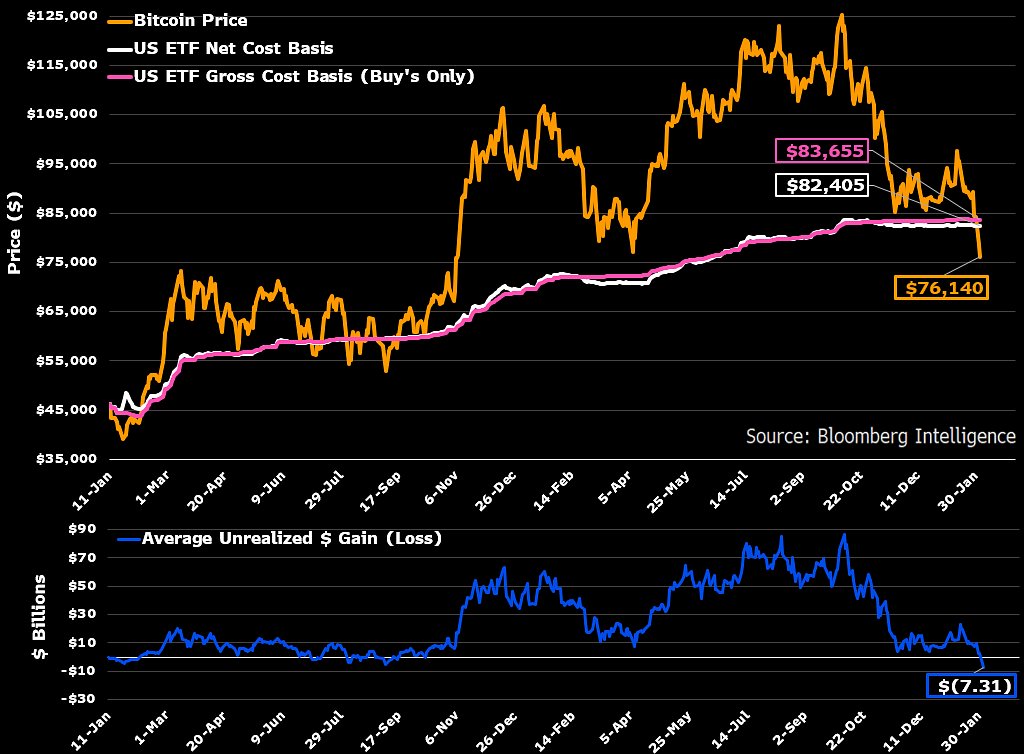
James Seyffart, a Bloomberg ETF analyst, noted that Bitcoin ETF holders, in aggregate, are holding their largest losses since the ETFs launched in January 2024, following Bitcoin’s price collapse.
He added that the ETFs are experiencing the worst Bitcoin pullback in percentage terms since launch, now at approximately a 42% loss with Bitcoin under $73,000.
Those figures are not a one-day trigger, but they change the market structure. In a market accustomed to steady ETF demand, sustained outflows reduce the size of the “automatic dip buyer,” making downside breaks more violent when stops and liquidations begin to fire.
The selling does not need to be dramatic to matter; it simply needs to be persistent enough to dull rebounds and thin liquidity at key levels.
And once the Bitcoin price fell through key levels, forced selling amplified the move. CoinGlass data showed that more than $1.2 billion in leveraged positions were liquidated as Bitcoin sank to record lows.
This represented a dynamic that can turn discretionary selling into a mechanical cascade.
That sequence is typical in crypto drawdowns. A selloff often begins with risk reduction, then accelerates when exchanges close derivatives positions, regardless of conviction or “fundamentals.”
When liquidity is thin, the forced flow can dominate price discovery. It can also make the tape appear to react to hidden information, when the more straightforward explanation is that leverage is being shut down quickly and automatically.
On-chain signals show realized losses and whale deposits
Meanwhile, blockchain data added a second layer to the story, showing both pain realization and potential supply moving toward venues where it can be sold or hedged.
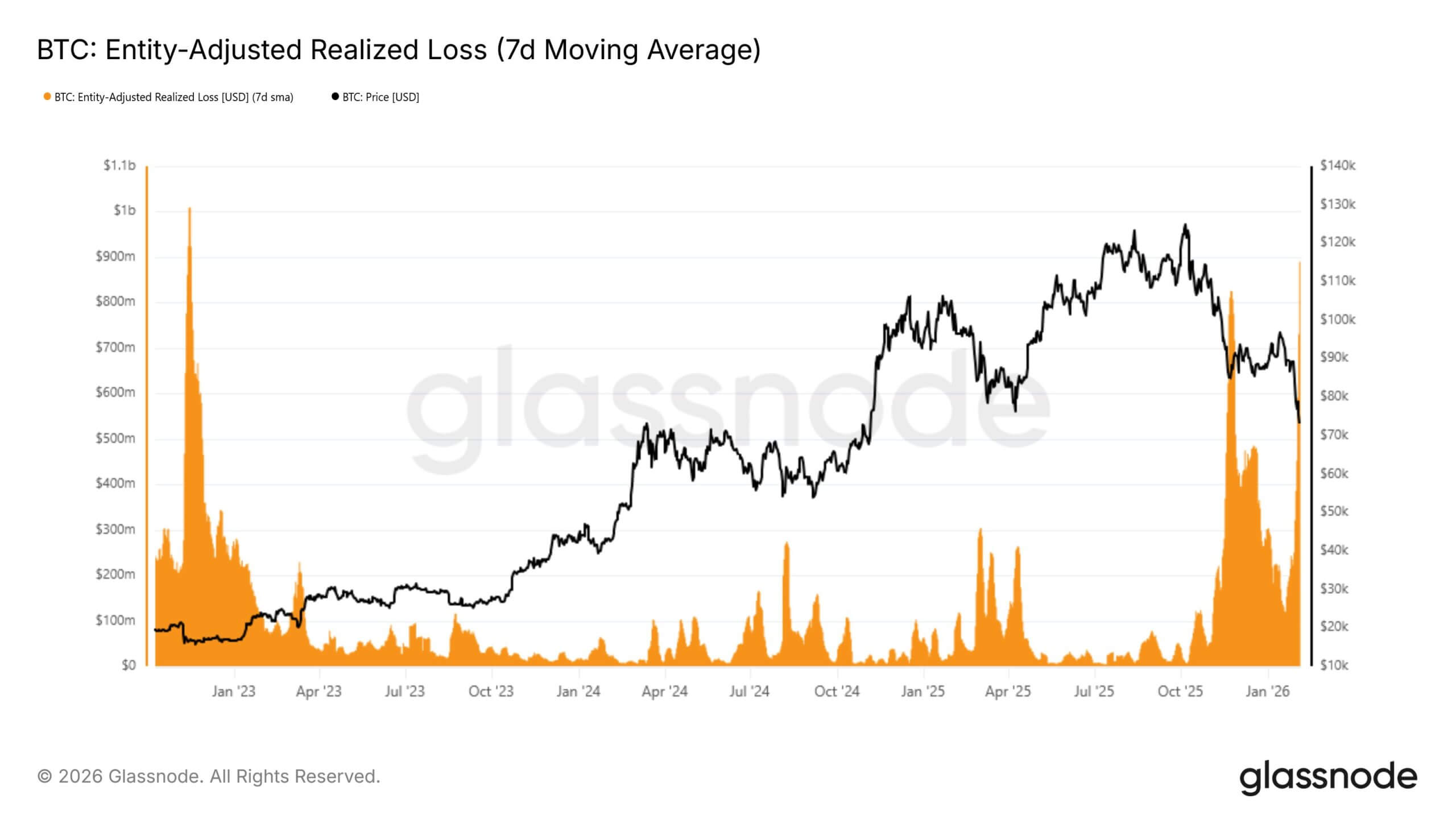
Glassnode data showed that on Feb. 4, Bitcoin’s Entity-Adjusted Realized Loss (7D-SMA) hit $889 million per day, the highest daily loss realization since November 2022.
This kind of print typically appears when coins are being sold at a loss at scale, consistent with capitulation dynamics during sharp drawdowns.
This is a reminder that the damage in a selloff is not only the headline price move, but also the volume of holders locking in losses as the market trades through levels that had previously served as psychological support.
On the other hand, CryptoQuant data pointed to whale behavior on Binance during the sell-off.
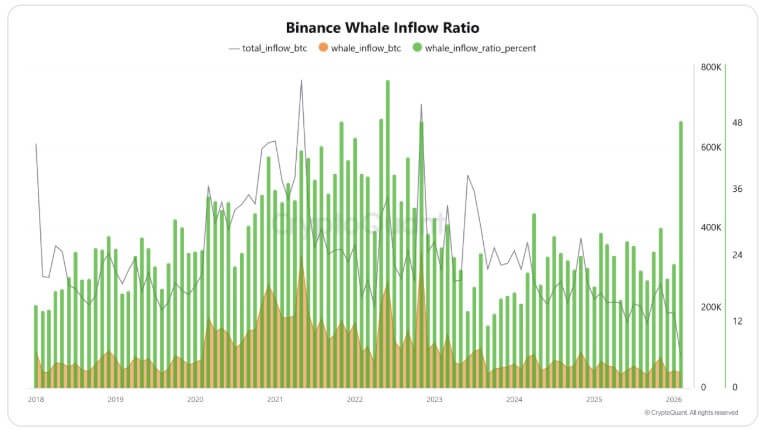
According to the firm, the Exchange Whale Ratio (30-day SMA) surged to 0.447, its highest level since March 2025.
An elevated whale ratio indicates that the largest inflows make up an unusually large share of deposits, a pattern often associated with whales preparing to sell, hedge, or reposition.
Additional CryptoQuant data quantified the scale of those deposits. It reported that total Bitcoin inflows to Binance were approximately 78,500 BTC in early February, with whale inflows of approximately 38,100 BTC, implying that whales accounted for roughly 48.5% of deposits.
Meanwhile, the above data does not guarantee immediate selling. Large deposits can also precede derivatives hedging, collateral moves, or internal treasury reshuffles.
However, in the context of a rapid price break and a liquidation cascade, this reinforces the idea that large players were active on the supply side as liquidity deteriorated. Even the possibility of supply moving toward an exchange can weigh on sentiment when the market is already fragile.
Moreover, Santiment data also framed the move as a distribution event among large holders.
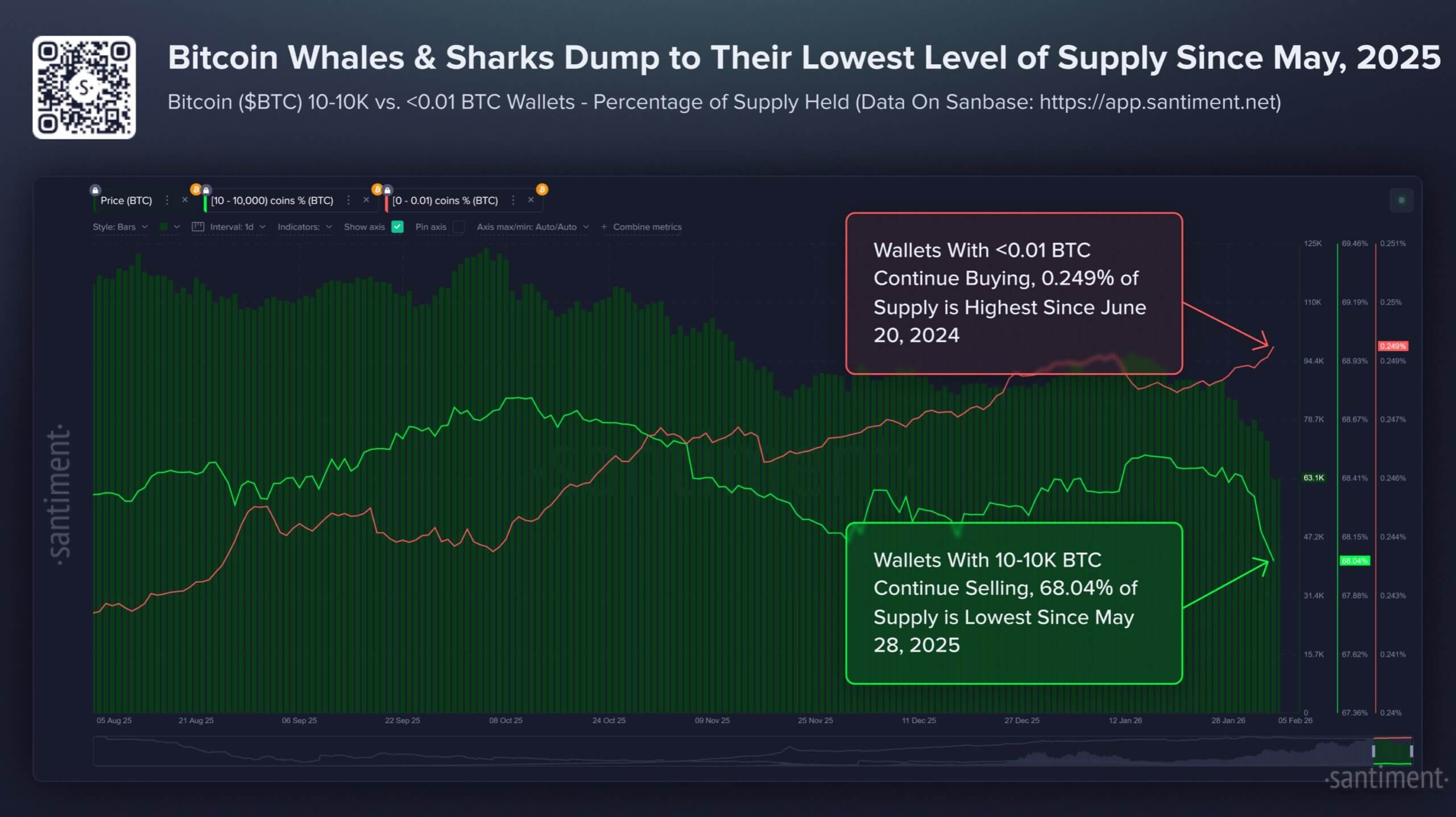
According to Santiment, wallets holding 10 to 10,000 BTC fell to a nine-month low of 68.04% of total supply after a net reduction of 81,068 BTC over eight days, while “shrimp” wallets holding less than 0.01 BTC rose to a 20-month high of 0.249% of supply.
Taken together, the on-chain picture is consistent with what the tape showed: large holders were active, loss-taking spiked, and smaller buyers were not enough to prevent an air pocket once leverage began to unwind.
Retail accumulation can slow a decline at the margin, but it rarely overpowers a market being pushed around by leverage resets and large-holder positioning.
Macro risk-off and cross-asset deleveraging tightened liquidity
The final leg of the explanation is macro, because Bitcoin has increasingly traded as a liquidity-sensitive risk asset during periods of stress.
Reuters linked the broader market mood to an unwind of leveraged and speculative positioning across multiple assets, including crypto, as investors retreated from risk.
At the same time, there was a sharp decline in commodities, including gold and silver, during the same window, underscoring that the pressure was not isolated to crypto.
When both speculative assets and traditionally “defensive” positions are being sold, liquidity can tighten quickly, particularly if margin requirements rise and funds reduce exposure across portfolios.
US equities also contributed to the risk-off tone. Reuters coverage over the week described a tech-led pullback as investors questioned the payoff timeline for heavy AI spending and debated whether AI disruption could compress margins across software and data services.
Moreover, fresh labor-market stress signals, including January layoff announcements, which are the highest for the month in 17 years, can feed into a broader repricing of growth and risk.
That matters for Bitcoin because macro-driven de-risking tends to hit the most liquid, most reflexive markets first.
In this episode, the price action fit that template. ETF outflows weakened the marginal bid, a break in spot prices triggered derivative liquidations, and on-chain data showed loss realization and whale deposits rising amid volatility.
The result was a move that looked like a “black swan” on a chart, but behaved like a liquidity event in the plumbing.