It’s a massacre in software: IGV down another 4.9%, who are the winners and losers?

2026-02-05 20:53:00
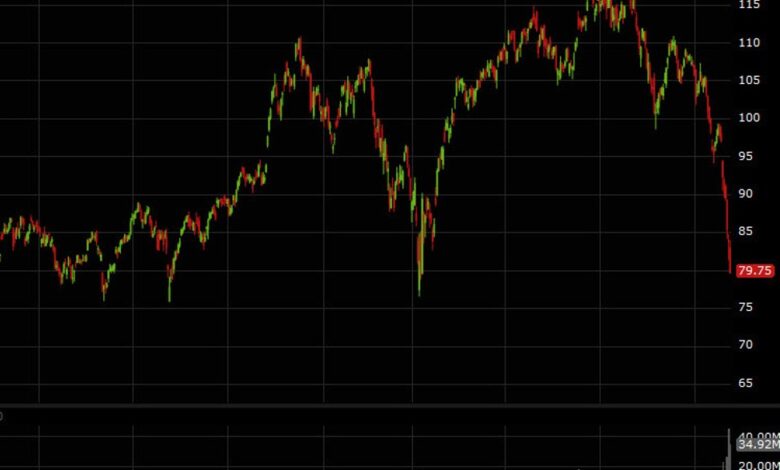
Have a look at the IGV ETF, which has become the poster child for the latest market selloff. It’s down 4.9% today and 32% since October.
The thinking is clear: AI agents are going to rule the internet. You won’t go to websites anymore, you’ll ask AI to do things and everything will happen in the context window. Particularly vulnerable are companies that rely on you paying for an interface, like Thomson Reuters, which sorts and annotates legal data as a large part of its business. That data isn’t proprietary and an LLM agent can take over, crushing a software business with a high monthly subscription cost.
Much of the damage has been done to these stocks and we’re getting to the point where people are sifting through the wreckage. The largest component of the IGV (look at that volume) is Microsoft, which is down 18% in the past six sessions, including 4.9% today.
Notice on the IGV chart above that volume is surging and many are likely shorting it as a hedge, though that shouldn’t really affect a behemoth like MSFT. I suspect the thinking is that if you need fewer white collar workers, you will simply need fewer licences for Windows and Office.
On the flipside, winners are likely to be companies where their core data is generated by the business itself
through proprietary processes that can’t be scraped, licensed, or synthesized
by an LLM. Think of them more like utilities than software.
Here are three in the financial space that have huge moats. Some have been beaten up and today’s price action in TradeWeb (+9% on earnings as a software stock on a day like today) shows how quickly they could bounce back.
All three are
trading below their historical average multiples because the market is lumping
them in with the interface-moat companies getting destroyed.
S&P Global (SPGI) – 24-26x forward P/E
S&P Global’s moat has
nothing to do with its interface. It’s that S&P credit ratings are written
into bond indentures, loan covenants, and Basel capital requirements by
name. Replacing them would mean rewriting hundreds of thousands of legal
contracts and renegotiating regulatory frameworks across dozens of
jurisdictions. Nobody’s doing that.
The S&P Dow Jones Indices
business has over $17 trillion in assets benchmarked and more than $2.2
trillion in ETF AUM directly linked to its indices. Commodity Insights (Platts)
provides price assessments that serve as contractual benchmarks in physical
commodity markets. These aren’t data products. They’re standards.
The numbers are clean. Q3 2025
revenue up 9% to $3.89 billion. Adjusted EPS up 22%. Ratings segment running
60%+ adjusted margins. FY2026 consensus sits around $19.10—call it 11% growth.
They’re returning roughly 85% of adjusted free cash flow to shareholders. At a
forward P/E of approximately 24–26x, this is below the five-year average of
roughly 40x.
Here’s what I find most
interesting. S&P Global isn’t fighting LLMs for the interface—it’s embracing
the role of infrastructure. They’ve already signed data API partnerships with
Microsoft, Anthropic, Google, Salesforce, and IBM. If LLMs become the dominant
interface for financial analysis, S&P’s data becomes the layer underneath
every query. That’s not disruption. That’s a promotion.
MSCI (MSCI) – 29-30x forward P/E
MSCI’s indices aren’t data
products. They’re financial infrastructure. Trillions in institutional mandates
are contractually benchmarked to MSCI indices. Changing your index provider
isn’t like switching software vendors—it requires board-level decisions,
mandate renegotiations, and regulatory filings. Years, not quarters.
The ACWI, EAFE, and Emerging
Markets indices set the benchmark for institutional asset allocation globally.
Every dollar of new ETF AUM linked to an MSCI index generates licensing revenue
at near-zero marginal cost. It’s one of the highest-margin businesses in
finance.
Revenue growth running around
10–12%, EPS growth similar, driven by margin expansion and buybacks. The
forward P/E is roughly 29–30x—meaningfully below its five-year historical
average of about 42x.
The LLM angle is simple. When an
AI agent rebalances a portfolio, the benchmark will be an MSCI product. When an
LLM answers “how should I allocate across international markets?”, it’ll
reference MSCI indices. The interface changes—from Bloomberg terminal to chat
window—but the standard doesn’t. MSCI’s value is completely independent of the
delivery mechanism.
Tradeweb Markets (TW) – 30x forward P/E
TW stock daily
This is the rare name where LLMs
are a clear positive.
Tradeweb runs the dominant
electronic trading platform for fixed income. The moat is the two-sided network of liquidity providers and institutional buyers. More
participants means better pricing means more participants. Classic network
effects. And you can’t license “liquidity” from an alternative provider.
Revenue grew approximately 13.8%
year-over-year in today’s annual report and it’s debt free. Forward P/E isn’t cheap at around 30x but it’s grown revenues by double digits for 7 years in a row. What you’re paying for is the secular shift from voice-negotiated
to electronic trading in the $130+ trillion global fixed-income market—a shift
that has decades of runway left. Bond markets are still far less electronic
than equity markets.
Now think about what happens as AI agents start executing trades. They
need electronic venues with deep liquidity. An LLM routes an order to Tradeweb
far more efficiently than a human trader negotiating over the phone. AI doesn’t
destroy Tradeweb’s business model, it improves it.
Here’s a comment in today’s earnings transcript that’s telling: “The geopolitical complexity kind of/drama whether or not we want to think about like the debasement trade or diversification away from U.S. assets. At a minimum, what we’re talking about, obviously, is central bank policy divergence. From our perspective, what’s that going to do? It’s going to spur more cross-border trading, more global activity. And we have, as you know well, a global enterprise. And our international business is exceptionally strong. So in January, we saw exceptionally good results from our European swaps business, European government bonds. Very strong numbers coming out of European credit. The revenues there were up 40%. Big news obviously happening this month in Japan, our JGB revenues were up 30% in January.”