
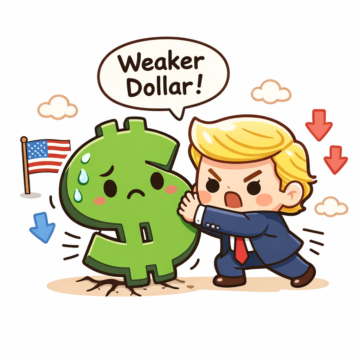
For decades, every U.S. administration, Republican and Democrat alike, has championed the “strong dollar policy.” But Trump has thrown that playbook out the window recently, publicly celebrating dollar weakness as a path to manufacturing revival and export growth. This represents one of the most dramatic shifts in U.S. currency policy in modern history.
Wait, what? Isn’t a strong currency supposed to be a good thing and vice versa?
Here’s what’s really happening, why it matters for markets and your wallet, and what beginner traders need to understand about currency strength and weakness.
The Basics: What Happened?
The Dollar’s Historic Collapse
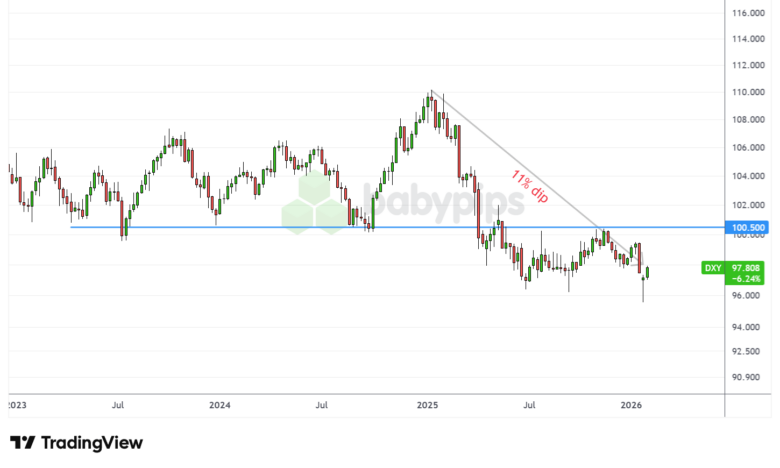
The U.S. Dollar Index (DXY), which measures the dollar against a basket of major currencies including the euro, yen, and pound, has fallen approximately 10% over the past year, hitting its weakest level since early 2022. In January 2026 alone, it dropped below 96, touching lows around 95.55.
To put this in perspective: this is the dollar’s worst annual decline since 2017. And unlike previous dips that triggered concern from Washington, this time the president is cheering it on.
“I think it’s great,” Trump told reporters in Iowa on January 27, 2026. “Look at the business we’re doing. The dollar’s doing great.”
Trump’s Break With Tradition
Trump’s embrace of dollar weakness marks a radical departure from decades of U.S. policy. Since the 90s, Treasury Secretaries have ritually affirmed America’s commitment to a “strong dollar” which is code for maintaining confidence in U.S. assets and the dollar’s global dominance.
Trump has consistently rejected this view, arguing that a strong dollar hurts American manufacturers by making U.S. exports more expensive and foreign imports cheaper. In his view, countries like China and Japan gained competitive advantages by keeping their currencies artificially weak, and America should do the same.
His Treasury Secretary Scott Bessent tried to walk back Trump’s comments the next day, reaffirming the “strong dollar policy.” But the damage was done, as the president had sent a clear signal that he welcomes dollar depreciation.
What Else is Driving the Decline?
Several factors have combined to push the dollar lower:
- Trump’s tariff chaos: His “Liberation Day” tariffs in April 2025, followed by waves of additional trade barriers, shook global confidence in U.S. economic stability and predictability.
- Attacks on Fed independence: Trump’s public criticism of Federal Reserve Chair Jerome Powell, including a Justice Department investigation and threats to remove him, raised fears the Fed might lose its independence and pursue inflationary policies.
- Massive fiscal deficits: U.S. debt now stands at $38.57 trillion and climbing. Trump’s proposed $500 billion defense spending increase and $2,000 checks to households funded by tariff revenue will widen the deficit further.
- Geopolitical tensions: Trump’s threats over Greenland, confrontations with European allies, and unpredictable foreign policy have made dollar assets seem less safe.
- Rate cut expectations: Markets anticipate the Fed will cut rates in 2026, lowering the opportunity cost of holding non-dollar assets.
Promotion: With U.S. debt climbing and the dollar index hitting multi-year lows, savvy traders are diversifying beyond fiat. Secure your portfolio with the world’s most trusted, regulated crypto exchange. Learn more at Coinbase.
Disclosure: We may earn a commission from our partners if you sign up through our links, at no extra cost to you.
Why It Matters: Market Impact
Gold Set Record Highs
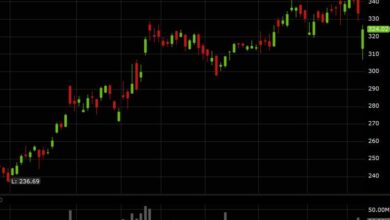
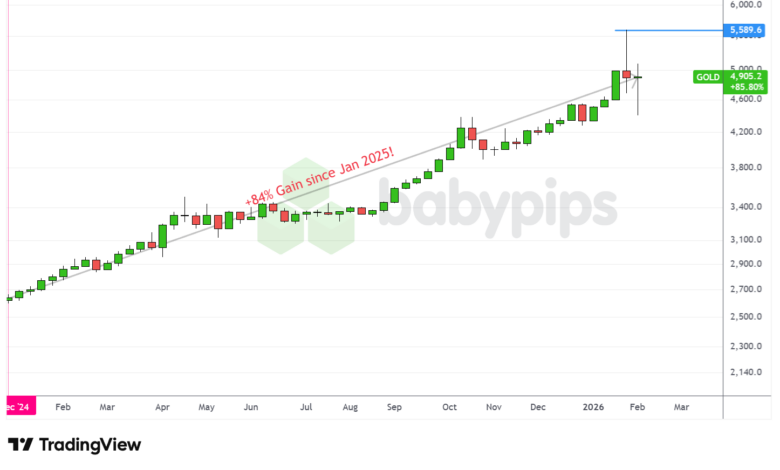
Gold Weekly: Chart Faster With TradingView
The dollar’s weakness has turbocharged gold prices. Last week, gold broke above $5,000 per ounce for the first time, peaking around $5,100-$5,115 before briefly surging as high as $5,555 later that week.
This followed a historic run: gold already rose 64% in 2025, marking its biggest annual gain since 1979, and added another 15%+ in just the first month of 2026.
Why the rally?
- Dollar debasement fears: Investors worry the U.S. may inflate away its debt burden
- Central bank buying: Emerging market central banks purchased an estimated 755-1,000 tonnes in 2025, diversifying away from dollars after the U.S. froze Russia’s reserves
- Safe-haven demand: Geopolitical uncertainty from Greenland to Venezuela to Middle East tensions
- Fed independence concerns: Fears that Trump will install a dovish Fed chair in May 2026 when Powell’s term ends
Commodities and Foreign Markets Also Rallied
Dollar weakness didn’t just lift gold, it boosted virtually all dollar-priced commodities:
- Silver jumped above $100 per ounce, benefiting from both safe-haven demand and industrial uses
- Oil and copper become cheaper for non-U.S. buyers, increasing demand
- Emerging market assets attract capital as dollar weakness eases financial conditions globally
International stock markets have crushed U.S. returns when measured in dollars:
- Europe’s Stoxx 600: +4.4% in 2026 (vs +1.4% for S&P 500)
- Japan: +7.2%
- Brazil: +17%
This “sell America, buy the world” trade has accelerated as the dollar weakened.
The Reserve Currency Question
Perhaps the most significant long-term consequence: questions about the dollar’s reserve currency status.
The dollar still comprises about 58% of global foreign exchange reserves, with the euro a distant second at 20%. But that 58% is down from 72% in 2001, and the trend has accelerated.
China’s President Xi recently called for building a “powerful currency” to challenge dollar dominance. While the yuan still makes up only 2% of reserves, central banks worldwide are actively diversifying, not just into other currencies, but into gold.
The Bottom Line
The dollar’s massive decline and Trump’s embrace of currency weakness represent far more than just an exchange rate adjustment. They signal a fundamental shift in U.S. economic policy with cascading effects across global markets.
What to Watch Going Forward:
- May 2026: Fed Chair Powell’s term expires. Trump is expected to nominate a replacement. If he chooses a “monetary policy dove” committed to lower rates regardless of inflation, expect further dollar weakness and gold strength.
- Central bank actions: Watch for signs that foreign central banks are accelerating diversification away from dollars and into gold, yuan, or other alternatives.
- Inflation data: If import prices surge due to weak dollar and tariffs, the Fed may be forced to pause rate cuts or even hike, which could reverse currency trends.
- Trade partner responses: Are other countries engaging in competitive devaluation? Any signs of a 1930s-style currency war?
- Gold’s technical levels: Goldman Sachs’ $5,400 target implies another 8%+ upside from $5,000. A break below $4,800 would suggest the rally is cooling.
Understanding dollar dynamics is crucial because it oftentimes has an influence on everything: stock valuations, commodity prices, inflation, interest rates, and international competitiveness. A 10% move in the dollar can make or break portfolios.
Currency trends unfold over months and years, not days. Don’t try to trade every headline. Instead, understand the big picture forces at work and position accordingly.
Remember that there are no guarantees. Trump’s weak dollar comments could be reversed tomorrow, trade deals could stabilize currencies, or a crisis could trigger safe-haven dollar strength. Stay flexible and protect your capital.
Stop guessing, start positioning. Get weekly deep dives and technical setups to trade the ‘Weak Dollar’ era with confidence! Check out our Premium membership for weekly & event analysis, short-term strategies, recaps and more!