

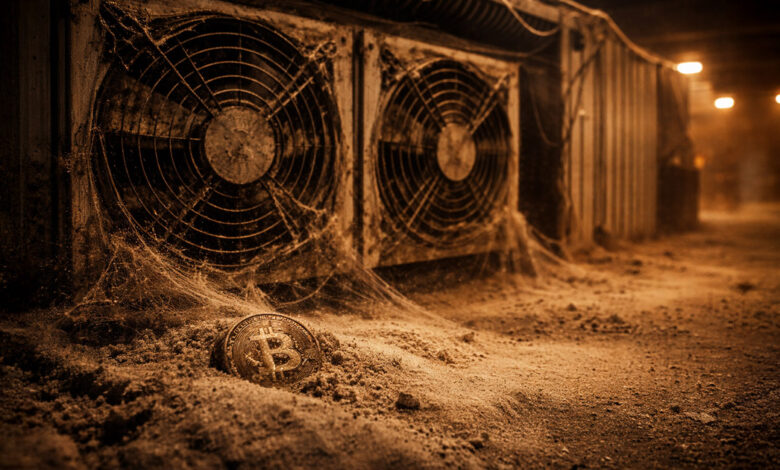

The euphoria of October’s record highs has evaporated, leaving the industrial backbone of the Bitcoin network facing a brutal reality check.
According to CryptoSlate’s data, Bitcoin is currently trading near $78,000, a level that represents a punishing decline of more than 38% from its all-time high of over $126,000 just four months ago.
While casual observers might see a standard market correction, the view from inside the mines is far more dire. The steep drop in the flagship digital asset’s price has collided with stubbornly high network difficulty and rising energy costs to create a perfect storm for operators.
Analytics firm CryptoQuant recently described miners as “extremely underpaid,” given the current combination of depressed prices and difficulty, with its profit-and-loss sustainability index slumping to 21. That is the lowest reading since late 2024.
Notably, the financial strain is already causing machines to go offline, resulting in Bitcoin’s total hashrate declining by about 12% since last November, the steepest drawdown since the China mining ban in 2021. This has left the network at its weakest level since September 2025.
For a system that sells itself as the most secure computer network in the world, this is more than just a bear-market story. It is a stress test of Bitcoin’s security model at a moment when miners have better-paying alternatives than ever before.
Bitcoin miners’ capitulation maths
Bitcoin’s security relies on a simple incentive structure in which the network pays a fixed block subsidy plus transaction fees to whoever solves the next block.
When prices were above $126,000 in October, the “security budget” was sufficient to cover inefficiencies. However, the margin for error has vanished as prices have crashed under $80,000.
New figures from the mining pool f2pool illustrate how severe the revenue compression has become.
On its Feb. 2 hardware electricity cost dashboard, the pool estimates Bitcoin’s price at around $76,176, network hashrate at near 890 exahashes per second (EH/s), and daily revenue at about $0.034 per terahash for miners paying $0.06 per kilowatt-hour.
To put that in perspective, Luxor Technology’s Hashrate Index recorded spot hashprice near $39 per petahash per second (PH/s) per day only a few months prior.
That figure was already thin by historical standards before falling toward an all-time low of around $35 as of press time.
The current f2pool figure of $0.034 per terahash, equivalent to $34 per PH/s, confirms that miners are operating at the historical floor.
When those economics are mapped onto individual machines, it becomes clear why hashrate is falling.
At a reference Bitcoin price of $75,000 and the same six-cent power cost, electricity accounts for about 52% of revenue for Bitmain’s newest Antminer S21 XP Hydro units, which combine roughly 473 TH/s of hashpower with 5,676 watts of draw. Those are the best numbers available.
As the efficiency curve worsens, the math turns red. Mid-generation rigs, such as an Antminer S19 XP or an Avalon A1466i, exhibit electricity cost rates of approximately 92%-100% at that price point.
Meanwhile, older or less efficient models, including the Avalon A1366, Whatsminer M50S, and S19 Pro lines, show electricity cost rates ranging from approximately 109% to 162%.
In plain English, this means that at $75,000 Bitcoin and a mainstream power tariff, vast fleets of hardware are mining at a cash loss before even accounting for debt, hosting fees, or general expenses.
The AI escape hatch
This current revenue crash differs from previous crypto winters because the miners’ distressed assets, like power contracts and grid connections, have a new, deep-pocketed suitor.
The same infrastructure that enables Bitcoin mining is precisely what hyperscale AI compute requires. And unlike the struggling Bitcoin network, AI infrastructure providers are willing to pay up.
The former mining operation CoreWeave has become emblematic of this shift. It pivoted from crypto to become a specialist “neocloud” for AI workloads and recently secured a $2 billion equity investment from Nvidia to accelerate its data center buildout.
In 2025, it sought to acquire miner Core Scientific in a multibillion-dollar deal, explicitly framing miners’ sites and power contracts as prime real estate for GPUs rather than ASICs.
Other public Bitcoin miners have taken the hint and are pivoting hard towards AI. For example, Canadian operator Hut 8 recently signed a 15-year, 245-megawatt AI data center lease at its River Bend campus, with a stated contract value of approximately $7 billion.
This deal effectively locks in long-term economics that differ markedly from the volatility of mining rewards.
For shareholders, these pivots offer a rational exit from the bleeding caused by the 30% price drop. They can swap cyclical Bitcoin revenues for contracted AI cash flows that investors currently value at a premium.
For the Bitcoin network, however, this raises a more difficult question: what happens when a component of its security infrastructure discovers a business that offers higher compensation?
Bitcoin’s network security budget under siege
Jeff Feng, co-founder of Sei Labs, called the current period “the biggest bitcoin miner capitulation since 2021,” arguing that large miners pivoting to AI compute are amplifying the drawdown.
The key difference from prior cycles is that some of this hash isn’t just powering down until the price recovers. It is being reallocated permanently.
Once a 245 MW site is fully re-racked for AI under a long-term lease, that power is, in practice, unavailable for future hashrate expansion.
Make no mistake, Bitcoin remains extremely secure in absolute terms. Even after recent declines, the cost of amassing sufficient hashpower to attack the network remains immense.
However, the concern is about direction and composition rather than immediate collapse. A sustained decline in hashrate lowers the marginal cost of attacking.
With less honest hash online, it takes fewer resources to acquire a disruptive share of the network’s compute, whether through renting capacity or building it outright.
This trend also narrows the base of stakeholders paid to defend the chain. If older, higher-cost operators exit and only a handful of ultra-efficient miners remain profitable, control over block production becomes increasingly centralized.
This creates a fragility that is masked by the headline hashrate numbers.
So, CryptoQuant’s “extremely underpaid” label is effectively a warning that, at today’s block rewards and fees, a meaningful slice of industrial hash is operating on thin or negative margins.
It serves as a forward indicator of how robust the network’s security budget really is relative to competing uses of capital and electricity.
How will Bitcoin miners survive?
From here, the miner squeeze could influence Bitcoin’s evolution in several distinct ways.
One path is quiet consolidation. Difficulty resets, the most efficient operators capture a larger share of block production, and hashrate grows more slowly than in previous cycles but remains large enough that few outside specialists notice.
For investors, the primary effect is volatility, as each market drawdown compresses a narrower group of miners, thereby increasing their selling and hedging behavior.
Another path would accelerate Bitcoin’s transition to fee-driven security faster than the halving schedule alone implies. If subsidies remain light relative to AI returns, the ecosystem may have to rely more on transaction fees to keep miners fully engaged.
That could mean greater focus on high-value settlement at the base layer, more activity on second-layer systems, and a wider acceptance that block space is a scarce resource rather than a cheap commodity.
A third, more speculative path would see external backstops become explicit. This would mean that the same institutions that normalized spot Bitcoin ETFs might eventually view the security budget as they view bank capital ratios, as something that can require deliberate support.
That could take the form of higher fees for certain transaction classes, industry-funded incentives for miners, or scrutiny of AI conversions that materially dent hashrate in key regions.
Notably, none of those outcomes would require a break with Bitcoin’s core design. All involve the industry deciding, in a more crowded energy market, how much it is prepared to pay to keep hash on the network rather than in GPU clusters.
At present, the f2pool dashboard provides a snapshot of that negotiation. A system with about 890 exahashes per second of compute and a price of approximately $76,000 is paying roughly 3.5 cents per terahash per day for its security.
Whether future energy investments accept that rate or demand something closer to AI economics will determine how the mining market ultimately pivots.