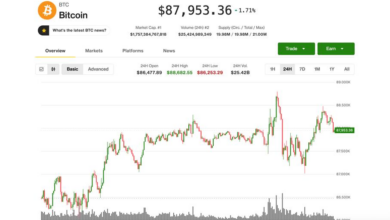
The next Bitcoin all-time high has a clear 3 year window but a brutal $1.3 billion exodus changes everything today






Bitcoin’s path back to a new all-time high and subsequent price discovery is being set by whether spot ETF flows turn persistent again after a two-way start to 2026 that tested how “sticky” institutional demand is in the post-ETF era.
CryptoSlate tracked $1.29 billion of net outflows from U.S. spot Bitcoin ETFs from Dec. 15 through Dec. 31, 2025. The stretch showed redemptions can cluster even late in the year.
The first full trading week of January 2026 brought another risk-off impulse. Spot Bitcoin ETFs shed a combined $681 million.
Farside Investors’ daily flow table for that window shows multiple large negative sessions. Those include -$486.1 million on Jan. 7, -$398.8 million on Jan. 8, and -$250.0 million on Jan. 9.
| Date (2026) | Spot BTC ETF net flow (USD mm) |
|---|---|
| Jan. 7 | -486.1 |
| Jan. 8 | -398.8 |
| Jan. 9 | -250.0 |
| Jan. 14 | +840.6 |
| Jan. 20 | -479.7 |
| Jan. 21 | -708.7 |
| Jan. 22 | -32.2 |
| Jan. 23 | -103.5 |
The whiplash cuts both ways, revealing how quickly the conduit can reopen and how quickly it can reclose when risk appetite fades.
The largest single-day inflow print of early 2026 arrived on Jan. 14. Inflows topped about $840 million, as Bitcoin traded above $97,000.
But the late-January tape shifted again: four sessions from Jan. 20 through Jan. 23 totaled roughly $1.32 billion of net outflows, led by -$708.7 million on Jan. 21. That reversal is the more current test of whether creations can persist beyond bursty, price-chasing days.
Spot ETF era changes the market’s pacing
The 2024 approval of spot Bitcoin ETFs was a key market structure change that makes these prints significant, reshaping how demand and supply are expressed through a regulated vehicle. Prior to that, any crypto ETF flows were essentially meaningless, as they were based on ‘paper Bitcoin’ through futures markets.
For traders trying to time the next all-time high, the most obvious question is whether this shift removes the halving cycle.
One thing we know for certain is that it changes the pacing and visibility of repositioning, because flows mostly respond to macro conditions rather than impose them.
History still sets the most recent reference point for “price discovery.” Bitcoin hit a record high of $126,100 in October 2025, in a move tied to U.S. equity gains and ETF inflows as the U.S. dollar retreated.
That October high landed in a window where cycle highs have always happened after past halvings, as CryptoSlate projected last year.
The forward-looking question is whether the next break above that October 2025 ceiling arrives sooner through a renewed, multi-week ETF bid under steady policy expectations outside of the usual cycle window.
Or, flows could remain tactical enough to delay a new high until the next cycle waypoint. This would not be until 2029 if we follow historical timing, or late 2027 if the 2020 – 2024 cycle repeats, when we saw another all-time high right before the halving.
For context on how the last breakout developed, see CryptoSlate’s explainer on why BTC reached a new all-time high.
Macro liquidity and rate expectations frame the setup
Near-term macro plumbing provides a measurable backdrop. In the Federal Reserve’s weekly H.4.1 release for the week ended Jan. 21, 2026, “Securities held outright” stood at about $6.285 trillion.
In the same release, “Reserve Bank credit” stood at $6.532 trillion. Some macro traders track it as a broader balance-sheet proxy and liquidity gauge.
Those levels do not map one-to-one onto Bitcoin’s price, but in the ETF era, they help describe the regime in which ETF creations may persist or revert, especially around policy meetings that can reprice risk.
| Fed H.4.1 line item | Week ended | Value (USD mm) | Approx. (USD T) | Source |
|---|---|---|---|---|
| Securities held outright | Jan. 21, 2026 | 6,284,577 | 6.285 | Federal Reserve (H.4.1) |
| Reserve Bank credit | Jan. 21, 2026 | 6,532,345 | 6.532 | Federal Reserve (H.4.1) |
The next volatility waypoint is also dated. The next FOMC meeting begins Jan. 27, 2026, and ends Jan. 28, with the statement due at 2 p.m. ET.
As of press time, the CME FedWatch tool shows a 97% probability of no change. In practical terms, that sets up a short-run test of whether January’s inflow day was the start of a longer creation streak, or whether late-January outflows mark a return to tactical, mean-reverting positioning.
It could also prove to be a one-day chase that unwinds quickly if rates repricing tightens financial conditions.
Three paths to the next Bitcoin all-time high
With those inputs, three timing windows emerge that traders can track without treating any single driver as deterministic.
Path 1
In a “liquidity steadies and the ETF bid persists” path, the next all-time high could come in 2026 or 2027 if daily net flows shift from bursts to multi-week net creations. The market has already shown it can absorb about $840 million of net inflows in one session.
The trigger, however, is persistence: repeated positive totals in ETF flows that do not quickly mean-revert into multi-day outflow streaks, combined with a calmer rates path around meetings such as the late-January FOMC window.
For cross-asset confirmation, the BTC/Nasdaq ratio is currently at 3.4, down from around 4.8 seen in October 2025, when Bitcoin hit its all-time high. BTC/Nasdaq (BTC price divided by the Nasdaq 100) acts as a relative-strength barometer for whether BTC is leading or lagging US growth risk.
Thus, since the October high, Bitcoin’s performance has deteriorated relative to the Nasdaq. Meaning BTC is in a weaker risk regime than it was at the peak.
Path 2
A second path keeps the cycle concept intact but “re-parameterized” by TradFi rails. Under that view, the next all-time high arrives later, potentially closer to the pre-2028-halving window.
The evidence for that slower path is visible in two-way valve behavior. Large outflows into year-end 2025 and again in early January 2026 were followed by a sharp positive day that can reflect tactical re-entry as price moves rather than long-horizon allocation, and then another late-January outflow streak.
Under that regime, price discovery becomes a conditional event. It requires both a break above the October 2025 highs and confirmation that creations are no longer mean-reverting around risk-off weeks, rather than a single catalyst date tied to issuance.
Path 3
A third path treats drawdowns as a continuing constraint even with ETFs. Market history includes large peak-to-trough declines that can reappear if a macro shock forces deleveraging across risk assets.
PortfoliosLab lists a -76.67% maximum drawdown from November 2021 to November 2022. It also shows earlier cycles exceeding -80%, including -85.3%, -83.8% and -93.07% in prior periods.
In this scenario, institutional rails may alter the speed and liquidity of distribution.
However, the envelope of historical outcomes remains wide enough that “next ATH timing” becomes subordinate to how deep a reset gets priced before a new accumulation phase begins.
Sell-side forecasts provide a separate reference range that can be tracked against these triggers without treating the target as a baseline.
Standard Chartered expects Bitcoin to hit $150,000 by the end of 2026. The bank cut the call to about half of its prior $300,000 target, setting a concrete marker that would require the market to reclaim the October 2025 highs and sustain above them.
Whether this path develops is now measurable day by day through ETF flow persistence and week by week through Fed balance-sheet reporting and rate-path expectations, rather than through halving narratives alone.
The immediate test for that framework comes in the same place the market is already watching. It is Jan. 28 at 2 p.m. ET, when the Fed releases its policy statement.