The “insider wallet” that made over $100M on October tariff trade in threat of liquidation if one asset continues to dip


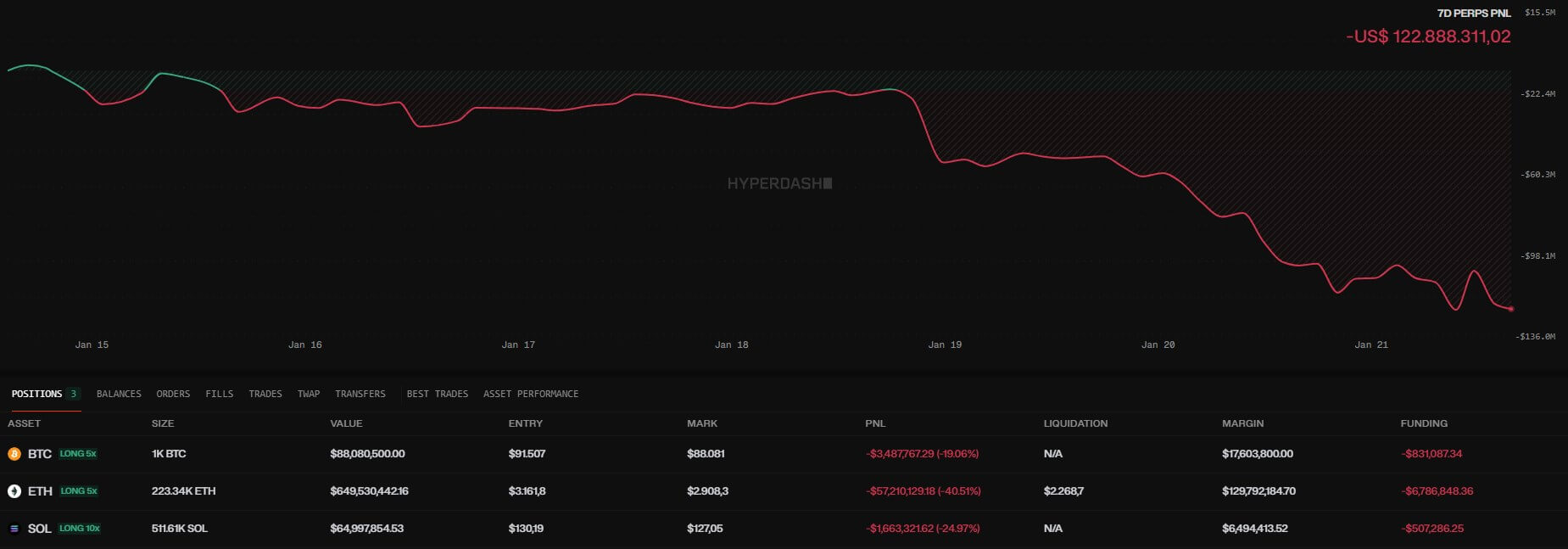

A single wallet on Hyperliquid holds a long position worth roughly $649.6 million in Ethereum (ETH), with 223,340 ETH entered at around $3,161.85, with a liquidation estimate near $2,268.37.
As of press time, ETH traded around $2,908.30, and the liquidation threshold sits about 22% below that. This is far enough to avoid imminent danger but close enough to matter if volatility accelerates.
The position has already bled roughly $56.6 million in unrealized losses and another $6.79 million in funding costs, leaving a cushion of about $129.9 million before forced closure.
The same wallet made over $100 million during October’s crypto selloff, riding two Bitcoin (BTC) shorts and an ETH long opened in early October to combined profits of $101.6 million across positions that lasted between 12 and 190 hours.
That track record makes the current drawdown notable: not because the trader lacks skill, but because the size of the position and the mechanics of cross-margin liquidation on Hyperliquid create pressure that could ripple beyond a single account.
How cross margin changes the calculation
Hyperliquid’s cross-margin system means the liquidation price displayed on the position isn’t fixed. It shifts as collateral changes, funding payments accumulate, and unrealized profit or loss accrues across other positions in the account.
The platform’s documentation states that, for cross-margin, the liquidation price is independent of the leverage setting. As a result, changing leverage reallocates the amount of collateral backing each position without altering the maintenance margin threshold.
This matters because “liq price” on cross margin is a moving target, not a countdown timer.
The wallet’s $129.9 million margin provides breathing room. Still, funding rates on ETH perpetuals can swing quickly during volatility, and any correlated losses in other positions would reduce account-level equity, pulling the liquidation price closer to spot.
What happens when liquidations hit
Hyperliquid sends most liquidations directly to the order book, meaning the forced position closure happens within the perpetual market first rather than dumping spot ETH.
The platform’s liquidator vault and HLP backstop absorb trades that fall below maintenance margin thresholds.
If conditions deteriorate to the point that even the backstop can’t cover losses, Hyperliquid’s auto-deleveraging mechanism kicks in, closing out opposing positions to prevent bad debt.
The spillover to the spot usually arrives indirectly. Arbitrageurs and market makers respond to dislocations between perpetual and spot prices, hedging flows accelerate, and basis spreads widen as leverage unwinds.
That chain of reactions can amplify downward pressure, especially if multiple large positions cluster near similar liquidation levels and trigger cascade effects.
Hyperliquid adjusted margin requirements after a March 2025 episode in which a roughly $200 million ETH long liquidation led to a $4 million loss for the HLP backstop.
The platform responded by introducing a 20% minimum collateral requirement in certain scenarios. That precedent shows Hyperliquid will intervene when large liquidations threaten system stability, but it also demonstrates that backstop losses are possible.
Where leverage clusters
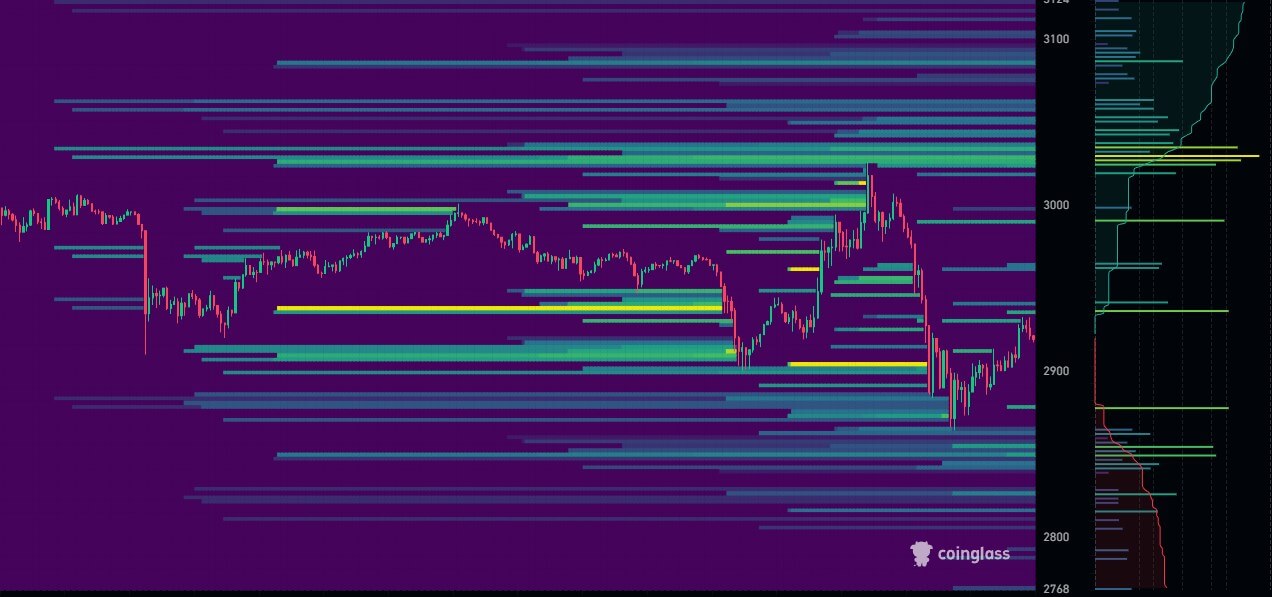
CoinGlass liquidation heatmaps offer a second view of where cascade risk concentrates.
The heatmaps are derived from trading volume, leverage usage, and related data, showing relative-intensity zones where liquidations could cluster if price moves through certain thresholds.
CoinGlass explicitly notes that the maps are relative indicators rather than deterministic forecasts, and that actual liquidation amounts may differ from the displayed levels.
For ETH, recent heatmap data suggests notable leverage clusters between $2,800 and $2,600, with another concentration near $2,400. The $2,268 liquidation threshold for the $650 million long sits below those clusters, meaning it wouldn’t necessarily trigger in isolation.
However, if a broader deleveraging wave pushes ETH through the $2,400 zone, that wallet’s position would be swept into the cascade.
The 22% downside to liquidation doesn’t imply imminent failure, but it does place the position within range of historical ETH volatility. ETH has printed 20%-plus drawdowns multiple times over the past two years, often during correlated risk-off moves across equities and crypto.
The wallet’s October success came from timing macro reversals and exiting before momentum flipped.
The current ETH long, by contrast, has been open long enough to accumulate significant negative carry-through funding and mark-to-market losses. The position now depends on ETH reversing course before funding drains more equity or volatility forces a margin call.