

Markets staged a sharp reversal on Wednesday as President Trump backed away from threatened European tariffs following a meeting with NATO leadership in Davos, with equities reclaiming most of Tuesday’s losses after the president announced he reached the framework of a deal regarding Greenland.
Check out the forex news and economic updates you may have missed in the latest trading session!
Forex News Headlines & Data:
- Australia Westpac Leading Index for December 2025: 0.1% m/m (0.3% m/m forecast; 0.0% m/m previous)
-
U.K. CPI Growth Rate for December 2025: 0.4% m/m (0.2% m/m forecast; -0.2% m/m previous); 3.4% y/y (3.1% y/y forecast; 3.2% y/y previous)
- U.K. Core CPI for December 2025: 0.3% m/m (0.2% m/m forecast; -0.2% m/m previous); 3.2% y/y (3.1% y/y forecast; 3.2% y/y previous)
- U.K. CBI Business Optimism Index for March 31, 2026: -19.0 (-27.0 forecast; -31.0 previous)
- U.K. CBI Industrial Trends Orders for January 2026: -30.0 (-28.0 forecast; -32.0 previous)
-
U.S. MBA 30-Year Mortgage Rate for January 16, 2026: 6.16% (6.18% previous)
- U.S. MBA Mortgage Applications for January 16, 2026: 14.1% (28.5% previous)
- Canada PPI for December 2025: -0.6% m/m (0.2% m/m forecast; 0.9% m/m previous); 4.9% y/y (5.9% y/y forecast; 6.1% y/y previous)
- U.S. Construction Spending for October 2025: 0.5% m/m (0.1% m/m forecast; -0.6% m/m previous)
- U.S. Pending Home Sales for December 2025: -9.3% m/m (1.4% m/m forecast; 3.3% m/m previous); -3.0% y/y (0.2% y/y forecast; 2.6% y/y previous)
- President Trump announced at the World Economic Forum in Davos that he would not use military force to acquire Greenland, later stating he reached “the framework of a future deal” with NATO Secretary General Mark Rutte regarding Greenland and the Arctic Region
- Kazakhstan’s CPC oil exports face new setback after force majeure at Tengiz field
Broad Market Price Action:
Dollar Index, Gold, S&P 500, Oil, U.S. 10-yr Yield, Bitcoin Overlay Chart by TradingView
Wednesday delivered a dramatic market reversal as geopolitical tensions eased following President Trump’s Davos announcements, with risk assets rebounding sharply from Tuesday’s selloff that had marked the worst single-day decline since October.
U.S. equities surged following Trump’s decision to back away from threatened European tariffs. The S&P 500 rallied 1.16% to close around 6,876, recovering most of Tuesday’s 2.1% decline. The index traded mostly sideways through Asian and early London hours before catching a strong bid around the 8:00 am ET Davos timeframe when Trump ruled out military force for Greenland. The rally accelerated through midday following Trump’s afternoon announcement that he had reached a deal framework with NATO and would not impose the February 1st tariffs. The move likely reflected relief that the threatened trade war with European allies had been averted, at least temporarily, with traders focusing on the immediate tariff removal rather than the uncertain details of the Greenland framework.
WTI crude oil posted the session’s strongest gains, rallying 2.24% to close near $60.63 per barrel. The rally appeared to correlate with supply disruption news from Kazakhstan, where force majeure was declared on crude deliveries from the Tengiz oilfield following power distribution issues. Oil production at the Tengiz and Korolev fields could be halted for seven to ten days according to industry sources, with the vast Kashagan field diverting oil to the domestic market for the first time due to bottlenecks at the Black Sea CPC terminal. The supply concerns likely outweighed the slower-than-expected Venezuelan oil export volumes, which reached only 7.8 million barrels under the U.S. supply deal.
Gold advanced 1.28% to settle around $4,824, extending its recent strength. The precious metal rallied steadily throughout the session with particularly strong gains during the U.S. afternoon, possibly reflecting continued safe-haven demand despite easing geopolitical tensions. The advance occurred even as equities rallied sharply, suggesting gold’s strength may have been driven by ongoing concerns about policy uncertainty and inflation rather than purely risk-off sentiment.
Bitcoin gained 0.79% to trade near $90,055, recovering from recent weakness. The cryptocurrency experienced volatile intraday action, declining during all three intraday sessions before staging a recovery ahead of the intraday close. The rebound likely correlated with the broader risk-on move in equities following the tariff news, though the modest gain compared to stocks suggests some caution remained in the crypto space.
Treasury yields declined 0.84% with the 10-year yield falling to approximately 4.26%. Yields dropped notably during the mid-morning U.S. session, possibly reflecting a return to U.S. assets after Trump’s Davos remarks. The decline persisted even as risk assets rallied later in the session, suggesting bond buyers may confident that trade war risks have actually declined.
Interested in fundamental analysis made for newbies and how to pair it up with technical analysis to find high quality opportunities that may match your trading and risk management style? Check out our Premium membership for event trading guides, short-term strategies, weekly recaps and more!
BabyPips.com Annual Premium Members also get an exclusive 30% discount on the annual subscription for the first year on Tradezella–the top rated journaling app! ($120 in savings)! Click here for more info!
FX Market Behavior: U.S. Dollar vs. Majors
Overlay of USD vs. Majors Forex Chart by TradingView
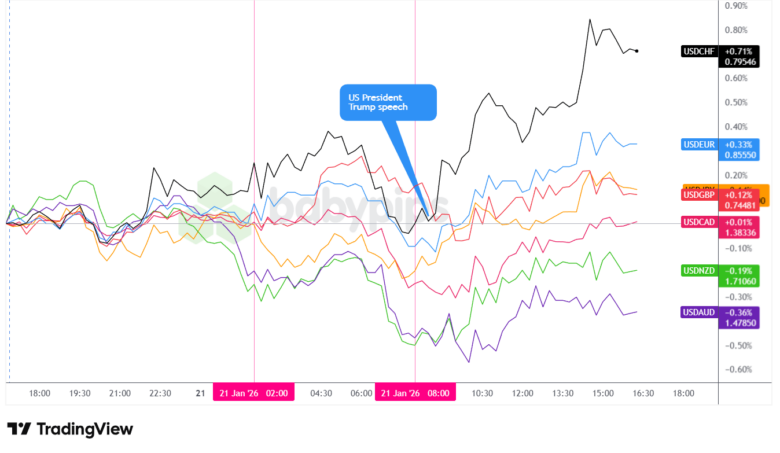
The U.S. dollar experienced choppy trading throughout Wednesday’s session, posting mostly sideways price action during Asian hours before turning bearish during the London session, then stabilizing and rebounding during the U.S. session to close mixed for the day against the major currencies with an arguably slightly bullish lean.
During the Asian session, the dollar traded mostly sideways with choppy price action and relatively low volatility. There were no significant regional catalysts driving clear directional momentum, with traders likely positioning cautiously ahead of the day’s heavy event schedule including Trump’s Davos speech and UK inflation data.
The London session brought volatility that picked up heading into mid-morning. UK inflation data came in hotter than expected, with the December CPI rising 3.4% year-over-year versus 3.1% forecast, while the Retail Price Index surged to 4.2% from 3.8% previously. Despite the inflationary surprise, the pound initially faded before finding a bottom going into the U.S. session, possibly reflecting complex trader positioning around Bank of England policy expectations.
The dollar saw bearish pressure against major currencies heading into the U.S. session, likely as traders repositioned ahead of Trump’s remarks and assessed the UK data’s implications for relative central bank policy paths.
During the U.S. session, the dollar stabilized and rebounded against the major currencies following Trump’s Davos announcements. The initial remarks around 8:00 am ET ruling out military force for Greenland appeared to ease immediate geopolitical tensions, while the afternoon announcement of the tariff framework deal likely prompted further dollar strength as reduced trade war risks potentially supported U.S. growth expectations. The greenback’s recovery through the afternoon suggested that markets viewed the tariff reversal as dollar-positive despite the uncertain nature of the Greenland framework itself.
At Wednesday’s close, the U.S. dollar closed mixed for the day against the major currencies, arguably with a slightly bullish lean. The dollar’s resilience despite Tuesday’s sharp selloff and the easing of geopolitical tensions possibly reflected expectations that reduced European trade friction could support U.S. economic growth and maintain the Federal Reserve’s cautious approach to further rate cuts.
Upcoming Potential Catalysts on the Economic Calendar
- New Zealand Electronic Retail Card Spending for December 2025 at 9:45 pm GMT
- New Zealand Visitor Arrivals for November 2025 at 9:45 pm GMT
- Japan Balance of Trade for December 2025 at 11:50 pm GMT
- Australia Employment Change for December 2025 at 12:30 am GMT
- Canada New Housing Price Index for December 2025 at 1:30 pm GMT
- U.S. Initial Jobless Claims for January 17, 2026 at 1:30 pm GMT
- Euro area Consumer Confidence Flash for January 2026 at 3:00 pm GMT
- U.S. Core Personal Consumption Expenditure for November 2025 at 3:00 pm GMT
- U.S. Personal Income & Spending for November 2025 at 3:00 pm GMT
- U.S. Kansas Fed Manufacturing Index for January 2026 at 4:00 pm GMT
- EIA Crude Oil Stocks Change for January 16, 2026 at 5:00 pm GMT
- U.S. Fed Balance Sheet for January 21, 2026 at 9:30 pm GMT
Thursday’s calendar features critical U.S. employment data with Initial Jobless Claims potentially providing early signals on labor market conditions, while the delayed Core PCE and Personal Income & Spending reports for November could offer insights into inflation and consumer behavior, though data quality concerns from the October government shutdown may limit their policy impact.
Australia’s Employment Change report could spark volatility in commodity currencies if the December labor market data shows unexpected weakness or strength. The EIA crude inventory report will be closely watched following Wednesday’s supply disruption news from Kazakhstan and the force majeure declaration on Tengiz oilfield deliveries.
Markets remain focused on the details of Trump’s announced Greenland framework agreement, with traders looking for clarification on what the deal actually entails given Denmark’s continued insistence that Greenland is not for sale. The temporary tariff reprieve may prove short-lived if the framework fails to materialize into concrete terms acceptable to all parties.