


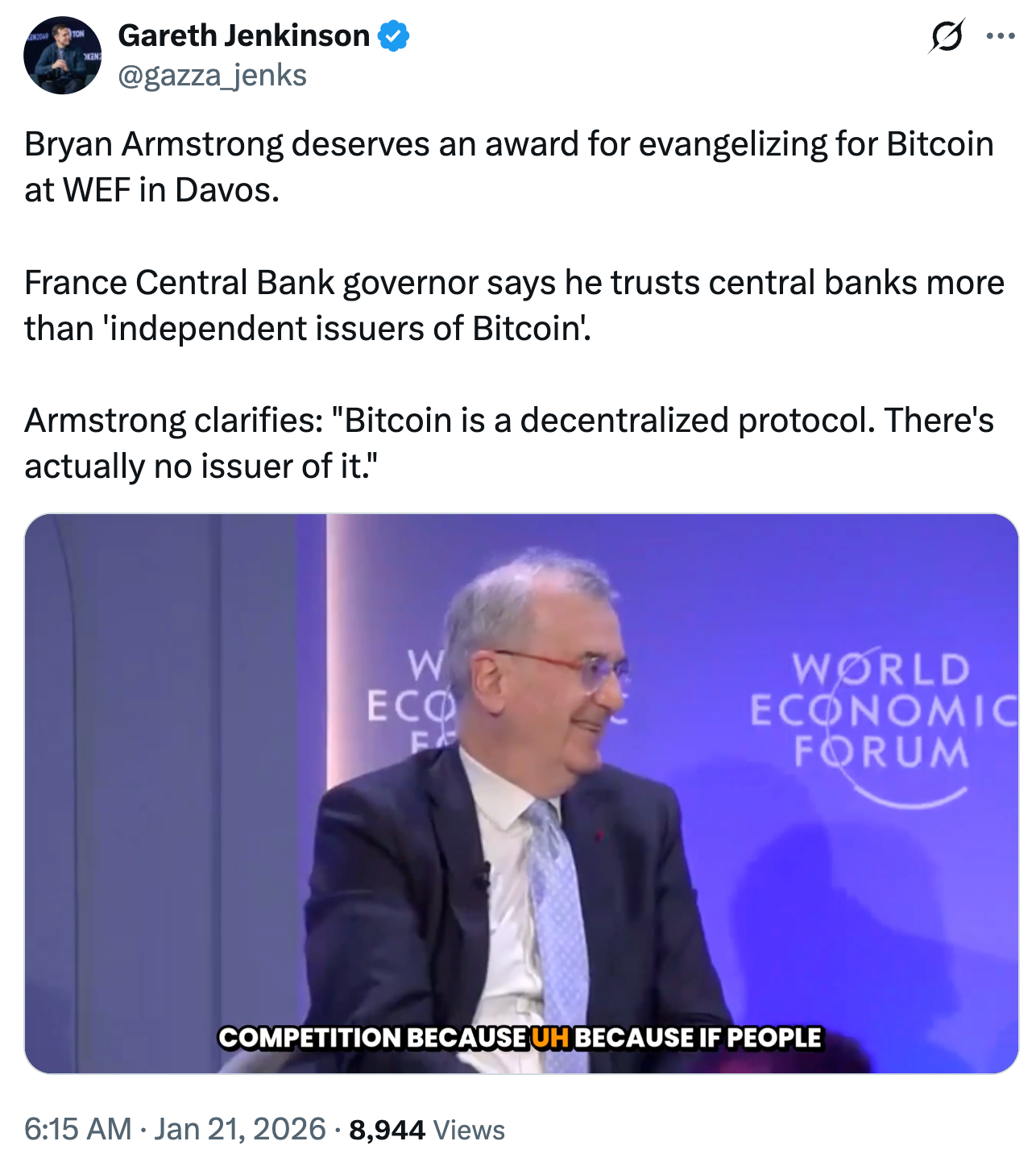
The long-running tension between central banks and Bitcoin resurfaced at the World Economic Forum in Davos, where senior executives and policymakers debated regulation versus innovation in digital finance.
Trust in money must come from regulated public institutions rather than private crypto issuers, French central bank Governor François Villeroy de Galhau said during a panel titled “Is Tokenization the Future?” on Wednesday.
“The guarantee for trust is independence on the central bank side,” Galhau said, adding: “I trust more independent central banks with a democratic mandate than private issuers of Bitcoin.”
His remarks sparked a sharp exchange, with Coinbase CEO Brian Armstrong clapping back by arguing that trust should ultimately be determined by users, not institutions.
Armstrong backs “healthy competition” between Bitcoin and central banks
Responding to Galhau’s argument, Armstrong said Bitcoin is a decentralized protocol with no issuer, contrasting it with central banks’ institutional independence.
“In the sense that central banks have independence, Bitcoin is even more independent,” Armstrong said, adding: “There’s no country or company or individual who controls it in the world.”
Armstrong said Bitcoin and central banks should compete rather than replace one another, a remark that drew a chuckle from Galhau:
“I think it’s a healthy competition because if people can decide which one they trust more, I think it’s actually the greatest accountability mechanism on deficit spending.”
Even though Galhau said he trusted central banks more than “private issuers of Bitcoin,” Galhau did not reject private involvement in money.
“Money has existed for centuries as a public-private partnership,” he said, suggesting tokenization could play a role if it operates within a regulated framework.
Related: Seventy economists urge EU to ‘let the public interest prevail’ on digital euro
“Regulation is not the enemy of innovation. On the contrary, it is a guarantee of trust,” he added.
The governor also sought to reassure banks that the EU’s central bank digital currency, the digital euro, is not intended to displace private financial institutions, saying the goal is to modernize payments while preserving monetary sovereignty.
Magazine: How crypto laws changed in 2025 — and how they’ll change in 2026