


Active users on the Ethereum network have overtaken major layer 2s as long-term development strategies begin to pay off.
The number of active addresses on Ethereum exceeded 791,000 on Monday, higher than that of the network’s major L2 players, including Base, Arbitrum and Optimism, according to data from Nansen.
Daily average transaction costs have also reached new lows. On Monday, average transaction fees were only $0.15. The average fee for a transaction on Ethereum was as high as $11 just one year ago.
These metrics for Ethereum utility come ahead of ambitious plans by developers to make the network bulletproof.
Active addresses on Ethereum overtake L2s, fees cost pennies
Over the last year, the number of active addresses on the Ethereum network has increased 71% from 460,000 accounts recorded a year ago.
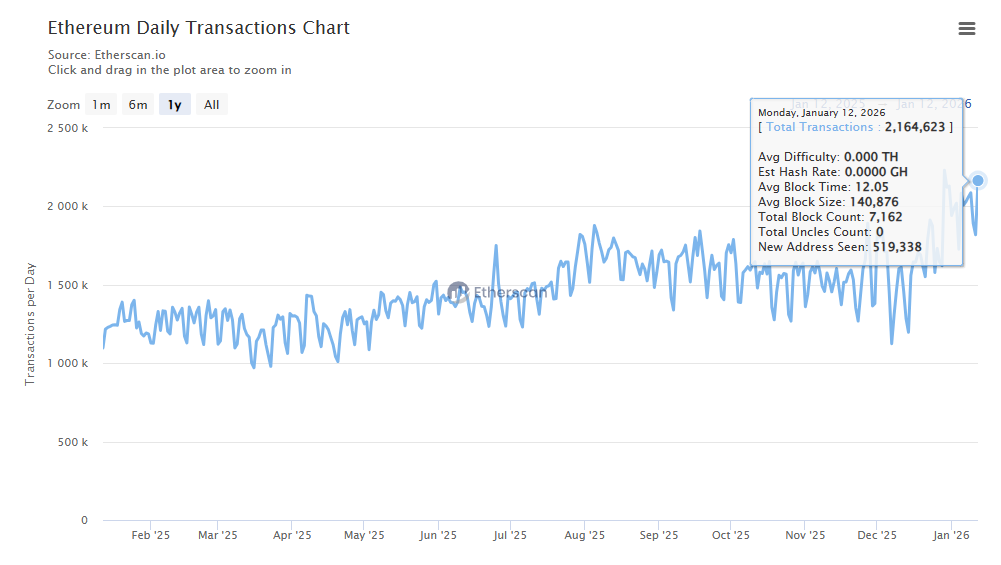
Daily transactions on Ethereum have also been hitting all-time highs, and are cheaper than ever. On Tuesday, there were 2.1 million transactions on the Ethereum blockchain with an average transaction fee of $0.15.
Transacting on Ethereum was notoriously expensive in the not-so-distant past. In late 2021 to mid-2022, when decentralized finance was exploding and the non-fungible token craze had reached its zenith, some users reported gas fees of over $200.
This raised questions around how usable Ethereum could really be. Then in 2023, L2 networks exploded to scale the network as major players like Coinbase jumped on board. The crypto exchange launched its own L2, Base, with mainnet opening for users in August of that year.
Last year saw two major upgrades to Ethereum. In May, the Pectra upgrade increased the capacity of blobs — a tool for storing transaction data. More blob space helps rollups post transaction data cheaper and can contribute to lower fees.
Related: What is the Ethereum Prague-Electra (Pectra) upgrade?
Blob capacity was further increased in the Fusaka upgrade, which activated on Dec. 3, 2025. Fusaka also introduced Peer Data Availability Sampling, which created a system wherein validators didn’t need to download entire blobs, but could use small samples for transaction verification.
In addition to lower fees and more addresses, developers are now more frequently choosing Ethereum as a settlement layer. According to Token Terminal, the number of new smart contracts created and published on Ethereum reached an all-time high of 8.7 million in the fourth quarter of 2025.
This indicator of future network activity comes at a time of increased competition between layer 1s like Ethereum, Tron, Solana and BNB Chain. Solana and BNB Chain are the industry’s top networks by transactions and active addresses, driven largely by their high throughput and popularity for retail and memecoin activity.
As the race heats up, Ethereum developers are looking for ways to future-proof the network.
Ethereum for 100 years
On Monday, Ethereum co-founder Vitalik Buterin said on X that the network needs to get to a point where developers can eventually walk away.
He said that building applications is “not possible on a base layer which itself depends on ongoing updates from a vendor in order to continue being usable.” Buterin said that the blockchain must have “the traits that we strive for in Ethereum’s applications. Hence, Ethereum itself must pass the walkaway test.”
Related: Ethereum must pass ‘walkaway test’ to endure for 100 years: Buterin
The network is far from such a point, and Buterin suggested a number of key factors to get it “to a place where Ethereum’s value proposition does not strictly depend on any features that are not in the protocol already.”
These included:
Full quantum-resistance.
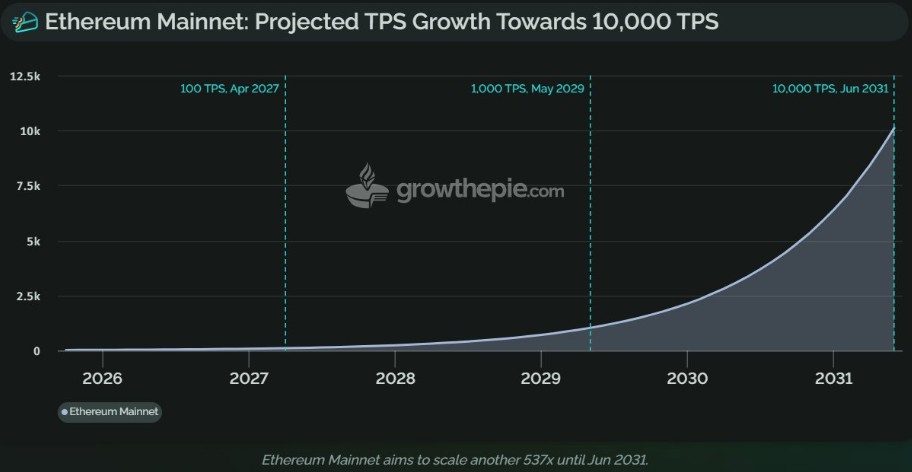
Architecture that can expand to sufficient scalability, thousands of times over.
State architecture that can last decades.
A general-purpose account model.
A proof-of-stake model that can “last and remain decentralized for decades.”
A block-building model that is resistant to centralization.
Buterin added that every year, Ethereum developers should “tick off at least one of these boxes, and ideally multiple.”
Related: Ethereum in 2026: Glamsterdam and Hegota forks, L1 scaling and more
Major changes are coming to Ethereum in 2026. The upcoming Glamsterdam fork will bring perfect parallel processing to the network and also increase the gas limit to 200 million from its current 60 million. It will also make further increases to blob size.
Perfect parallel processing will purportedly increase transaction bandwidth and allow for larger block sizes without increased gas limits.
As Ethereum continues to make network upgrades, the data is showing more activity on its L1. The pay-off could soon be a network developers can walk away from, and on which future generations of app developers can build.
Magazine: One metric shows crypto is now in a bear market: Carl ‘The Moon’
Cointelegraph Features and Cointelegraph Magazine publish long-form journalism, analysis and narrative reporting produced by Cointelegraph’s in-house editorial team and selected external contributors with subject-matter expertise. All articles are edited and reviewed by Cointelegraph editors in line with our editorial standards. Contributions from external writers are commissioned for their experience, research or perspective and do not reflect the views of Cointelegraph as a company unless explicitly stated. Content published in Features and Magazine does not constitute financial, legal or investment advice. Readers should conduct their own research and consult qualified professionals where appropriate. Cointelegraph maintains full editorial independence. The selection, commissioning and publication of Features and Magazine content are not influenced by advertisers, partners or commercial relationships.