
The USD is little changed with limited up & down price action to kickstart the US session

2026-01-07 13:44:00
The forex market is waffling in narrow trading ranges for the major currency pairs. Looking at the low to high ranges shows:
- EURUSD 30 pips
- GBPUSD 35 pips
- USDJPY 50 pips
- USDCHF 24 pips
- USDCAD 26 pips
- AUDUSD 50 pips
- NZDUSD 22 pips.
That is not a lot of price action to trade. Buyers and sellers are battling in looking for the next shove. In the video above, I take a look at the 3 major currency pairs – the EURUSD, USDJPY and GBPUSD (Greg Michalowski and author of Attacking Currency Trends). I outline the key levels in play and define the short-term bias, the risk, and the targets for each of those currency pairs.
In Australia, the latest Consumer Price Index (CPI) data came in softer than expected, reinforcing the narrative of easing upstream inflation pressures. On a month-on-month basis, prices were unchanged at 0.0%, missing expectations for a 0.1% increase. On a year-on-year basis, PPI slowed to 3.4%, below the 3.6% forecast and down from 3.8% previously. The data initially pressured the AUD lower as traders reacted to the weaker inflation signal and its implications for the RBA’s policy outlook.
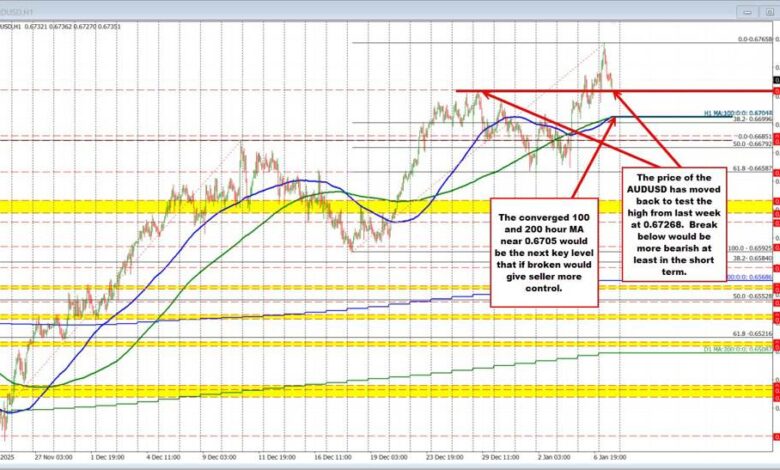
However, that downside reaction proved short-lived. The pair quickly reversed course, with buyers stepping back in and driving price to its highest level since early October, peaking at 0.6766. That rebound suggested a degree of resilience in the broader bullish structure, even in the face of softer domestic data. Since topping out, though, momentum has faded and price has rotated back lower, bringing the focus back to near-term support levels.
Currently, the pair is testing highs from last week near 0.67268, a level that now acts as an important short-term pivot. A sustained break below that area would tilt the near-term bias more decisively to the downside, shifting trader attention toward the converged 100- and 200-hour moving averages near 0.6705. A move down to—and especially through—that moving-average cluster would be technically significant, as it would give sellers greater control and signal that the post-PPI rebound has likely run its course (see the blue and green lines on the chart).
Looking at other markets, US stocks are mixed in premarket trading. The futures are implying:
- Dow industrial average up 97 points
- S&P index up 2.68 points
- NASDAQ index -36 points
In the commodity markets:
- Crude oil is trading down $0.40 and $56.89.
According to CNBC, citing a White House source, oil sales from Venezuela will continue indefinitely as part of an agreement with the US administration that includes a reduction in sanctions. Under the deal, an initial tranche of 50 million barrels will be sold to the United States, with oil that would have previously gone to China and other buyers being rerouted to the US instead. The proceeds from these sales are expected to benefit both the United States and Venezuela, although no details have been provided regarding the pricing of the oil. US energy secretary Wright is saying that the the US government wants to sell Venezuela in oil and deposit the money into US controlled accounts, but adds that the money from selling th oil will flow back to benefit Venezuelan citizens. E
- Gold is down $48.60 or -1.10% at $4445.
- Silver is tumbling $3.80 or -4.7% at $77.34
The price of bitcoin is trading down $1600 and $92,109.
In the US debt market, yields are moving lower with a flatter yield curve:
- 2-year yield 3.448%, -2.4 basis points
- 5 year yield 3.678%, -4.2 basis points
- 10 year yield 4.127%, -5.1 basis points
- 30 year yield 4.811%, -5.5 basis points.