


Setting effective trading goals is the difference between consistent progress and spinning your wheels. This guide shows you how to set realistic trading goals that actually improve your performance, not just your wishful thinking.
Quick Answer: The best trading goals for beginners focus on process over profit. Instead of “make $10,000,” aim for “follow my trading plan 100% of the time” or “risk only 1% per trade.” These behavior-based goals give you complete control over your success.
Why Do Most Trading Goals Fail?
92% of New Year’s resolutions fail, and trading goals are no exception. Here’s why:
- They focus on outcomes you can’t control (profit targets, win rates)
- They lack specific action steps (no clear “how”)
- They ignore the learning process (expecting instant results)
- They’re too ambitious (trying to fix everything at once)
The solution? Shift from outcome-based goals to process-based goals.
What Are Process Goals vs. Outcome Goals in Trading?
| Outcome Goals | Process Goals |
|---|---|
| Make $5,000 this month | Follow my trading checklist for every trade |
| Achieve 65% win rate | Review and journal all trades within 1 hour of closing |
| Double my account | Risk exactly 1% per trade, no exceptions |
| Become a full-time trader | Complete 50 hours of strategy backtesting |
Process goals focus on actions you control 100%. Outcome goals depend on market conditions, luck, and factors outside your control.
How to Set Trading Goals: 5-Step Framework
Step 1: Identify Your Biggest Weakness
Before setting goals, diagnose what’s actually holding you back:
Overtrading? You take trades that don’t meet your criteria
Poor risk management? You risk too much per trade
Emotional trading? You revenge trade after losses
Lack of consistency? You don’t follow your plan
Pick ONE weakness to address in Q1 2026. Multi-tasking fails.
Step 2: Create a Specific Process Goal
Transform your weakness into a measurable behavior goal:
❌ Bad Goal: “Be more disciplined” ✅ Good Goal: “Only enter trades that score 8/10 or higher on my setup checklist”
❌ Bad Goal: “Stop revenge trading”
✅ Good Goal: “Take a mandatory 15-minute break after any losing trade before considering another entry”
❌ Bad Goal: “Improve my trading” ✅ Good Goal: “Spend 30 minutes every Sunday reviewing my trades and logging patterns in my journal”
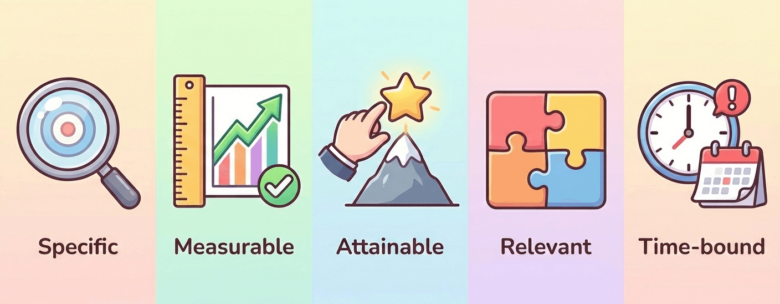
Make it SMART:
- Specific: Exactly what you’ll do
- Measurable: You can track yes/no completion
- Attainable: Realistic for your schedule
- Relevant: Addresses your actual problem
- Time-bound: Daily, weekly, or per-trade action
Step 3: Build Micro-Goals for Each Quarter
Break your annual goal into 90-day sprints:
Example: Annual Goal = “Follow my trading plan consistently”
- Q1: Take screenshots of every setup before entering + write entry reason
- Q2: Add exit analysis to journal (why I closed where I did)
- Q3: Review weekly performance and identify my 3 best vs. 3 worst trades
- Q4: Develop plan adjustments based on 9 months of data
Small, sequential wins build the habit. Don’t skip ahead.
Step 4: Track Behavior, Not Just P&L
Create a daily trading scorecard:
Daily Process Checklist:
Followed trading plan (only took valid setups)
Stuck to position sizing rules (1% risk max; adjust lower based on trading strategy)
Set stop loss before entry and didn’t move it (unless it was a pre-planned adjustment to predetermined scenario developments)
Avoided emotional/revenge trades
Updated trading journal
Weekly Score: X out of 5 days = ____%
Target 80%+ adherence. If you hit this consistently, profit typically follows.
Step 5: Schedule Quarterly Reviews
Set calendar reminders for:
- March 31: Q1 review
- June 30: Q2 review
- September 30: Q3 review
- December 31: Annual review
Ask yourself:
- What’s working? Why? (Consider doubling down on this)
- What’s not working? Why? (Adjust or eliminate)
- Do I need to modify my goals based on what I’ve learned?
- Am I still energized by these goals, or do they feel like a chore?
Markets change. Strategies evolve. Your goals should too.
What Are Good Trading Goals for Beginners?
Best beginner trading goals focus on foundation-building:
Risk Management Goals
Risk no more than 1% of account per trade (but be open to lower depending on trading style & conditions)
Never risk more than 5% of account in open trades simultaneously
Set stop loss before every entry (no exceptions)
Trading Psychology Goals
No trading within 15 minutes of a loss (cooling-off period)
Take only 3 trades per day maximum (prevents overtrading)
Close trading platform after hitting daily loss limit of 2%
Education & Analysis Goals
Complete 1 chapter of trading education per week
Backtest strategy on 50 historical setups before going live
Review all trades within 24 hours in trading journal
Execution Goals
Only trade during your designated trading hours
Follow complete setup checklist before every entry
Wait for full candle close before entry (if that’s your rule)
Common Trading Goal Mistakes to Avoid
❌ Mistake #1: Setting Profit Targets as Your Primary Goal
Why it fails: You don’t control if the market gives you opportunities.
Better approach: Set process goals that enable profits (following your edge consistently).
❌ Mistake #2: Trying to Fix Everything at Once
Why it fails: Overwhelm leads to abandoning all goals.
Better approach: One major process goal per quarter. Master it, then add another.
❌ Mistake #3: Comparing Yourself to Other Traders
Why it fails: Everyone has different account sizes, strategies, risk tolerance, and experience.
Better approach: Compete only with your past self. Are you better than 90 days ago?
❌ Mistake #4: All-or-Nothing Thinking
Why it fails: One missed day = “I failed” = quitting entirely.
Better approach: Track consistency percentage. Missing 2 days out of 20 = 90% success. That’s excellent.
❌ Mistake #5: No Accountability System
Why it fails: Goals without tracking disappear into the void.
Better approach: Use a trading journal, accountability partner, or weekly self-review.
FAQs: Setting Trading Goals
Q: Should beginners set profit goals?
A: No. Focus on process goals first. Once you’re consistently profitable for 6+ months, you can add conservative outcome goals.
Q: How many trading goals should I have?
A: One primary process goal per quarter. Too many goals = none get done.
Q: What if I break my goal streak?
A: Reset and continue. A broken streak doesn’t erase progress. 80% consistency over time beats 100% for two weeks then quitting.
Q: How long until I see results from process goals?
A: Most traders notice improvement in 4-6 weeks. Major changes take 3-6 months of consistent application.
Q: Can I adjust my goals mid-year?
A: Absolutely. Quarterly reviews exist for this reason. Adjust based on what you learn.
Your 2026 Trading Goals Action Plan
Right now, complete this:
- My biggest trading weakness is: _________________
- My Q1 2026 process goal: _________________
- How I’ll measure it: _________________
- My accountability method: _________________
- My next review date: _________________
Don’t just read this. Actually write it down. Studies show written goals are 42% more likely to be achieved.
The Bottom Line: Process Beats Prediction
You can’t predict your profit in 2026. But you can control your behavior every single trading day.
Focus relentlessly on process. Track what you control. Build habits that compound. The profits will take care of themselves.
Every professional trader started exactly where you are—setting goals, missing them, adjusting, and trying again. The only difference? They kept showing up.
Start building your trading process today, not tomorrow.