


Brett Harrison, the former president of the now-defunct FTX US exchange, has closed a $35 million funding round for his new derivatives venture, signaling renewed investor confidence in the sector and continued venture appetite for crypto-linked derivatives infrastructure.
On Tuesday, The Information reported that Harrison’s startup, Architect Financial Technologies, is using the funding to build an institutional trading platform spanning derivatives, equities, futures and digital assets. Participants in the round included Miax, Tioga Capital, ARK Investment, Galaxy and VanEck.
The new capital follows a $12 million funding round in 2024 backed by Coinbase Ventures, Circle Ventures, SALT Fund and other investors.
The funding comes after Architect received regulatory approval in Bermuda to offer perpetual futures contracts tied to traditional assets such as stocks, commodities and foreign currencies. Perpetual futures, or “perps”, were first popularized in crypto markets by BitMEX and later became a core product at FTX prior to its collapse in late 2022.
Architect is explicitly targeting professional and institutional traders, offering features such as algorithmic trading capabilities, advanced risk management tools and multi-asset derivatives support. The company plans to expand beyond Bermuda into additional markets, including Europe and the Asia-Pacific region.
Related: Kraken doubles down on US futures with $100M ‘Small’ acquisition
Derivatives markets outsize traditional asset trading
Derivatives are widely regarded as the largest segment of global financial markets. By some measures, the notional value of outstanding contracts in over-the-counter and exchange-traded derivatives markets is valued in the hundreds of trillions of dollars, dwarfing world economic output by every conceivable metric.
As S&P Global noted in a February report, the derivatives market is constantly evolving, but liquidity remains a core challenge across many asset classes. Investors are increasingly focused on products with deep liquidity and tight bid-ask spreads, even as market structures and index-based solutions continue to innovate.
Derivatives have been widely embraced by the cryptocurrency sector, though not without consequences. According to some estimates, derivatives account for about 75% to 80% of total trading volume across major crypto exchanges, underscoring their central role in market activity.
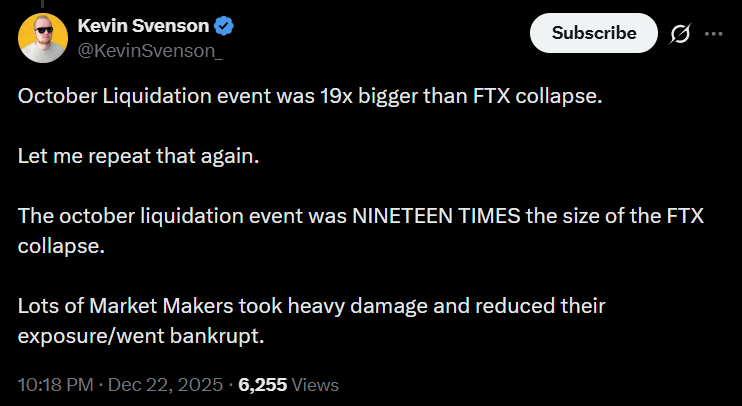
That dominance has also amplified volatility. The risks were on display during the crypto market’s Oct. 10 liquidation event, which was the largest in history, with $19 billion erased in a single day.
Related: VC Roundup: Big money, few deals as crypto venture funding dries up